Here's something most fragrance guides skip entirely: the attar you love in the bottle can behave like a completely different scent on your wrist by hour three — and the reason usually has nothing to do with the oil itself. It's your skin. Dry skin burns through top notes fast and lets base notes dominate early. Oily skin holds onto everything, sometimes too much. And if you've layered a heavy attar over a fresh retinol application without realising it, you already know how that story ends — redness, a strange metallic edge to the scent, and a morning you'd rather forget.
So before we get into amber versus tobacco versus white oud, it's worth admitting that "heavy" isn't just about the attar. It's about the surface you're putting it on.
Why "Heaviness" Is a Skin Question First
Ask five perfumers what makes a scent feel heavy and you'll get five different answers — resin content, base note weight, projection radius. But ask a dermatologist, and the answer shifts. Moisturised, well-hydrated skin holds molecules longer because there's more lipid surface for the oil to bind to. Dry or compromised skin, on the other hand, lets scent evaporate quickly at first, then suddenly release a concentrated, almost sharp burst hours later as the last of it clings to dead skin cells that haven't been exfoliated. That's not the attar changing. That's your skin barrier deciding how the story unfolds.
This matters enormously when you're choosing between something like amber, tobacco oud, or white oud, because these three sit at genuinely different points on the weight spectrum — and your skin type can push any of them further in either direction than you'd expect from a blotter test alone.
Amber: Warm, Grounded, Forgiving
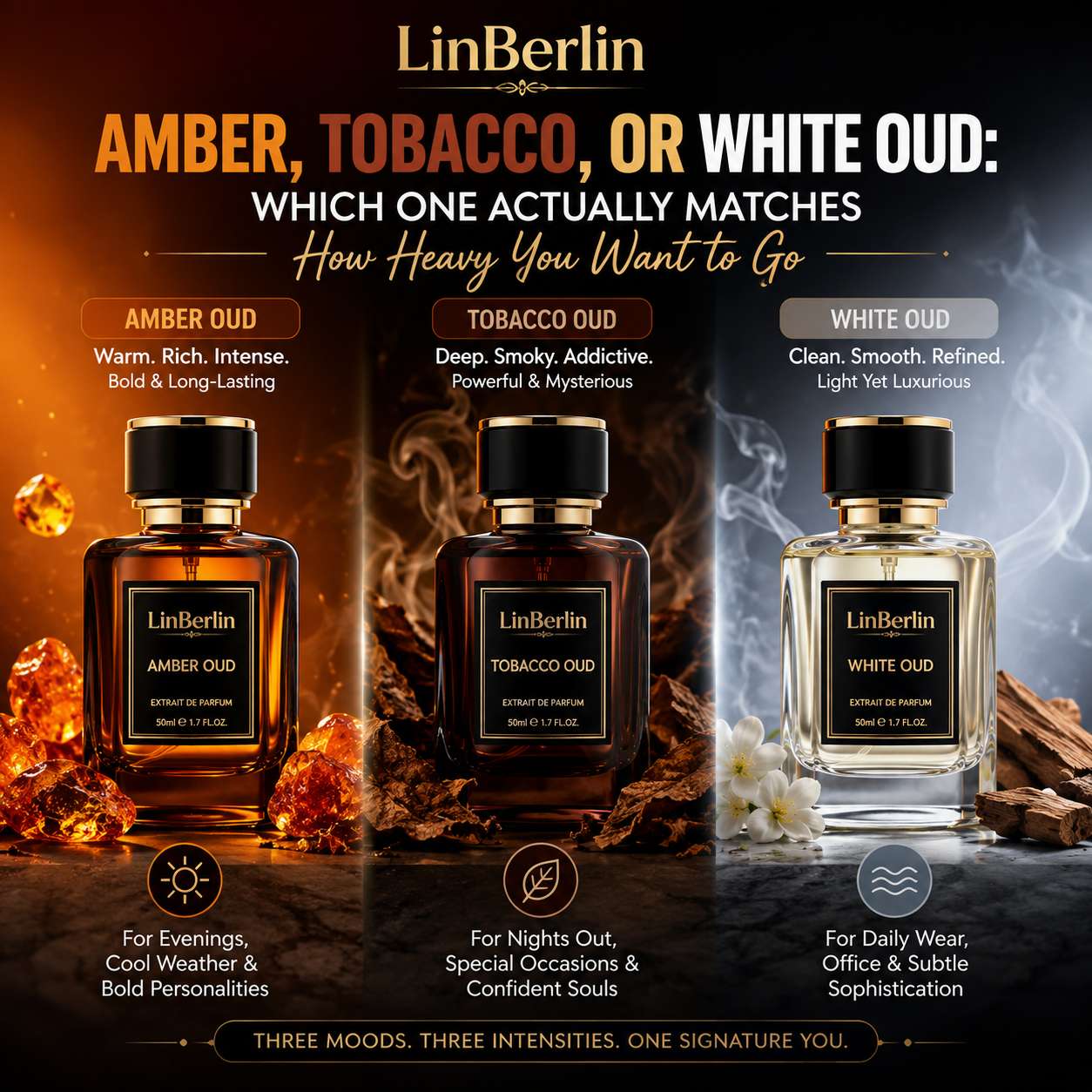
Amber is the one people reach for when they want depth without theatrics. It's resinous and warm, often built around labdanum and benzoin, with a sweetness that reads more like a candlelit room than an actual dessert note. On skin, amber tends to be forgiving — it doesn't spike or sharpen the way some woody oud blends can, and it blooms gradually rather than announcing itself.
If you're gifting for someone who wears fragrance sparingly, or someone who's nervous about "too much," amber is usually the safer bet. LinBerlin's Amber e Khaas, our amber oud attar, sits in this exact register — warm enough to feel substantial, restrained enough to wear to a meeting without turning heads for the wrong reason. On oily or combination skin, expect it to run slightly richer and last longer than the label suggests. On very dry skin, it may fade faster in the first two hours, so a light, fragrance-free moisturiser underneath genuinely helps — apply it, wait a minute or two for absorption, then apply the attar on top.
Tobacco Oud: The One With Character
Tobacco oud is not subtle, and it isn't trying to be. There's a dried-leaf sweetness to it, sometimes edged with honey or dark fruit, sitting on top of oud's characteristic depth. It reads mature — the kind of scent that suits someone comfortable being noticed, not someone hiding behind fragrance.
Realistically, this is the heaviest of the three in most formulations, and it's worth being honest about that rather than dressing it up. If the person you're buying for already wears strong ouds or leans toward statement fragrances, tobacco oud attar | Oud e Khumar is the kind of gift that gets remembered. On skin, tobacco oud performs almost identically across skin types — the sweetness in it seems to carry regardless of how dry or oily the wearer is, which is somewhat unusual for an oud-forward blend. One caveat, though: because tobacco notes can carry facial-flush triggers for people with rosacea-prone or reactive skin (the warmth of the scent combined with any thermal reaction on the neck or chest can feel intensified), it's worth patch-testing on the inner wrist first if the recipient has known skin sensitivity.
White Oud: The Quiet Alternative
White oud gets its name from the pale, almost powdery quality it carries compared to darker, more resinous oud styles. It's softer, cleaner, occasionally floral at the edges — the kind of scent that feels closer to skin than to a room. This is the one to choose when someone says they want oud but don't want to smell like they're wearing oud.
white oud attar | Noor e Oud is a good example of this lighter register done properly — present without being loud, and it's genuinely one of the more office-friendly options in an oud category that can otherwise feel intense. On dry skin especially, white oud can fade within a few hours unless the skin is prepped with moisture first. That's not a flaw in the attar; it's just how lighter, less resin-heavy compositions behave. If longevity matters more than subtlety to the wearer, this may not be the right pick — and that's worth saying plainly rather than glossing over.
Matching Skin Type to the Right Weight
Oily and combination skin types generally hold fragrance longer across the board, which means even lighter attars like white oud can perform well without extra help. Normal skin sits in the middle — most attars behave close to how they're described. Dry skin is where the real decisions happen. If dryness is a known factor, either lean toward amber or tobacco oud (both of which have enough resinous weight to survive faster evaporation), or commit to a proper moisture layer before applying anything lighter.
There's a shared visual thread running through amber and white oud that's worth mentioning too — how amber warmth and white oud's soft glow work together in quiet luxury pairings is a good read if you're considering gifting both, or layering them for someone who wants range depending on occasion.
Applying Attar Without Fighting Your Skincare Routine
The mistake I see most often isn't choosing the wrong attar — it's applying it at the wrong moment in a skincare routine. Attar applied directly over active ingredients like retinoids, high-percentage AHAs, or benzoyl peroxide can cause irritation, because the oil carriers in attar can increase penetration of those actives into skin that's already sensitised. The safer sequence: complete your skincare routine, let actives fully absorb (fifteen to twenty minutes is a reasonable buffer), then apply attar to pulse points — wrists, inner elbows, base of the throat — rather than directly onto the face.
Pregnant readers, or anyone shopping for someone who is, should know that strong resinous or musky notes can occasionally trigger heightened sensitivity during pregnancy, and it's generally advisable to check with a physician before introducing new concentrated fragrance oils, attar included.
For the Gift Buyer: A Practical Read
Buying attar for someone else is genuinely harder than buying for yourself, because you're guessing at their skin, their tolerance for attention, and their existing fragrance habits all at once. But there are a few reliable signals. Someone who already owns dark, resinous perfumes will likely appreciate tobacco oud's confidence. Someone who prefers understated, "what are you wearing?" compliments over bold entrances will probably gravitate toward white oud. And amber sits comfortably as the middle ground — the gift you choose when you're not entirely sure, because it rarely misses.
For a broader sense of how these fragrance families sit next to each other in practice, this piece on fragrances that share the same evening covers pairing logic that's useful if you're building a small gift set rather than a single bottle.
A Few Practical Notes Before You Decide
Attar concentration means a little genuinely goes further than most people expect on their first try — two dabs, not a full spray-equivalent amount. And skin oils naturally shift with temperature, humidity, and even hormonal cycles, so a scent that felt perfectly balanced in winter might read heavier in summer heat, when skin produces more natural oil to bind fragrance to.
The honest truth is that no amount of research replaces testing something on actual skin for a full day. Blotter tests and online reviews get you close, but they can't account for your specific skin chemistry — or the recipient's, if you're buying as a gift. Where possible, opt for a smaller trial size before committing to a full bottle for someone else.
Where to Land
If restraint matters most, white oud. If you want something with unmistakable presence, tobacco oud. And if you're caught between the two, or buying for someone whose taste you're still learning, amber tends to bridge that gap better than either extreme. None of these choices is wrong — they're just calibrated to different comfort levels with being noticed, and to skin that will interpret each of them slightly differently than the bottle promises.