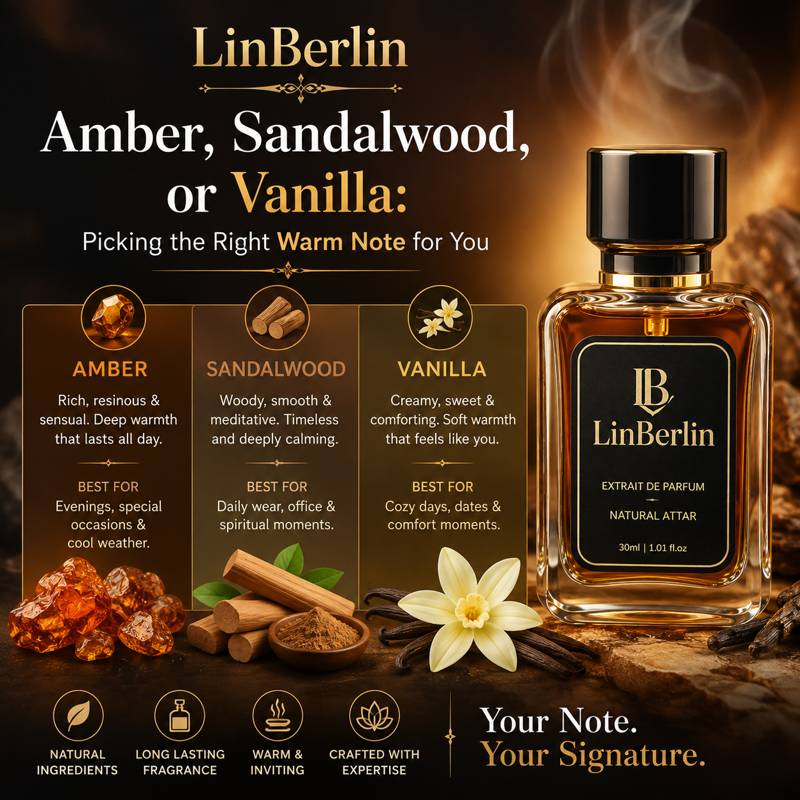
Two people can wear the exact same attar and walk away with two completely different fragrances. Not a slightly different version — actually different, sometimes different enough that neither would guess it's the same bottle. That's not a flaw in the perfume. It's chemistry, and it's the whole reason "which warm note is best" is the wrong question. The better one is which warm note is best for your skin, your climate, and honestly, your patience for how long you're willing to wait for a scent to reveal itself.
Why Warm Notes Behave Differently on Different People
Skin isn't a neutral surface. It has its own pH, its own oil production, its own microbiome, and all of that interacts with fragrance oil the moment it touches skin or the fabric held against it. Drier skin tends to let top and heart notes fade faster, because there's less natural oil to slow evaporation — so an amber or vanilla attar might read lighter, sweeter, and shorter-lived on someone with dry skin than on someone with naturally oilier skin, where the same oil-based fragrance clings longer and develops a richer, sometimes muskier undertone as it mixes with the skin's own chemistry.
This is worth understanding even though LinBerlin attars are formulated for application on clothing and fabric rather than direct skin contact. The body's warmth still projects the scent outward from fabric close to skin — a collar, a wrist cuff, an inner sleeve — and skin oil, sweat, and temperature all still shape how that fragrance develops in the air around you, even without direct contact. Someone who runs warm will experience an amber attar completely differently than someone who runs cool, regardless of where exactly the oil sits.
Amber: The Note That Rewards Warmth
Amber isn't actually amber — not the fossilised resin, anyway. In perfumery, "amber" is usually a built accord combining labdanum, benzoin, vanilla, and sometimes a touch of tonka bean, engineered to produce that honeyed, resinous warmth people associate with the word. It's less a single ingredient and more a mood, constructed the way a chord is built from separate notes.
On skin that runs warm, amber develops fast and deep — within the first thirty minutes you'll often smell a richer, almost caramelized sweetness than what the bottle alone suggests. On cooler or drier skin, that same amber can stay lighter and more resinous, less sweet, closer to its raw labdanum character. Neither is wrong. But if you're someone who's tried amber before and found it "too much," the truth is it might not have been the composition — it might have been your skin's natural warmth amplifying it past your comfort zone. Amber attar, Rooh e Amber, is a good test case for this because it's built with restraint rather than maximum sweetness, which makes it easier to judge how your own chemistry is shaping it rather than the composition doing all the work.
Sandalwood: The Slow, Even Burn
Where amber tends to react strongly to skin chemistry, sandalwood is comparatively forgiving. It's a creamy, woody, slightly milky note that doesn't swing wildly between skin types the way amber can — though it isn't immune to variation either, and dry skin will still shorten its life somewhat compared to naturally oilier skin.
What sandalwood does react to is quality and age of the raw material, more than skin type. Real aged sandalwood oil carries a depth that synthetic substitutes never manage — a softness that sits close to the body instead of projecting loudly. That's part of why sandalwood shows up across so many cultural and devotional contexts; it doesn't demand attention, it just stays present. If you've found sandalwood attar, Rooh e Chandan, worked well for you on a humid day but felt thinner in dry winter air, that's the raw material responding to ambient moisture as much as anything happening on your skin — sandalwood is genuinely sensitive to environment, not just to the person wearing it.
Vanilla: Sweet, but Not as Simple as It Smells
Most people assume vanilla is the "safe" choice among warm notes — familiar, comforting, hard to dislike. And it mostly is. But cheap or poorly balanced vanilla compositions fall into a specific trap: they end up smelling like a bakery counter rather than a fragrance, all sugar and no structure. A well-built vanilla attar needs something underneath to hold it up — a woody base, a resinous edge, sometimes a whisper of spice — or it collapses into one-note sweetness within the first hour.
Skin chemistry plays a role here too, though differently than with amber. Vanilla tends to smell sweeter and more linear on drier skin, since there's less oil to round it out with other undertones. On oilier skin, the same vanilla often reads warmer and slightly less sugary, because it's blending with the skin's own subtle scent rather than sitting on top of it. Vanoor, our vanilla attar, was built specifically to avoid the flat, bakery-counter problem — it leans on a woodier base rather than raw sweetness alone, which is part of why people who normally find vanilla "too much" tend to respond well to it.
For a deeper look at why so many vanilla perfumes fail in exactly this way, it's worth reading through how most vanilla perfumes fall into the bakery-counter trap and what separates a balanced composition from a one-dimensional one.
So Which One Is Actually Right for You
Here's a rough framework, though it's not an exact science — nothing about skin chemistry ever is.
If your skin runs warm and you tend to sweat easily, amber will likely feel richer and longer-lasting on you than the bottle description suggests, so consider starting with a lighter application than you think you need. If your skin is naturally dry, sandalwood tends to be the most forgiving option since it doesn't lean as hard on skin oil to develop properly — vanilla and amber both benefit more from that oil than sandalwood does. And if you're someone who runs cool and finds most sweet fragrances underwhelming on you rather than overwhelming, vanilla with a strong woody base, like Vanoor, is often the better match than a lighter, sweeter vanilla composition would be.
None of this is a guarantee, of course. Fragrance is genuinely personal in a way that resists tidy rules, and the only real way to know is to wear something for a full day rather than judging from a single sniff.
When Skin Sensitivity Changes the Calculation
A separate consideration, and an important one: sensitive skin, active allergies, or pregnancy all change how cautiously you should approach concentrated fragrance oils generally, regardless of which warm note you're drawn to. Because LinBerlin attars are designed for fabric application rather than direct skin contact, this risk is already reduced compared to skin-applied oils — but it isn't eliminated. Anyone using strong skincare actives (retinoids, exfoliating acids, benzoyl peroxide) should be especially careful about fragrance sitting close to that skin, since compromised or freshly treated skin barriers absorb and react to fragrance compounds more readily than healthy skin does. If you're pregnant or have a documented fragrance allergy, a patch test on fabric — away from the body first — is a sensible precaution before wearing anything new for a full day.
Building a Warm-Note Collection Rather Than Picking Just One
Realistically, most enthusiasts don't settle on a single warm note forever — preference shifts with season, mood, and occasion. Amber suits colder months and evening wear. Sandalwood works nearly year-round and carries cultural weight that amber and vanilla don't always have. Vanilla, done well, suits casual daytime wear more than people expect, since a woody-based vanilla doesn't read as sweet or heavy as its reputation suggests.
If you're deciding between building out a full gourmand collection or keeping things focused on wood and amber, the comparison in how LinBerlin's chocolate, vanilla, and amber patchouli compositions compare against each other is a useful next step, as is the broader breakdown in the complete guide to wood, amber, and gourmand attar for anyone building a full warm-note wardrobe rather than a single signature scent.
The Takeaway
There's no universally "best" warm note — only the one that responds well to your particular skin, climate, and the amount of development time you're willing to give it. Test each on fabric close to the body for a full day before deciding, pay attention to how your own chemistry is shaping what you smell, and don't judge any of these three from the first ten minutes alone. That's usually where the wrong conclusions get drawn.