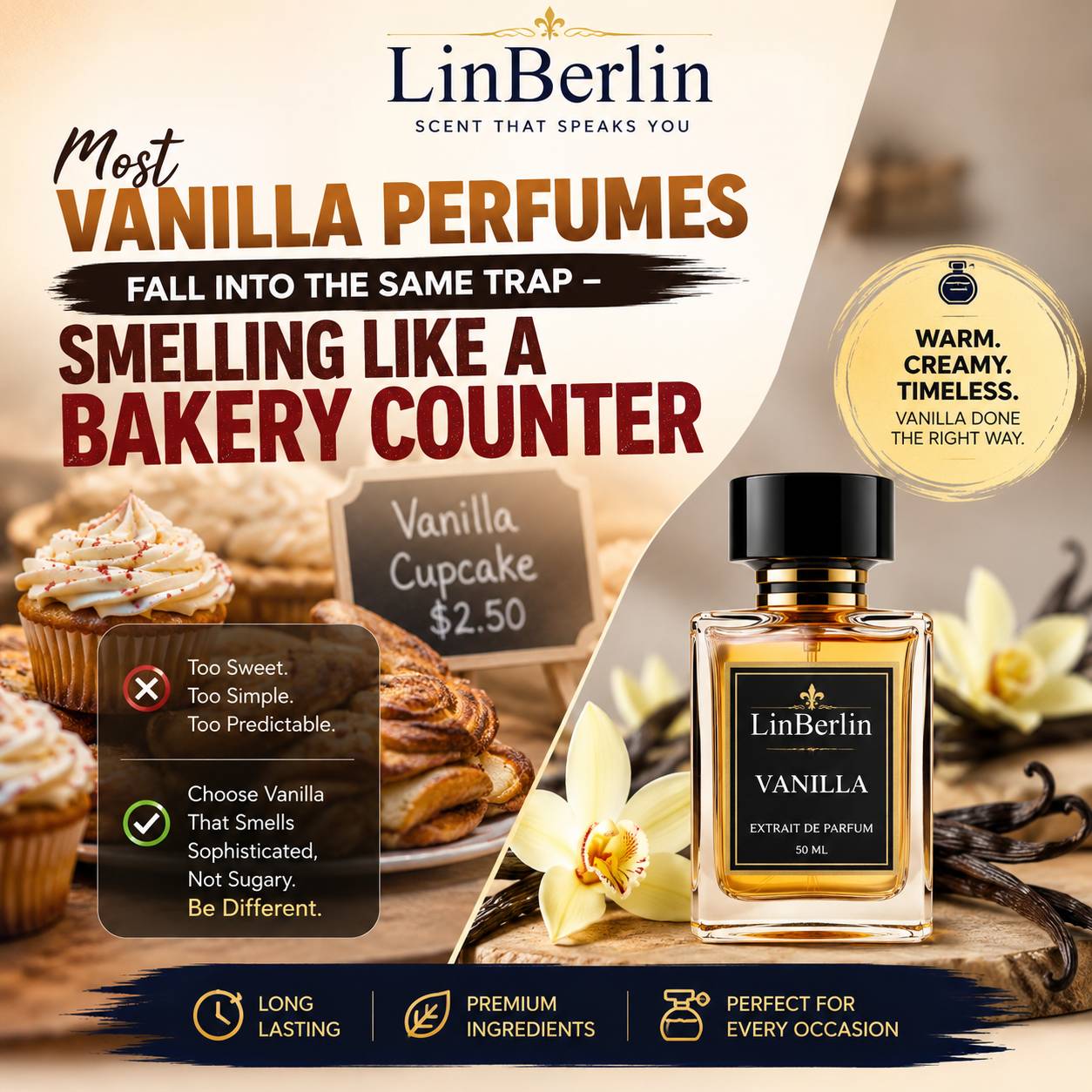
I once had a client tell me her vanilla perfume made her feel like she'd walked into a Cinnabon at 9 a.m. She wasn't wrong to feel that way, and she wasn't alone either. Somewhere between the actual vanilla orchid — a shy, green-and-black pod that takes months to cure — and the little roller bottle on her dresser, something got lost. What got lost was restraint.
Vanilla is one of the oldest, most trusted notes in perfumery, and also one of the most abused. Walk through any fragrance counter and you'll smell the same story repeated in a dozen bottles: sugar, cream, a whisper of caramel, and not much else. It's comforting, sure. But comforting isn't the same as interesting, and a scent that reads as dessert before it reads as perfume has already lost half its job.
Why Vanilla Keeps Ending Up in the Same Corner
Vanillin, the aroma molecule most associated with vanilla, is cheap to produce and extremely stable on skin. That's exactly why it's everywhere — in candles, in body sprays, in fabric softener. So when a brand wants a "safe" bestseller, vanillin does the heavy lifting, and the result smells sweet, flat, and interchangeable with the one next to it. It's not that vanilla is a boring material. It's that most formulations never ask it to be anything more than sugar.
Natural vanilla absolute, by contrast, carries dozens of trace compounds — smoky, boozy, faintly leathery, even a little medicinal at the edges. That complexity is what separates a perfume from a scented candle. And it's the difference a trained nose notices within the first ten seconds of a spray, even if they can't name why.
What "Bakery Vanilla" Actually Smells Like — And Why It Fades Fast
Here's the thing: bakery-style vanillas tend to wear out their welcome twice. First, they smell one-note from the very first spritz, so there's nowhere for the fragrance to go over the next few hours. Second, because they lean so heavily on vanillin and sugar-adjacent aroma chemicals, they often burn off skin faster than a composition built around resins, woods, or a proper attar base. You get an hour of cupcake, then nothing.
A well-built vanilla, on the other hand, is layered on purpose. Top notes might open slightly boozy or spiced. The heart settles into something warmer — tonka, benzoin, sandalwood. And the drydown, hours later, should smell like skin that's simply warm and a little sweet, not like it walked out of an oven. That structure is what makes a fragrance feel considered rather than mass-produced.
How Your Skin Changes the Whole Equation
This is the part most buying guides skip, and it matters more than people realize. Fragrance doesn't sit on top of skin — it interacts with it, and different skin types hold and release scent very differently.
Oilier skin tends to trap and amplify fragrance molecules, which means a vanilla that smells balanced on a friend with dry skin can turn noticeably sweeter, even syrupy, on you. Dry skin, meanwhile, has less natural oil to bind scent to, so top notes evaporate quickly and the fragrance can feel thinner and shorter-lived — sometimes within two or three hours. Combination skin sits somewhere in between and can behave differently depending on the season, which is honestly one of the more frustrating things about buying fragrance for yourself rather than sampling it first.
The practical fix is simple, if a little unglamorous: moisturized skin holds scent longer than dry skin, full stop. A thin, unscented or lightly scented body lotion applied before your attar gives the fragrance oils something to cling to, which slows evaporation and extends wear by an hour or two in most cases. Skip this step on dry skin in particular, and you may find yourself reapplying by early afternoon.
Layering Attar Over Skincare Without Causing Trouble
Attars and natural perfume oils are more concentrated than alcohol-based sprays, which is part of why they last — but it also means how you apply them over skincare actually matters.
- Let active skincare finish absorbing first. Applying attar directly over fresh retinol, vitamin C, or exfoliating acids can trap those actives against skin and increase irritation, so give it at least fifteen to twenty minutes.
- Apply to pulse points where skin is naturally warmer — wrists, inner elbows, behind the ears — since warmth helps the oil's aromatic compounds diffuse into the air rather than sitting flat.
- Don't rub wrists together after applying. It's a small habit, but friction breaks down the top notes and can shorten how long the opening phase of the scent lasts, which somewhat defeats the point of buying a well-structured vanilla in the first place.
Realistically, most irritation people blame on "sensitive skin" is actually a layering problem rather than the fragrance itself being at fault. That's not always true, though — sometimes it genuinely is the fragrance, and pretending otherwise isn't doing anyone favors.
Who Should Be More Careful With Vanilla Attars
Vanilla is generally one of the gentler notes in perfumery, but "generally gentler" isn't the same as "safe for everyone." A few groups should approach it with a bit more caution.
People with fragrance sensitivities or a history of contact dermatitis should patch test any new attar on a small area of skin — inside the elbow works well — and wait 24 to 48 hours before applying it more broadly. Vanilla absolute itself is rarely the main irritant; it's more often the accompanying materials like benzoin or certain resins that can cause reactions in people prone to them. If you're pregnant or breastfeeding, it's worth checking with your doctor before introducing new concentrated fragrance oils, simply because some essential oil components haven't been extensively studied in that context. And if you have eczema or generally compromised skin barrier function, apply fragrance to clothing or hair rather than directly to irritated areas — the oils can sting on broken skin, and that's not a risk worth taking for the sake of a nicer-smelling wrist.
What Actually Separates a Good Vanilla From a Forgettable One
So what should you be smelling for, standing in front of a testing strip? A few things, in rough order of importance.
First: does it smell like something other than dessert within the first thirty minutes? If the answer is no, that's usually a sign the formula is vanillin-heavy and light on supporting materials. Second, does it change over the next two or three hours, or does it just get quieter? A vanilla with real structure should evolve — maybe growing woodier, or slightly more resinous — rather than simply fading out at the same intensity. Third, and this one's easy to overlook: how does it smell on your specific skin the next day, on the pillowcase or a worn shirt? Dry-down character often tells you more about a fragrance's quality than the first impression does.
LinBerlin built our vanilla perfume with exactly this problem in mind — the goal wasn't to smell like sugar, it was to smell like warm skin that happens to carry a trace of vanilla underneath. Lavina pairs a natural vanilla absolute against a soft musk and a touch of amber, so the sweetness stays low and skin-like rather than sitting on top like frosting. It's not trying to be the loudest vanilla on the shelf. It's trying to be the one you still like wearing after six hours, which — in this category, at least — turns out to be the harder achievement.
Pairing and Layering Ideas Worth Trying
Vanilla rarely wants to stand entirely alone, and part of the fun of natural attars is building small combinations. A soft rose adds a slightly cooler, more romantic edge to vanilla's warmth — a combination we talk through in more depth in this guide on vanilla and rose in the evening air. Lavender does something different — it calms vanilla's sweetness down and adds a herbal, almost medicinal contrast that reads a bit more unisex, which is covered in this piece on lavender and vanilla together. And if you're shopping for two people at once, there's a whole separate skill to picking scents that complement rather than clash, which our guide to choosing a romantic perfume combo for couples gets into.
A Small Caveat Worth Saying Out Loud
Not every "bakery vanilla" is a bad purchase, to be fair. Some people genuinely want that gourmand, cotton-candy effect — it has its place at a party, or in cooler weather, or just on a day when subtlety isn't the goal. This guide leans toward the more restrained, skin-like vanillas because that's where natural attar tends to shine, but it's not a universal rule that louder is worse. Sweet tooth or not, the fragrance that works is the one that fits how you actually want to smell.
The Practical Takeaway
Before you buy another vanilla, test it on skin — not paper — and give it two to three hours before deciding. Check what it smells like once it's dried down, not just in the first five minutes at the counter. Moisturize before you apply. And if you've been disappointed by one-note bakery vanillas before, look specifically for blends built around vanilla absolute paired with musk, resin, or wood, rather than straight vanillin. That's usually where the difference between "smells nice for an hour" and "this is actually my scent" lives.