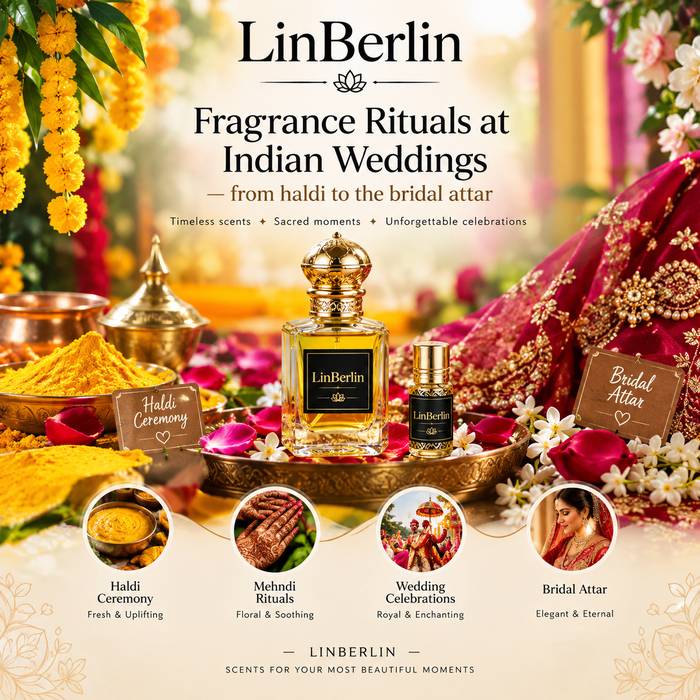
The pillowcase gives it away. Days after an Indian wedding, when the guests have gone and the tents are folded, there is often a faint yellow ghost of turmeric on some cotton cover, and a smell that refuses to leave the room: crushed jasmine, a little marigold, something woody underneath. Nobody planned that smell as a single composition. But it is one, built slowly over many days, ritual by ritual.
Where the fragrance begins: the haldi
Long before any perfume is opened, the wedding already smells of a kitchen. Haldi paste, made from raw turmeric, sandalwood powder, a little gram flour and milk or rose water, is patted on the bride and groom by aunts who have opinions about exactly how much to use. It smells earthy, slightly bitter, warm. Not pretty, really (and that is rather the point).
The ritual is practical as well as symbolic. Turmeric and chandan have been used on Indian skin for generations to calm and brighten it before the big day. The scent is part of the medicine, a signal to the body that something is beginning.
Here is where the beauty-writer in me has to interrupt. Turmeric stains, and it can irritate some skin types, especially dry or reactive skin, and anyone who has recently used retinol or exfoliating acids. If that is you, do a patch test on the inner forearm a day or two ahead. Realistically, most families skip this step. It is worth doing anyway.
Mehendi night and the smell of wet earth
Mehendi has its own odour, and it is not the one people expect. The paste is green, clay-like, sharp with clove oil or eucalyptus, and it needs hours to dry on the hands. Then the flaking begins, and the room fills with something that is almost rain on a dusty road.
That petrichor quality is old in Indian perfumery. It is the idea behind mitti attar, and it is why a scent like the one described in sandalwood and wet earth quietly remembering the rain feels so familiar to people who grew up around clay pots and monsoon courtyards. Earth, in these traditions, means grounding. A bride sitting still for hours while her hands are painted is being grounded, whether she knows it or not.
One caution: do not apply attar over fresh mehendi designs or on the hands while the paste is still wet. The oil can smudge the pattern, and it may darken or blotch the stain unevenly.
Before the pheras: prayer, incense and the first flowers
Most weddings open with a puja, often to Ganesha, and the fragrance there is devotional rather than decorative. Camphor, ghee lamps, incense, fresh marigold. It is a different job from perfume, and confusing the two is a common mistake. If you want to understand the line between fragrance for the gods and fragrance for the person, the guide on what fragrance belongs in a Durga Puja or Navratri ritual explains it well, and much of the same thinking carries into wedding prayers.
It is quiet, this part. The smoke rises. Somebody's phone rings.
The morning of the wedding: jasmine, chandan and a holy kind of stillness
If one pairing defines the wedding morning across much of India, it is jasmine with sandalwood. Gajra threaded into hair, a smear of chandan on the forehead, garlands hanging in doorways. The combination works because the two do opposite things: jasmine is bright, a little indecent, almost animal at its heart, while sandalwood is creamy and calm and keeps it from shouting. The longer piece on the timeless holiness of jasmine and sandalwood in Indian mornings goes deeper into why it feels sacred rather than merely pleasant.
What people notice on the day, and I have watched this happen, is that jasmine behaves very differently on different bodies. On oily skin it blooms fast, gets loud, and can turn a touch sweet-heavy by noon. On dry skin it fades quickly unless the skin is moisturised first, because dry skin drinks fragrance and gives little back. Normal skin sits between the two. Sensitive skin may simply object, and that is worth respecting.
The bridal attar: how it is actually worn
A bridal attar is not a spray. It is oil, applied in small amounts, and that changes everything about how you handle it.
Apply after moisturiser has absorbed, not while it is still wet, because a slippery surface pushes the oil around and muddles both products. Touch it to the pulse points: inner wrist, behind the ears, the hollow of the collarbone. One small dab each is plenty. Do not rub your wrists together, as friction breaks down the top notes faster than you would think.
- Skip attar on freshly waxed, threaded or facial-treated skin. It is open and reactive for at least a day, sometimes two.
- If you are using retinoids, strong vitamin C or chemical exfoliants in the weeks before the wedding, apply attar to clothing hems or the hair ends instead of directly to skin, and always patch test first.
- Pregnant brides, or anyone with a known allergy to botanical oils, should speak to a doctor before using any concentrated essential-oil-based fragrance. Natural does not automatically mean gentle, and I would rather say that plainly than hide it.
- Silk and pale fabrics can take a grease-spot from oil. Test somewhere invisible.
And one honest limitation. Natural attars are not always the longest-lasting option on every skin. Some fade to a whisper in a few hours on very dry or very hot skin. That is the trade for a scent without a synthetic fixative, and I think it is a fair one, but you should know it going in.
Choosing for the couple, not just the bride
The groom usually gets forgotten in fragrance conversations, which is a shame, since he spends hours in heavy sherwani fabric under lights. Something lighter and woodier tends to suit him better than something sugary, and a citrus opening helps in warm months. There is a nice illustration of how brightness and floral warmth interact on cloth in citrus light meeting jasmine warmth on fabric, which is useful reading for anyone dressing in layers of silk or cotton.
For couples who want a wider look at pairing scents for both partners, this guide to choosing the perfect wedding fragrance for bride and groom is a good place to start. Whatever you pick, it should be decided weeks in advance, worn a few times, and tested on the actual skin that will wear it.
A few things families rarely say out loud
Weddings are crowded, hot and long. Scent that seemed elegant in a quiet room can turn cloying by the third hour of ceremony, so less is nearly always better.
And do not layer three new products on the morning itself. Trying something for the first time on the wedding day is how people end up with a rash, a headache, or a scent they disliked by lunch. Keep the new things for the days before.
There is a smaller point I will only half explain: the same attar can smell noticeably different in the evening than at dawn, partly temperature, partly the body. Try it at both hours if you can.
What stays
What is remarkable, looking back across these rituals, is that no single fragrance owns the wedding. Turmeric starts it, clay carries it, jasmine and sandalwood crown it, and the couple's own skin finishes the work. Choose one oil you love, apply it lightly to well-moisturised skin, test it early, and then let the day do what it will with it. The pillowcase will remember either way.