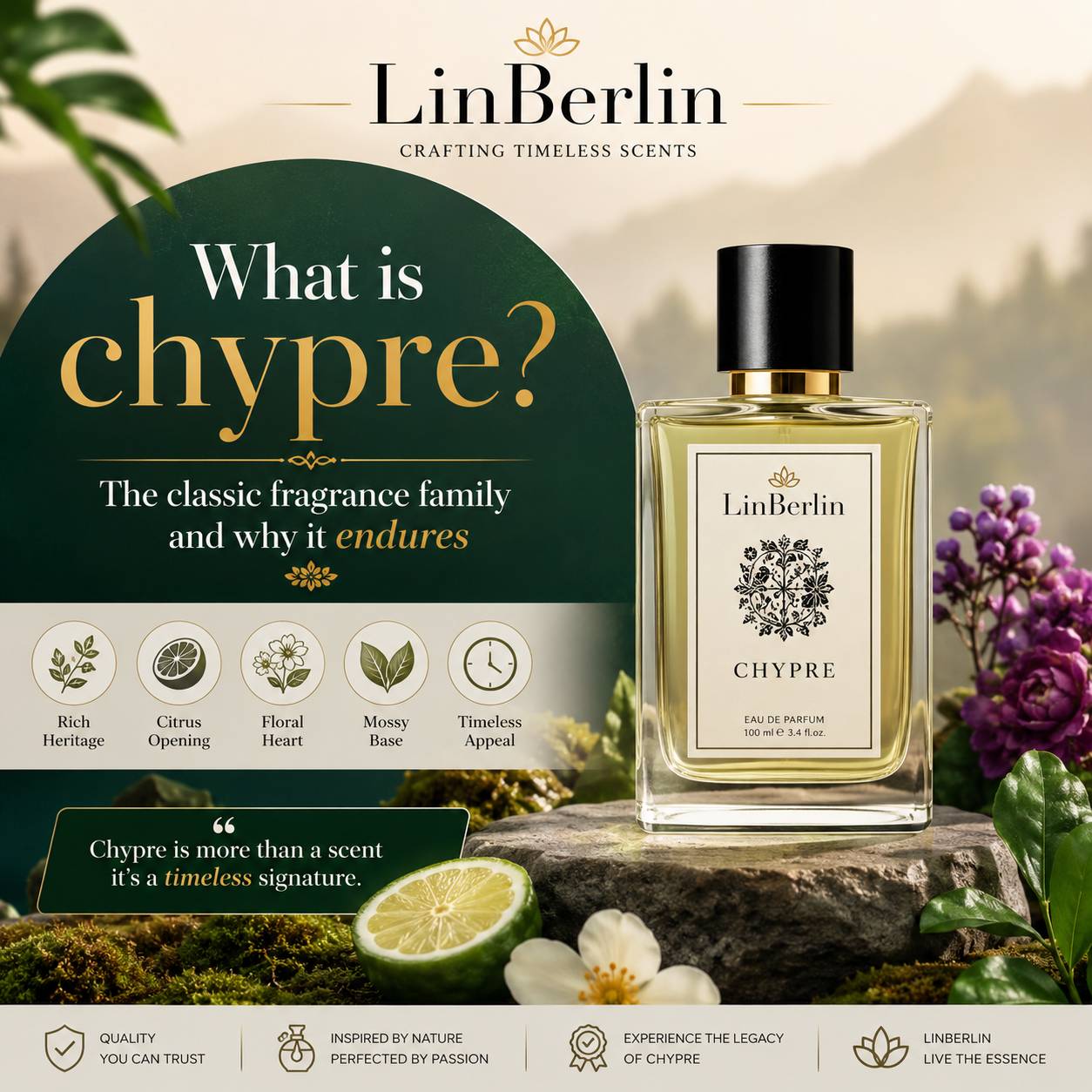
Ask ten perfumers to define chypre and you'll get ten slightly different answers, and honestly, that disagreement is kind of the point. It's one of the few fragrance families named after a place rather than an ingredient or a mood — Chypre is the French word for Cyprus, the island where the structure is said to have first taken shape from local labdanum and moss. A century later, the name has outlived the specific formula that inspired it. What's left is a skeleton, a way of building a scent, that perfumers keep returning to because nothing else quite does what it does.
For a beginner, that's actually useful news. You don't need to memorize a list of "chypre ingredients" the way you might for, say, a gourmand. You need to understand a relationship — one between brightness up top and shadow underneath — and once that clicks, you'll start recognizing chypre structure in fragrances you never would have labeled that way before.
The basic architecture: citrus over moss
Strip away the historical trivia and a chypre comes down to a contrast built in three parts. Up top, something bright and citrus — bergamot almost always, sometimes joined by mandarin or a green note. In the middle, usually rose or jasmine, though this layer varies more than people assume. And underneath, the part that actually defines the family: oakmoss, labdanum, patchouli, sometimes a touch of animalic musk. That base is what gives chypre its signature — a dry, mossy, slightly bitter depth that reads as sophisticated rather than sweet.
What makes this structure interesting from a science standpoint is the tension it creates. Citrus top notes are volatile — they evaporate fast, sitting near the top of the vapor pressure scale among common perfume materials. Oakmoss and labdanum are the opposite: heavy, slow-releasing, built to anchor a composition for hours. So a well-made chypre isn't really one smell. It's two smells happening on a timeline, with the sharp opening burning off within the first twenty minutes or so and the mossy base taking over for the long stretch afterward. Wear one and you'll notice this yourself — the fragrance you smell at 9am and the one you smell at 3pm can feel like distant cousins.
Why oakmoss became a regulatory problem
Here's where the story gets a little complicated, and most beginner guides skip right past it. Natural oakmoss contains atranol and chloroatranol, compounds linked to skin sensitization in a meaningful percentage of users. IFRA — the industry body that sets fragrance safety standards — has restricted oakmoss concentrations sharply since the early 2000s, and that restriction reshaped what a "chypre" could legally smell like in mass fragrance. Many modern interpretations lean on synthetic mossy accords or substitute materials like evernyl to approximate the effect without the same allergen load.
This matters for anyone with reactive or sensitive skin. Genuine oakmoss-forward attars and perfumes, particularly older formulations or small-batch natural ones, can trigger contact dermatitis in people who've never reacted to fragrance before — it's one of the more well-documented sensitizers in perfumery, alongside certain synthetic musks. If you've never worn a heavy chypre before, patch testing on the inner forearm for 24 hours isn't overcautious. It's just sensible, especially with anything marketed as built on natural moss rather than a modern reformulated substitute.
And if you're pregnant, it's worth running any new concentrated fragrance oil past your doctor first — not because chypre specifically carries unusual risk, but because that's sound practice with any strong botanical composition, chypre or otherwise.
How chypre translates into attar and oil-based perfumery
Western chypre developed mostly as an alcohol-based fine fragrance tradition, but the underlying idea — bright top, mossy-resinous base — maps onto oil perfumery surprisingly well, even if the vocabulary differs. Attar traditions have long paired citrus-adjacent or green opening notes with deep resinous or woody bases; the effect isn't identical to a French chypre, but the structural logic (contrast, then depth) rhymes with it closely enough that fans of one tend to gravitate toward the other.
Oil-based versions actually solve one of chypre's classic problems. Alcohol formulations project hard in the first hour and then fade unpredictably as the alcohol carrier evaporates. Oil sits differently on skin — it releases more evenly, which means the transition from citrus opening to mossy base tends to feel smoother, less like a costume change and more like a slow fade. Worth knowing if you've tried chypre before in spray form and found the shift jarring.
Sandalwood shows up in a lot of chypre-adjacent oil perfumery too, standing in for or reinforcing the mossy base with its own creamy, slightly dry warmth. But sandalwood is one of those ingredients where the market is flooded with synthetic or diluted versions sold as the real thing, so if a chypre-style attar leans on sandalwood as a base note, it's worth knowing how to tell genuine sandalwood from synthetic substitutes before assuming you're getting the real thing.
What chypre actually smells like on skin — and who tends to reach for it
Describing chypre to someone who's never smelled one is a bit like describing the taste of a dry martini to someone who's only had sweet cocktails. The honest answer is: it's not immediately crowd-pleasing the way a vanilla or a fruity floral is. It's dry. Sometimes bitter in the best sense, the way good dark chocolate or strong tea is bitter. It doesn't ask to be liked in the first three seconds — it asks for patience.
That's probably why chypre has historically skewed toward a more mature, confident audience rather than beginners chasing an instantly likable scent. But the truth is, that reputation is a little outdated. Modern oil-based chypre-adjacent compositions, built with lighter moss substitutes and warmer resins, are considerably more approachable than the sharp, almost austere formulas of decades past. It's still not a scent for someone who wants immediate sweetness. It rewards someone who wants to smell composed rather than loud — which is part of why chypre-leaning structures turn up so often in quiet, controlled fragrances built for office or professional settings, where you want presence without volume.
Common mistakes people make with chypre
A few things trip up newcomers consistently.
The first is judging a chypre off the first sniff from the bottle. Because the top notes are so citrus-forward and immediate, people smell the opening, decide it's "just another citrus scent," and move on before the mossy base ever gets a chance to develop. You genuinely need to wear it — on skin, for at least an hour — before forming an opinion. Sampling from a strip or a quick wrist pass won't show you the part that actually defines the family.
Second mistake: applying too much, too eagerly. Because the base notes are heavy and slow-releasing, overapplication doesn't just make a chypre stronger — it makes it heavier in a way that can tip toward muddy rather than complex. A little goes further here than it does with lighter fragrance families.
Third, and this one's more of a gifting note than a wearing one — chypre isn't always the safest pick as a gift for someone whose taste you don't know well, given how divisive that dry, bitter opening can be for the unprepared. If you're shopping for someone whose preferences are uncertain, something in the range of accessible, easy-to-love gifting perfumes tends to land better than a structurally demanding chypre would.
A quick note on musk-heavy chypre variations
Not every chypre leans purely mossy. Some compositions — particularly in oil perfumery — push the base toward a more animalic, musk-forward direction rather than a strictly green-mossy one. If that's the direction that appeals to you more than the classic oakmoss profile, it's worth exploring musk-based attars built around that same deep, lingering base note logic, since the underlying principle — contrast between an initial brightness and a slow, dark undertone — carries over even when the specific materials shift.
Where this leaves you as a beginner
Chypre isn't a trend, and it's not going to be reinvented into something unrecognizable next year. It's a structural idea — brightness giving way to shadow — that's flexible enough to survive a century of reformulation, regulatory restriction, and shifting taste, which is a fairly rare thing in perfumery. If you're new to the category, the best entry point isn't reading more about it. It's finding one oil-based version, applying it properly, and giving it the full hour it needs to show you what it actually is underneath that first citrus impression.