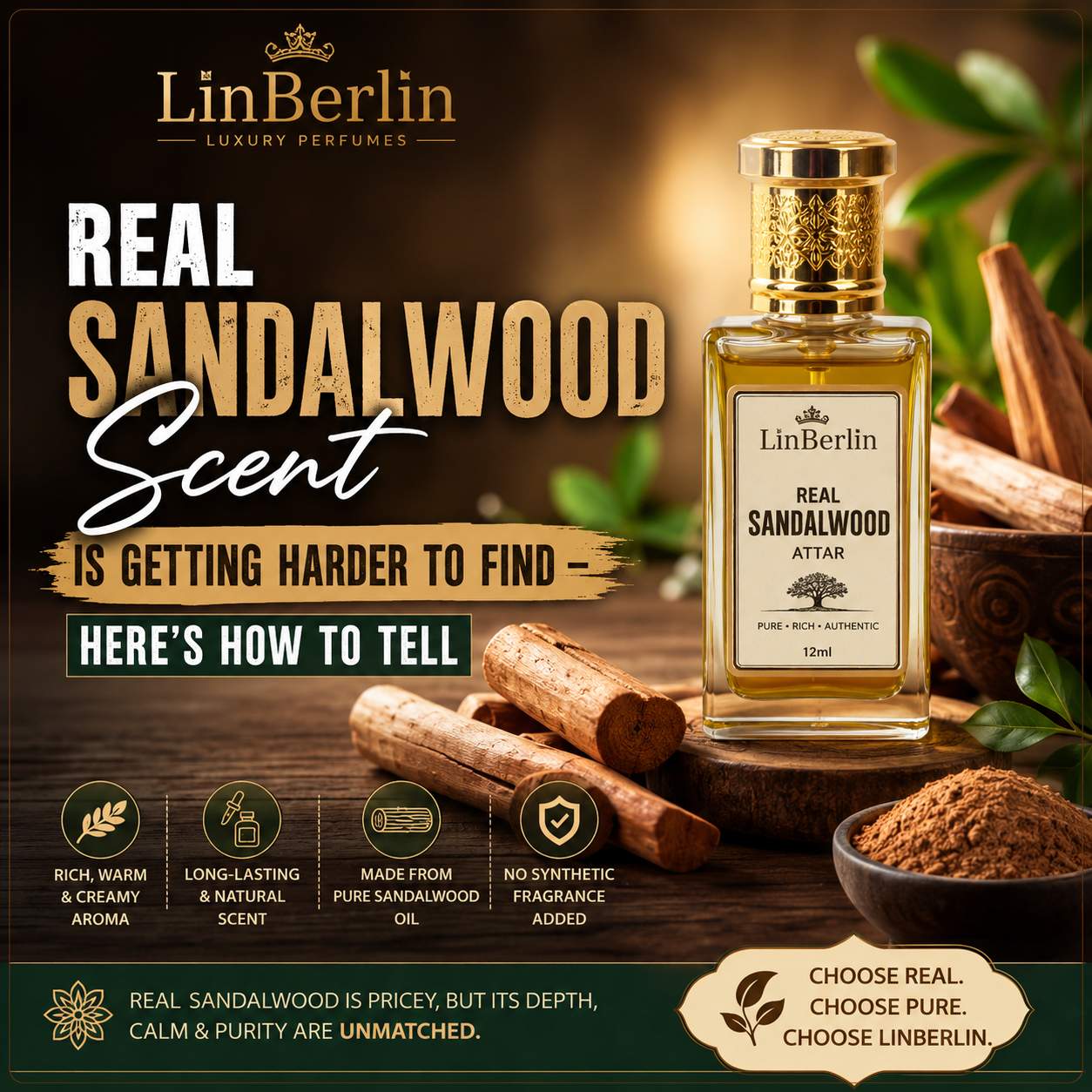
A perfumer I know keeps a small vial of Mysore sandalwood oil from the 1990s locked away — not to sell, not even really to use, but to remind himself what the real thing actually smells like whenever a new batch of "sandalwood" comes across his desk and he needs a reference point. That's a slightly unsettling thing to learn, honestly. That even people who work with this material professionally sometimes need to check their memory against a decades-old sample because the market has drifted that far from what sandalwood used to smell like. Real sandalwood is genuinely harder to find than it was even fifteen years ago, and the reasons are mostly boring and structural — overharvesting, decades-long growth cycles, government regulation — rather than anything mysterious. But the practical problem for anyone buying attar or perfume today is simpler: a lot of what's labelled "sandalwood" now isn't, not really, and telling the difference takes a bit of actual knowledge rather than trusting the label.
Why the supply actually shrank
Santalum album, the Indian sandalwood species responsible for the sandalwood scent most people think of when they hear the word, takes somewhere between thirty and sixty years to develop the heartwood density needed for high-quality oil extraction. Not five years. Not ten. Decades. Combine that with a century of overharvesting across South India and the Indian government's tightening restrictions on wild sandalwood logging — restrictions that exist for genuinely good conservation reasons — and you end up with a raw material that's structurally scarce, not just expensively marketed to seem that way. Australian sandalwood, Santalum spicatum, has filled a lot of the commercial gap since, and it's a legitimate, sustainably farmed alternative. But it smells noticeably different — drier, less creamy, with a sharper, slightly more medicinal edge compared to the soft, almost buttery roundness of genuine Mysore sandalwood. Neither is fake, exactly. They're just not the same material, and a lot of buyers don't realise they've been sold one while expecting the other.
What's actually in most "sandalwood" fragrance today
Here's the less comfortable part. A large share of commercial sandalwood-labelled fragrance — perfume, attar, incense, skincare, all of it — uses synthetic sandalwood substitutes rather than any real Santalum oil at all. Sandalore and Javanol are the two most common lab-created molecules, built to approximate sandalwood's woody-creamy character without the cost or scarcity of the real thing. They're not dangerous, and honestly, some of them are made quite well. But they smell different in ways that become obvious once you know what to listen for, so to speak. Synthetic sandalwood tends to smell flatter and more linear — the same note from first spray to last, without the slow, gentle evolution real sandalwood oil goes through as it warms on skin. Real sandalwood opens milky and soft, deepens into something almost powdery after twenty minutes or so, and settles into a warm, slightly sweet base note that can last most of the day. Synthetic versions often just... stay where they started. Pleasant, but static.
How to actually test it on your own skin
This is where most buying guides stop short, and it's frustrating, because the real test isn't on a paper strip — it's on skin, over time, because that's the only way sandalwood's actual behaviour reveals itself. Apply a small amount to the inner wrist and wait. Don't judge it in the first five minutes; that's not where real sandalwood shows its character. Come back at the twenty-minute mark, then again after an hour. Genuine sandalwood oil should have deepened and softened by then, taking on that characteristic creamy warmth rather than staying identical to how it smelled straight out of the bottle. If it smells exactly the same an hour in as it did at application — sharp, clean, unchanging — that's a reasonably strong signal you're dealing with a synthetic isolate rather than real Santalum oil, however nicely it's been blended into the surrounding composition. Skin type actually affects this test meaningfully, which is something worth knowing before you draw conclusions. Dry skin can make even genuine sandalwood oil read thinner and fade faster than it would on well-moisturised skin, simply because there's less natural oil on the surface to hold the fragrance molecules in place. So if you're testing on dry skin without any moisturiser underneath, apply a light, fragrance-free lotion first — otherwise you might dismiss a perfectly authentic sandalwood as "weak" when the real issue is dry skin working against it, not the oil itself.
What genuine sandalwood does for different skin types
Oily and combination skin tends to hold sandalwood beautifully on its own, without much help needed — the skin's natural sebum acts almost like an extension of the oil base sandalwood is already carried in, extending both depth and duration considerably. Realistically, this is one of the more forgiving fragrance families across skin types generally, which is part of why it's remained such a foundational note in natural perfumery for so long. Sensitive skin usually tolerates real sandalwood reasonably well too — it sits lower on the irritation-risk scale than citrus oils or concentrated floral absolutes tend to. That said, "usually well-tolerated" isn't the same as "risk-free for everyone," and anyone with a documented fragrance allergy should still patch test a new sandalwood blend on the inner arm and wait a full day before wearing it properly, same as with any concentrated natural oil. Sandora, our sandalwood perfume, is built around genuine sandalwood's fuller, rounder character specifically because that slow unfolding on skin is the whole point — a synthetic shortcut would defeat the purpose entirely. Layering with skincare is where a bit of caution genuinely helps. Applying any concentrated oil-based fragrance, sandalwood included, directly over freshly used retinol or strong exfoliating acids can occasionally cause mild stinging on skin that's temporarily more reactive than usual. Waiting twenty to thirty minutes after active skincare has properly absorbed avoids this almost entirely, and it's a small enough habit that it's worth building regardless of which fragrance you're reaching for.
A few honest limits to this whole approach
None of this makes anyone a lab, and it shouldn't be treated as a substitute for buying from a source you actually trust. Even trained noses occasionally misjudge a well-blended synthetic against a lower-grade real sandalwood — the two categories aren't always as cleanly separated as this piece might suggest, particularly with newer synthetic molecules that are genuinely getting better at mimicking the real thing's slow evolution rather than just its opening note. The skin test described above is a strong indicator, not an infallible one.
Beyond identification — wearing it well
Once you've found a genuine sandalwood you trust, how you apply it matters almost as much as what you bought. There's a good piece on how to wear attar for the right scent trail, worth a read since sandalwood's slow-building character rewards a lighter, more deliberate application than a spray-and-go habit would suit. And if sandalwood is becoming something closer to your everyday signature rather than an occasional choice, there's a broader guide on how to choose a signature scent that actually represents you, useful context for anyone deciding whether sandalwood deserves that role in their routine long-term.
The short version
Real sandalwood is scarce, and that scarcity has genuinely reshaped what most of the market sells under that name. Trust your skin over the label — give any candidate an hour to reveal whether it deepens and softens the way real Santalum oil does, or stays flat the way most synthetic substitutes tend to. That single test, more than any ingredient list, tells you what you're actually wearing.