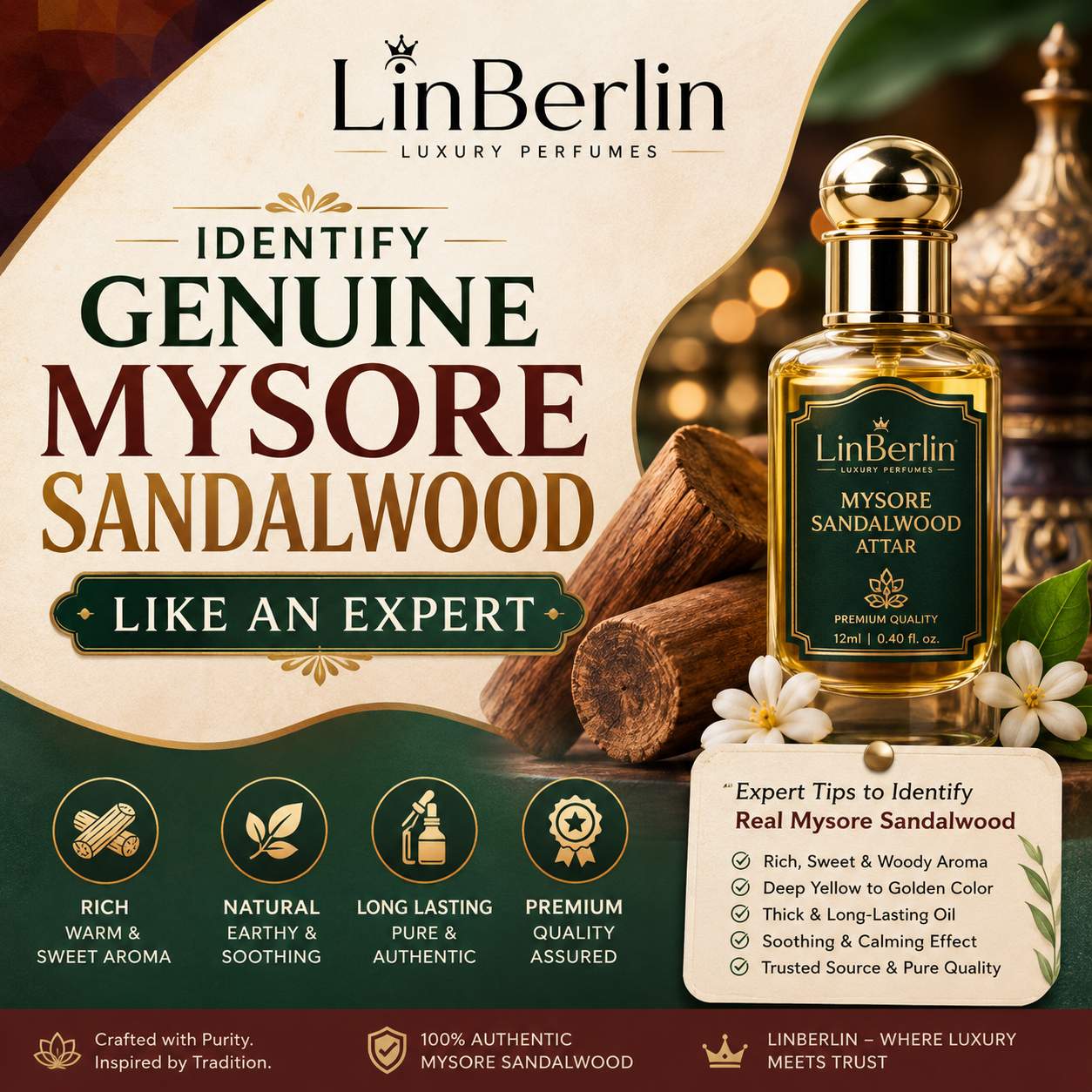
A bottle labeled "pure sandalwood" told me nothing the first time I held one up to the light in a Mysore perfume market years ago. The seller swore it was the real thing. It smelled close — creamy, a little sweet, faintly milky. But it faded within two hours, and real Mysore sandalwood simply doesn't do that. That gap between what a fragrance promises on the label and what it actually does on skin is where most buyers get burned, and it's rarely because they weren't paying attention. It's because synthetic sandalwood has gotten genuinely good at mimicking the opening notes while completely missing everything that happens after.
So this isn't a guide about learning to sniff harder. It's about understanding what actually separates Santalum album — true Mysore-origin sandalwood — from the synthetic molecules built to imitate it, and why that difference matters far more on skin than it ever does in a bottle.
Why Mysore sandalwood became the benchmark in the first place
Santalum album grown in the Mysore region of Karnataka carries an unusually high concentration of santalol, the compound responsible for sandalwood's characteristic creamy, woody-sweet depth. Trees need decades — often 15 to 30 years — of slow growth in that specific soil and climate before the heartwood develops the oil concentration perfumers actually want. That's the entire problem in one sentence, really. You can't rush biology, and you can't rush geography either.
Decades of overharvesting pushed genuine Mysore sandalwood toward scarcity, government-controlled extraction, and prices that put real oil well out of reach for most casual buyers. Which is exactly the gap synthetic sandalwood molecules — things like Javanol, Ebanol, or Sandalore — were built to fill. And to be fair to those materials, they're not cheap knockoffs in the pejorative sense. Some are impressively engineered. They just aren't the same thing, chemically or experientially, and treating them as interchangeable is where buyers go wrong.
The tell that actually works: how it behaves over time, not how it smells at first
Here's the thing most buying guides skip past — first impressions are nearly useless for this particular ingredient. Synthetic sandalwood molecules are frequently designed to smell impressive in the opening ten minutes, sometimes even more immediately "sandalwood-like" than the real oil, which can actually be quieter and more restrained at first application.
The real test is patience. Apply a small amount to skin and check back at the two-hour mark, then again after four. Genuine sandalwood attar deepens — it gets creamier, slightly more animalic, and it tends to develop a warmth that wasn't obvious in the first twenty minutes. Synthetic versions tend to do the opposite: strong opening, followed by a fade that's often complete or nearly complete by hour three or four, sometimes leaving behind a faint, slightly flat woody note that doesn't really resemble sandalwood at all anymore.
If you want a longer, more technical breakdown of the specific chemical markers and sourcing questions worth asking a seller, our piece on how to identify genuine sandalwood aroma covers that ground in more depth than we need to here.
What your skin type does to this equation
This is where things get genuinely interesting from a skincare standpoint, and it's the part most buying guides leave out entirely.
Dry skin tends to absorb sandalwood attar quickly — sometimes too quickly, meaning the oil sinks in before it's had a chance to develop that characteristic depth on the surface, and the wearer ends up smelling less of the fragrance than they'd expect. A light, unscented moisturizer applied a few minutes beforehand creates a barrier that lets the sandalwood sit rather than vanish. Oily skin does the reverse: it tends to amplify sandalwood's richness, sometimes to the point of making a strong attar feel almost heavy by midday, which means a slightly lighter application usually serves oily-skinned wearers better than the amount that works fine on someone with normal or dry skin.
Sensitive or reactive skin needs a different kind of attention entirely. Sandalwood oil, real or synthetic, isn't among the more aggressive sensitizers in perfumery — but it's not risk-free either, particularly for people with a history of contact dermatitis or eczema. Realistically, patch testing on the inner forearm for 24 hours before applying anything new to the neck or wrists is the safer habit, especially with concentrated oil-based attars rather than diluted sprays. And if you're pregnant or nursing, it's worth running any new concentrated fragrance oil past your doctor first, not because sandalwood carries some unusual documented risk, but because that's just sound practice with any strong botanical extract.
Reading a label without getting fooled by it
A few practical checks, roughly in order of usefulness:
- Price is still one of the more honest signals available, even though it feels unsatisfying to rely on. Genuine Mysore-origin sandalwood oil is expensive to produce — the decades-long growth cycle alone guarantees that — so an attar priced like a synthetic fragrance but marketed with "pure sandalwood" language on the label deserves real skepticism before you buy.
- Look for actual sourcing language, not just the word "natural." Terms like Santalum album, Mysore-origin, or specific extraction method (steam-distilled is standard for genuine sandalwood oil) tend to appear on labels from sellers who actually know and can speak to their supply chain. Vague phrasing — "inspired by," "sandalwood accord," "sandalwood notes" — is often a quiet admission that the product is synthetic or blended.
- And consistency across a seller's full catalog matters more than people assume. If every single fragrance in a shop claims to be "100% pure sandalwood attar" regardless of price point, something in that claim isn't holding up — real sandalwood-forward attars, like our own Rooh e Chandan, are priced and described in a way that reflects what actually went into the bottle, not blanket marketing language applied across an entire range.
The truth is, no visual or label-based check is completely foolproof on its own. A confident seller can write convincing sourcing language regardless of what's actually in the bottle, and that's an honest limitation worth naming rather than glossing over. The skin-behavior test — watching how the scent develops over several hours — remains the most reliable check available to an actual buyer, because it's the one thing synthetic sandalwood consistently struggles to fake all the way through.
Where sandalwood attar fits beyond skin wear
Genuine sandalwood oil isn't only worn directly. Its depth and staying power make it a popular base for scenting fabric — a use case where the same authenticity questions apply, since a synthetic substitute will fade from linen or cotton far faster than real oil does. If that's the direction you're exploring, it's worth looking at how LinBerlin's sandalwood-based fabric perfume, Santure, approaches that specific application, since fabric scenting and skin wear ask genuinely different things of the same core ingredient.
Common mistakes enthusiasts still make
Buying based on the strength of the opening scent is probably the single most common error, largely because it's the most intuitive one — a fragrance that hits you immediately feels like quality, when it's often the opposite signal with sandalwood specifically. Overapplying is a close second; because real sandalwood attar builds in intensity over hours rather than fading, a small amount that feels underwhelming at 10am can feel entirely appropriate — sometimes even generous — by mid-afternoon. And trusting country-of-origin claims without asking about the actual botanical species is a mistake enthusiasts make more than beginners do, oddly enough, because they assume their experience makes them harder to mislead. It doesn't, not on this particular ingredient.
What to actually do with this before your next purchase
Buy a small quantity first, no matter how confident the seller sounds or how good the opening smells in the store. Apply it, then genuinely wait — check in at two hours, then again later in the day, and pay attention to whether it deepens or disappears. That single habit, more than any label-reading skill or price comparison, is what separates buyers who end up with real sandalwood from buyers who end up with a convincing three-hour impression of it