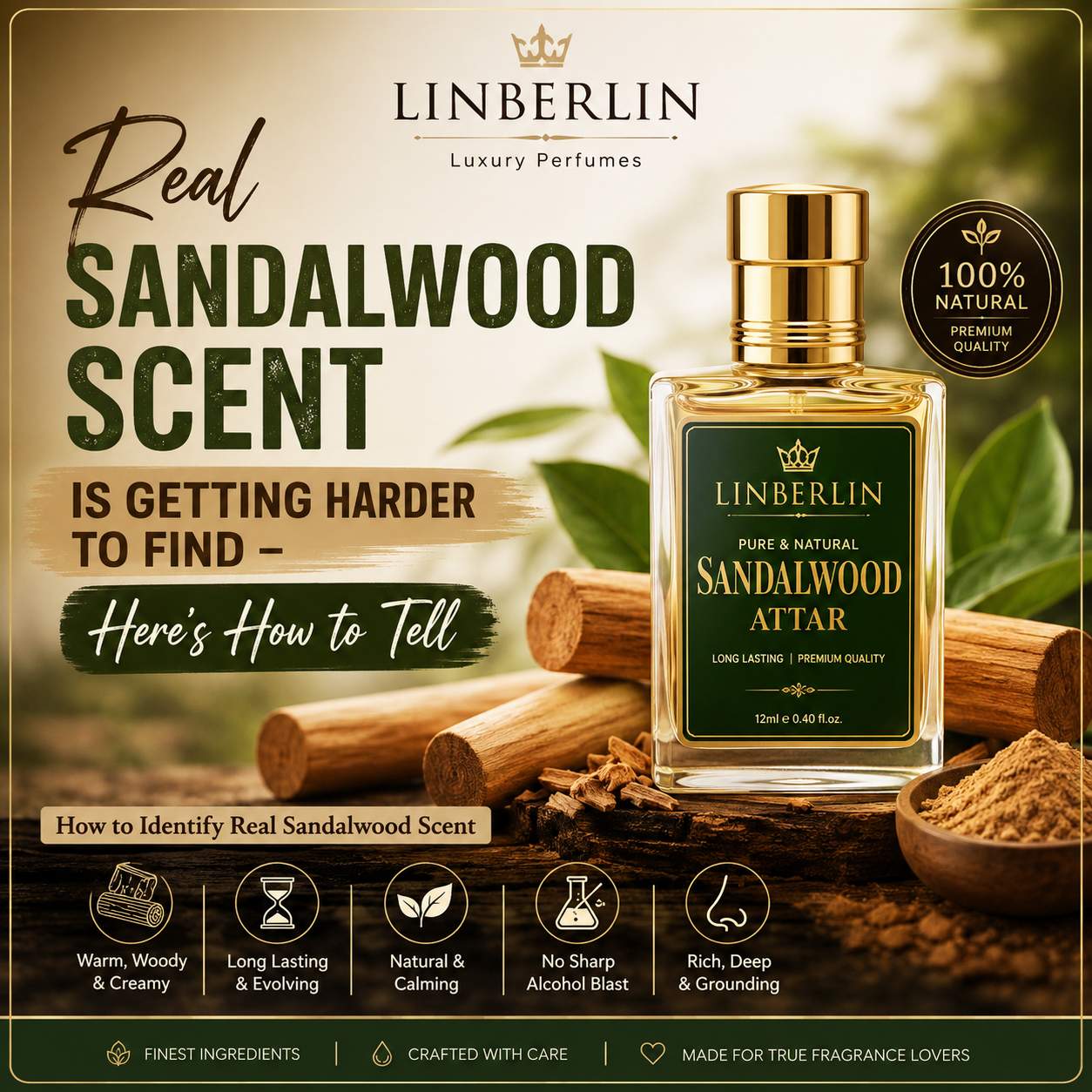
A friend of mine, a jeweller who's spent thirty years around precious materials, once told me the easiest way to spot a fake gemstone is to stop looking at the stone and start looking at how the seller talks about it. I think about that a lot when people ask me about sandalwood. Everyone wants to talk about the woody, creamy, meditative scent. Almost no one wants to talk about the tree it comes from, the decades it takes to mature, or the fact that most of what's sold as "sandalwood" today has never touched an actual sandalwood log. That gap — between the story people are sold and the reality of the raw material — is where this guide lives.
Why real sandalwood has become so scarce
Indian sandalwood, Santalum album, needs somewhere between 15 and 30 years to develop the oil-rich heartwood that perfumers actually want. Not the bark. Not the outer wood. The heartwood, deep inside a tree that's spent decades quietly building up santalol, the compound responsible for that unmistakable creamy, milky-woody character. Compare that to lavender or citrus, which can be harvested annually, and you start to understand why sandalwood behaves more like a slow-growing hardwood investment than an agricultural crop.
Decades of overharvesting in India, combined with export restrictions that were introduced partly to protect what remained of wild sandalwood forests, pushed prices upward and supply downward at the same time. Australian sandalwood plantations have picked up some of the slack, and they're a legitimate, more sustainable source — but the oil profile is different, generally sharper and less creamy than the Mysore-origin material old-school perfumers still chase. So when a bottle claims "pure sandalwood" at a price that would have been laughable a decade ago, that claim deserves a second look. Realistically, if the ingredient took thirty years to grow and the price didn't move with the scarcity, something in that equation isn't sandalwood.
What the industry actually sells as "sandalwood"
Here's the thing — most commercial "sandalwood" fragrance today is built on synthetic substitutes like Javanol, Sandalore, or Ebanol. These aren't scams exactly. They're legitimate perfumery molecules developed because natural sandalwood oil became too expensive and too regulated to use at scale. But they smell different up close. Synthetic sandalwood notes tend to be louder and more linear — they hit one woody-creamy chord and hold it, without the shifting, almost powdery-sweet complexity that real attar sandalwood develops as it warms on skin.
And that's really the tell. Natural sandalwood attar doesn't sit still. It opens slightly sharp, almost medicinal, then rounds out over the first twenty minutes into something warmer and milkier. Synthetics jump straight to the "finished" note and stay there for hours without much evolution. If a fragrance smells identical at minute two and hour six, that's worth noting.
Reading a label like someone who knows what they're looking for
A few things to check before you buy:
Look for the botanical name, Santalum album or Santalum spicatum, listed somewhere on the packaging or product page — not just the word "sandalwood." Brands sourcing genuine oil are usually proud enough of it to name the species. Vague blends that just say "sandalwood fragrance" or "sandalwood accord" are, more often than not, synthetic-forward or synthetic-only. And price is a rough but genuinely useful signal: pure sandalwood attar in a meaningful concentration is not going to be the cheapest oil on a shelf, because the raw material itself isn't cheap.
LinBerlin's own approach with Sandora leans into sourced sandalwood oil rather than trying to mimic the note with synthetics — which is one reason it behaves the way it does on skin over the course of a day, shifting rather than sitting flat. If you're specifically hunting for that traditional, temple-incense-adjacent chandan character, our sandalwood perfume is built around that intention rather than an approximation of it.
How sandalwood actually behaves on different skin types
This part gets underexplained a lot, so let me be specific. Oily skin holds fragrance longer because the natural oils on the skin's surface act as a kind of anchor, slowing evaporation — sandalwood attar on oily skin can genuinely last six to eight hours without reapplication. Dry skin is the opposite story. Without that lipid layer, the oil evaporates faster and the scent can feel thinner within a couple of hours, which is why people with dry skin often assume a fragrance is "weak" when really it's their skin chemistry doing the work.
Moisturised skin sits somewhere in between, and it's honestly the best canvas for attar generally. A light, unscented or minimally scented moisturiser applied before the attar gives the oil something to bind to, which extends wear noticeably. But — and this matters — layering attar over heavily active skincare (retinoids, strong exfoliating acids, benzoyl peroxide) can cause irritation on compromised or freshly-treated skin, since the concentrated oil sits directly on a barrier that's already stressed. If you've just used a retinol or had a chemical peel, give your skin a night or two before applying attar to that area, or apply it to clothing and pulse points that skipped the treatment instead.
Combination skin tends to hold scent unevenly across the face and body, which is normal and not something to overthink. Sensitive or reactive skin is where I'd urge more caution generally — natural sandalwood oil is gentle by fragrance standards, but it's still a concentrated botanical oil, and anyone with a known sensitivity to woody essential oils, or anyone pregnant, should patch test on the inner arm and ideally check with a doctor before regular use. This isn't me being overly cautious for the sake of it. Essential oil concentrations in attar are genuinely higher than in alcohol-based sprays, and that difference matters for skin that's already reactive.
Applying it so it actually lasts
Pulse points still work, but they're not the whole story. Wrists, inner elbows, behind the ears — these areas run slightly warmer, which helps the oil diffuse rather than sit inert. Rubbing wrists together after application, despite being a habit almost everyone has, actually breaks down the top notes faster through friction and heat. Dab, don't rub. It's a small thing. But it adds real minutes, sometimes hours, to how the fragrance develops.
So how much should you apply? Less than you think. A drop or two of concentrated attar goes considerably further than the equivalent amount of alcohol-based perfume, since there's no diluting carrier evaporating off within seconds. People used to spray perfumes tend to over-apply attar out of habit, and end up with something that reads as heavy rather than layered. If you're still working out how much presence you want to leave behind in a room, this guide on building the right scent trail goes into that balance in more detail than I can here.
A caveat worth being honest about
No brand, LinBerlin included, can promise that a natural attar will behave identically for every single person. Skin pH, diet, medication, even the climate someone lives in all shift how an oil reads on a given day. What a good brand can promise is sourcing integrity — that what's in the bottle matches what's on the label — and enough guidance that you're not guessing blind. Beyond that, some of it really is trial and error, and any brand claiming otherwise is probably overselling.
Choosing sandalwood as part of a broader signature
Sandalwood rarely works alone for people building out a scent identity — it's often the base that other notes rest on. If you're trying to figure out where sandalwood fits into your own preferences rather than buying it as a one-off, this piece on building a signature scent is a useful place to think that through, since sandalwood's role changes depending on what you pair it with and how much projection you actually want day to day.
The bottom line
Real sandalwood isn't disappearing because demand dropped. It's the opposite problem — demand stayed high while a slow-growing, heavily regulated raw material couldn't keep pace, and the market filled the gap with synthetics that smell close enough to pass at a glance. Knowing the botanical name, trusting your nose over the first twenty minutes of wear, and being honest about what your skin type does to longevity will get you further than any marketing copy. Buy from someone willing to tell you exactly what's in the bottle, patch test if you have any doubt about your skin, and give the fragrance time to actually unfold before deciding what you think of it.