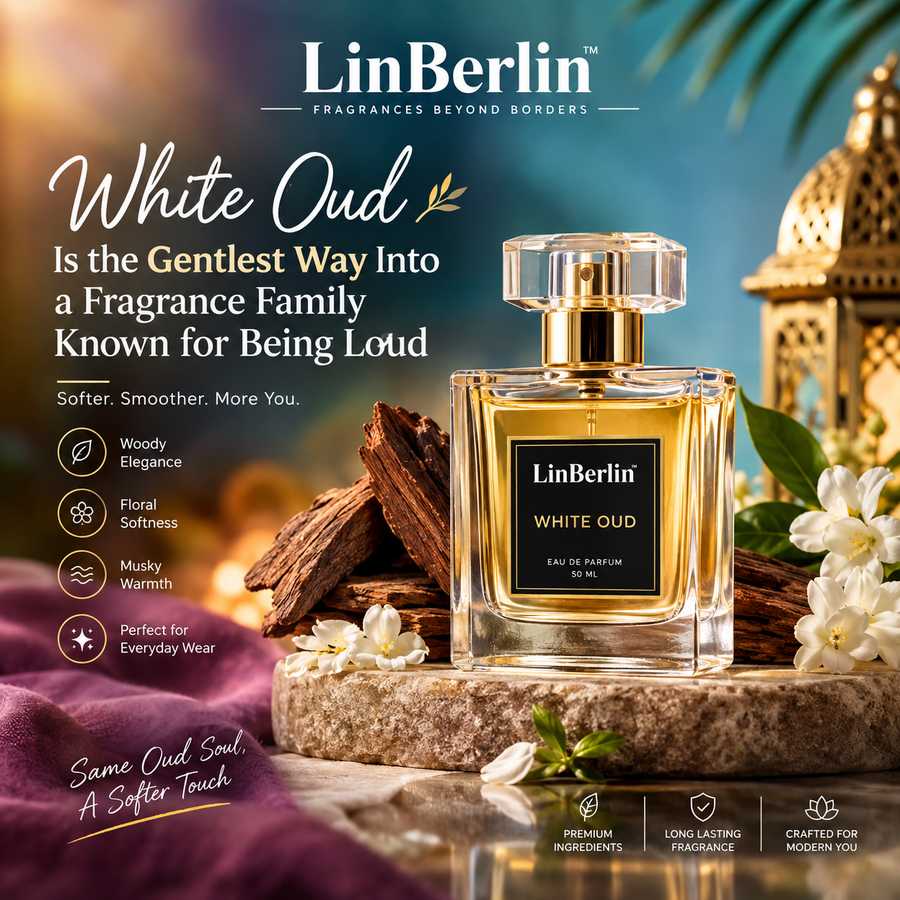
My first real conversation about oud happened at a wedding in Hyderabad, standing near a doorway where an uncle had over-applied something dark and resinous, and three people quietly stepped back without saying why. Nobody was rude about it. It just — happens. Oud has a reputation, and mostly it's earned. But that memory is exactly why white oud caught my attention years later, in a much smaller room, on a much calmer wrist. It didn't announce itself. It waited to be noticed.
That distinction matters more than most fragrance guides admit. White oud isn't a diluted version of "real" oud, and it isn't a beginner's compromise either. It's a different expression of the same wood, one that trades smoke and barnyard funk for something creamier, greener, almost milky at times. For someone who has always found traditional oud a little intimidating — the kind of scent that seems to require permission before you wear it — white oud offers an actual way in, not a watered-down substitute.
What Makes Oud "White" in the First Place
The name doesn't refer to color, at least not literally. Most white oud attars are pale to golden in the bottle, not white. What it refers to is character. Traditional dark oud is distilled from heavily resin-infected agarwood, aged and processed in ways that pull out deep, smoky, sometimes almost fecal notes that oud purists genuinely prize. White oud, by comparison, comes from lighter agarwood or is distilled and blended to emphasize the sweeter, creamier facets of the wood while dialing back the animalic intensity.
So it's still oud. The DNA is there — that woody, slightly resinous backbone doesn't disappear. But the loud parts get quieter, and what's left is something closer to sandalwood's cousin than oud's usual, unapologetic self. Enthusiasts sometimes describe it as oud that's been to finishing school. That's a bit unfair to dark oud, honestly, which has its own devoted following for good reason. But it captures the shift in tone reasonably well.
Why Skin Chemistry Changes Everything Here
This is where most buying guides stop short, and it's the part I actually care about. Attar doesn't behave the same way on every wrist, and white oud is more sensitive to skin type than people expect.
On drier skin, white oud tends to sit closer to the surface and fade faster — sometimes noticeably faster, within two or three hours instead of six or more. That's because oil-based attars rely partly on the skin's own natural lipids to anchor and slow-release the fragrance molecules. Dry skin has less of that natural barrier to work with, so the scent has less to cling to. On oilier skin, the opposite happens: white oud often blooms warmer and lasts considerably longer, sometimes taking on a slightly heavier character than it did in the bottle, because sebum interacts with the wood and resin compounds and amplifies them.
Here's the thing worth saying plainly: if you have dry skin and you've tried an attar once, on unmoisturized skin, and thought it did nothing — that's not necessarily the fragrance's fault. Moisturized skin holds scent measurably longer than dry skin does, across almost every oil-based perfume category, not just attar. A thin layer of an unscented or lightly scented barrier cream, applied a few minutes before the attar, gives the fragrance oils something to bind to. It's a small step people skip constantly, and it changes the whole experience.
Layering Attar With Skincare Without Wrecking Either One
This is where things go wrong more often than people realize. Attar and active skincare ingredients don't always coexist peacefully, and the mistakes are usually invisible until later in the day.
Retinoids and strong exfoliating acids — glycolic, salicylic, that whole family — thin the outer layer of skin and make it more reactive. Applying a concentrated oud or floral attar directly over freshly treated skin can trigger irritation that has nothing to do with an actual fragrance allergy. It just looks like one. People assume they're sensitive to oud when really their skin barrier was compromised by something else entirely, and the attar simply lit the match. The fix is straightforward, if a little inconvenient: apply actives at night, attar in the morning, or leave a buffer of at least twenty to thirty minutes and a moisturizer between the two.
Vitamin C serums are a slightly different story — less about irritation, more about scent distortion. Some vitamin C formulations oxidize over the day and develop a faint metallic or sour edge, and layering a warm, resinous attar like white oud on top can create an odd combination that neither ingredient intended. Not dangerous. Just unpleasant, and easily avoided by applying attar to clothing or a pulse point that hasn't been treated with serum, rather than directly over it.
Reading the Different Faces of White Oud
Not every white oud attar is built the same, and this is where enthusiasts start to have real preferences. Some lean creamy and almost lactonic, closer to sandalwood with a whisper of smoke behind it. Others keep more of the traditional oud sharpness intact, just softened rather than eliminated. Realistically, the "best" one depends entirely on what you're trying to move away from or toward.
LinBerlin's own white oud attar, Noor e Oud, sits closer to the creamy end of that spectrum — the kind of profile that reads as elegant rather than assertive, and works surprisingly well for people who've never worn oud in any form before. It doesn't try to prove anything on first spray, which, for a category this often associated with excess, is a deliberate and slightly unusual choice.
People who already enjoy floral attars often gravitate toward white oud faster than they expect. If white oud meeting rose in the quiet hours sounds appealing, that combination tends to soften the wood even further, adding a petal-soft sweetness that keeps the whole thing approachable. And for anyone drawn to warmth over freshness, exploring how amber settles into white oud shows a different, cozier direction entirely — less green, more golden.
Common Mistakes People Make With White Oud
Overapplication is the obvious one, but it's not the only one. A few others worth flagging:
Applying attar right after a hot shower, while skin is still slightly damp and pores are open, can make even a subtle scent feel overwhelming within the first ten minutes — it settles unpredictably and often smells stronger than intended before it calms down. Waiting five or ten minutes for skin to fully cool and dry first solves this almost completely.
Storing the bottle near a bathroom mirror or windowsill is another quiet mistake. Heat and light degrade the top and heart notes of natural attars faster than most people assume, sometimes within a few months, leaving only the heavier base notes behind. A cool, dark drawer does far more to preserve the original character than people give it credit for.
And rubbing the wrists together after application — that old habit — actually breaks down some of the more delicate aromatic molecules through friction and heat, flattening the scent's development. Dabbing, not rubbing, preserves the way it's meant to unfold.
When to Be Cautious
A few honest caveats belong here, because pretending attar is universally safe for everyone would be dishonest. Natural attars, including white oud blends, can contain trace botanical or resin compounds that trigger reactions in people with known fragrance sensitivities or certain skin conditions like eczema or rosacea — a patch test on the inner forearm, left for twenty-four hours before wider use, is a reasonable precaution rather than an overcautious one. Pregnant readers, particularly in the first trimester, often report a heightened or altered sense of smell, and some choose to avoid concentrated fragrance oils during that window simply for comfort, not because of documented risk — this is worth mentioning to a doctor if there's any underlying concern. And anyone currently using strong prescription retinoids for a diagnosed skin condition should probably check with a dermatologist before combining daily attar wear with that treatment, just to rule out anything specific to their situation.
A Quieter Way Into Oud
What white oud ultimately offers isn't a shortcut around oud's complexity — it's a different entry point into it. Someone who found rose and white oud drifting together genuinely surprising might, months later, find themselves curious about darker, smokier expressions they once avoided outright. That's how most people's relationship with oud actually develops. Slowly, and usually starting somewhere gentler than the version that made everyone at that wedding take a step back.
If there's one practical takeaway worth carrying forward, it's this: moisturized skin, a light hand, patient storage, and a little awareness of what's already on your skin before the attar goes on. Everything else is preference — and with white oud, the preferences are unusually forgiving.