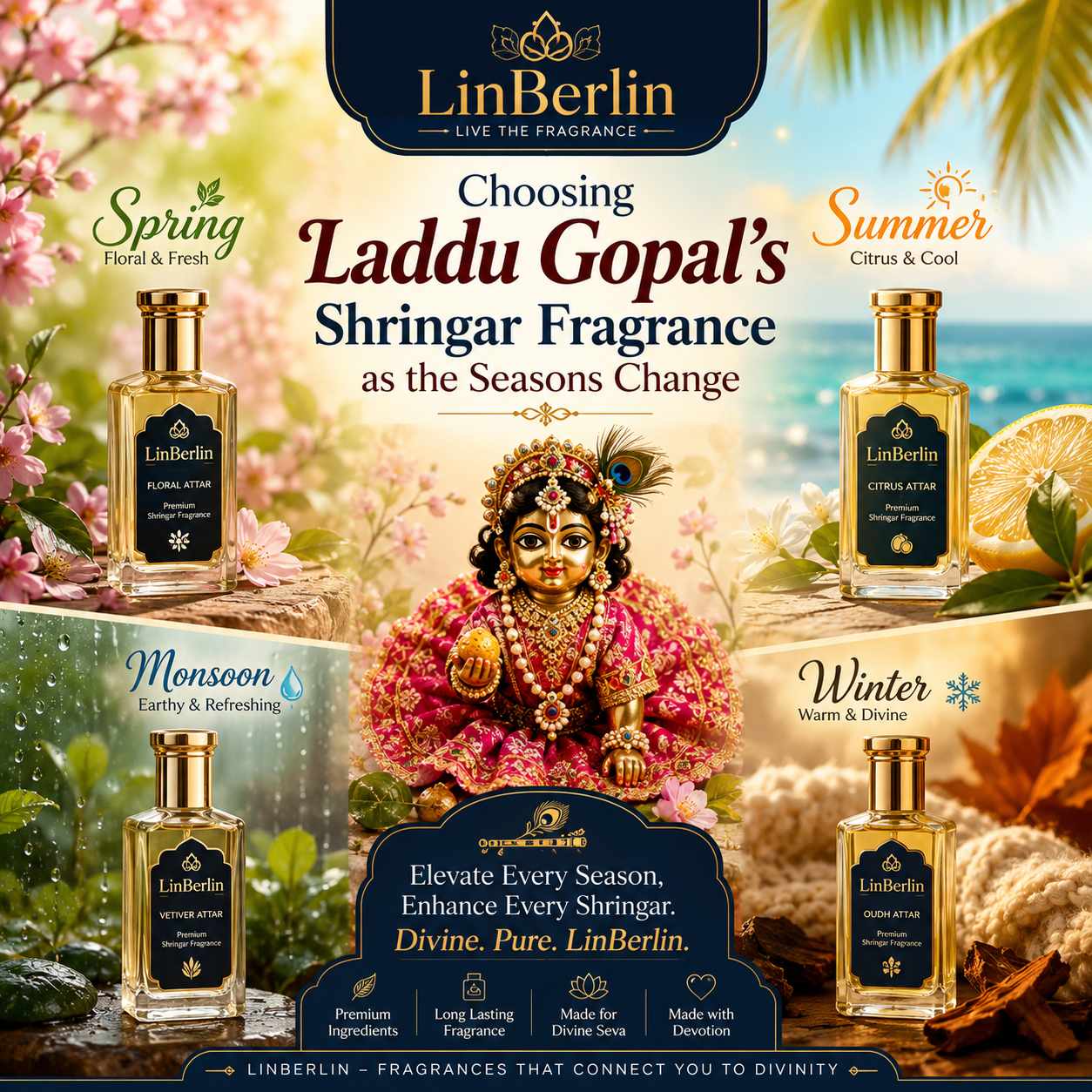
There is a particular moment every seer or sevak knows well — the instant just after the malmal or silk vastra is changed, before the attar touches the murti, when the room still smells like nothing in particular. Whatever gets chosen next decides how Kanha Ji's presence fills that space for the rest of the day. Most households never think about this moment as a design choice. It is one.
Shringar, at its heart, is an act of dressing someone you love in the best of what you have. Fragrance is not decoration on top of that act — it is part of the act itself. And like every other element of shringar, from the color of the pichwai to the weight of the ornaments, the fragrance should shift as the year turns. What smells devotional and grounding in a Delhi winter can feel almost suffocating by the time June arrives. Few families adjust for this. Fewer still know why they should.
Why Seasonal Attar Selection Actually Matters for Thakur Ji's Seva
Attar is not synthetic perfume. It does not sit flat on a surface waiting to be smelled — it responds to heat, humidity, airflow, and the material it is placed on. A drop of a heavy oud or deep musk on a summer afternoon in a closed puja room can turn cloying within an hour, changing the character of the whole space. The same drop in December, when the air is drier and cooler, unfolds slowly and holds its shape for the entire darshan window. This is not superstition. It is basic perfumery chemistry, the same principle that governs how any oil-based fragrance behaves on skin, fabric, or stone.
Realistically, most families choose attar the way they choose incense — by habit, or by whatever the local attar seller happens to be selling that week. There's nothing wrong with that, exactly. But it does mean a lot of households are unknowingly fighting the season instead of working with it.
Reading the Season Before Reaching for the Bottle
Summer calls for restraint. Heat amplifies scent — a fact anyone who has walked past a flower market at noon in May already understands instinctively. Attars built around khus, rose, or light florals work better here than anything resinous, because they cool the sensory experience rather than adding weight to it. A rose or khus-based shringar attar applied lightly to the vastra, rather than directly saturating the fabric, tends to carry beautifully through an afternoon aarti without becoming overwhelming by evening.
Monsoon is trickier than people expect. Humidity does two things at once: it slows evaporation, so scent lingers longer, but it also makes damp fabric hold moisture and, occasionally, faint mustiness if the vastra isn't aired properly between changes. Lighter florals or subtle green notes work well here — something that can cut through humidity without turning heavy. This is also the season where jasmine attar's after-dark transformation becomes genuinely relevant, since evening aartis during monsoon often bring out a rounder, more indolic side of jasmine that many people never notice during daylight hours.
Winter is where the deeper, more resinous, more grounded attars finally get to breathe. Cold air slows scent diffusion, so a fragrance that felt overpowering in April can feel exactly right, even restrained, in January. This is the season for musk-forward compositions and warmer oud blends — the kind that unfold slowly rather than announcing themselves. If your household leans toward deep, mysterious musk-based attars, winter is genuinely the only season where they can be used generously without dominating the room.
Choosing Fragrance for Different Kinds of Shringar Occasions
Not every day is the same, and treating every darshan identically is probably the most common mistake in home seva. A quiet Tuesday morning shringar doesn't need the same fragrance weight as Janmashtami or a festival day surrounded by guests, more flowers, and a longer puja duration.
For special occasions — festivals, birthdays, any day where the shringar itself is more elaborate — a dedicated Raj Shringar attar for Laddu Gopal earns its place. It's composed specifically to hold up through longer ceremonies, larger gatherings, and the extra warmth that comes from more people, more diyas, more heat in the room. For an ordinary morning routine, something lighter and quieter usually suits better — you don't need the full occasion fragrance for a five-minute aarti before work.
There's also the question of how much to use, which honestly gets overlooked more than the fragrance choice itself. One or two drops on the vastra, applied with a clean finger or a small cotton swab, is almost always enough. Attar is concentrated — more so than most people expect coming from a spray-perfume background — and oversaturating the fabric doesn't make the shringar more devotional. It just means the fragrance turns sharp faster and fades unevenly, sometimes leaving a slightly oily patch on delicate silk.
What to Watch For — Fabric, Metal, and a Few Honest Cautions
Here's the thing nobody tells new sevaks: not every attar is safe for every material. Deep, oil-rich compositions can leave faint stains on very pale or very delicate silks if applied directly and left undiluted for too long — a small dab on an inconspicuous edge, tested first, avoids this entirely. Metal ornaments and jewelry, especially anything with gold plating or delicate stonework, do better with fragrance applied to the vastra rather than directly on the ornament itself, since some oils can dull plating over repeated contact.
And if there are young children or elderly family members in the house who are sensitive to strong scent — some people genuinely do get headaches from concentrated musk or oud in a small, closed puja room — it's worth choosing something lighter or improving ventilation rather than pushing through with a heavier attar out of habit. Devotion doesn't require discomfort.
One honest caveat, since this deserves saying plainly: attar quality varies enormously across the market, and not every bottle labeled "pure" or "natural" actually is. Synthetic dilution is common, and it's not always obvious from smell alone, especially to someone still building familiarity with how real attar behaves versus how synthetic fragrance oil behaves. Sourcing from a maker who's transparent about ingredients matters more here than in almost any other fragrance category, precisely because this scent is going onto something sacred, not just onto a wrist.
Building a Small Seasonal Collection Instead of One Bottle for the Whole Year
Most families don't need six different attars. But having even two or three — something light and floral for summer and monsoon, something deeper for winter, and perhaps one dedicated festive blend — changes the entire texture of the year's seva. It stops being one flat, unchanging note and starts becoming something that moves with the calendar, the way the vastra colors already do, the way the bhog offerings already do.
Some households build this out further, pairing seasonal shringar attar choices with broader guidance on how attar fits into the wider world of Kanha Ji's daily shringar, treating fragrance as one part of a larger, considered practice rather than an afterthought picked up at the last minute before aarti.
A Simple Way to Start
None of this needs to be complicated. Start with one seasonal swap — maybe just moving to something lighter for the next few months of heat — and notice how the room feels different by evening. Pay attention to how long the scent actually lasts, how it changes between morning and night aarti, whether it sits well on the vastra without staining. That kind of noticing, more than any bottle or brand, is what turns shringar from a routine into something genuinely attentive. The fragrance changes. The devotion, presumably, does not.