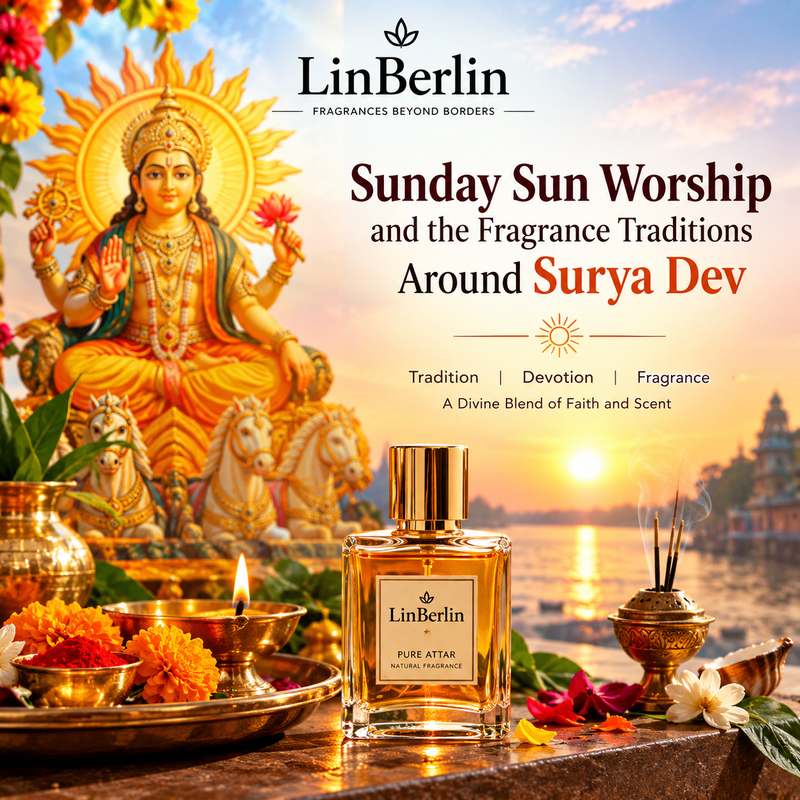
There is a specific kind of light that falls into North Indian courtyards on a winter Sunday morning — low, orange, almost solid enough to touch — and it is this light, more than any scripture, that first taught people to associate the sun with fragrance. Long before anyone wrote down the rules of Surya puja, someone noticed that certain flowers only opened fully in that early light, and that their scent seemed to carry further on a clear Sunday than on any other day of the week. Whether that was chemistry or devotion hardly mattered to them. It became ritual.
Why Sunday Belongs to Surya Dev
In the Hindu calendar, each day carries the imprint of a planetary deity, and Sunday — Ravivar — is set aside for Surya, the sun god who represents vitality, clarity, and the kind of steady discipline that doesn't announce itself loudly. Surya worship isn't the most theatrical of Hindu devotional practices. There are no elaborate processions in most households, no dramatic midnight rituals. It's quieter than that. A person rises before sunrise, offers water facing east, and often lights incense or applies a few drops of attar before beginning the day's prayers. The simplicity is the point.
What's easy to miss, if you've only read about Surya puja rather than practiced it, is how central fragrance actually is to the whole exercise. Scent in Hindu worship isn't decorative — it's structural. It marks the boundary between ordinary time and ritual time, and for Surya specifically, the fragrance chosen tends to lean bright, floral, and slightly sharp, echoing the quality of sunlight itself rather than the heavier, smokier notes reserved for evening deities.
The Flowers the Sun God Prefers
Ask a priest at a Surya temple which flowers matter most, and you'll almost always hear the same few names: red hibiscus, marigold, and — most tellingly — the surya pushp, sometimes called the sunflower or the sun-turning flower in regional tradition. It's not really about the flower's color, though red and gold dominate. It's about behavior. These are flowers that track the sun, or bloom in its direct heat, and that botanical loyalty made them the natural template for the fragrance oils used in Surya devotion.
This is where the practical side of attar-making becomes genuinely interesting. Capturing the scent of a flower that only fully releases its aroma under strong daylight is not a straightforward distillation job. The Surya Pushp attar for Surya Dev puja is built around exactly this challenge — an oil that tries to hold onto a brightness most florals lose the moment they're processed. It's not a perfect science, and honestly, no natural attar maker will tell you it is. But when it's done well, you get something that smells less like a bouquet and more like warmth itself, if warmth had a scent.
Realistically, most people who buy this attar aren't fragrance connoisseurs. They're householders following a practice their grandmother followed, and their grandmother before her. The continuity matters more than the perfection of the note.
Reading the Skin Before the Ritual
Here's the thing nobody tells you when you're handed a bottle of temple attar for the first time: skin changes everything about how a fragrance performs, and Surya pushp attar is no exception. On well-moisturised skin — skin with an intact lipid barrier — the oil-based fragrance molecules bind and release slowly, which is why attar applied after a light, unscented moisturiser tends to hold its character for six to eight hours instead of fading within two. Dry or under-hydrated skin, on the other hand, absorbs the oil almost too quickly. The scent blooms fast, peaks early, and disappears — which is fine for a fifteen-minute puja but frustrating if you wanted the fragrance to carry through the morning. Oily skin behaves differently again. It tends to amplify the top notes and mute the deeper, more honeyed undertones that floral attars often develop after twenty minutes or so on the skin. None of this is a flaw in the attar. It's just biology doing what biology does.
A mistake I see constantly, and this applies well beyond Surya worship, is layering attar directly over an active skincare product — retinol, vitamin C serums, or strong exfoliating acids. The combination can irritate already-sensitised skin, sometimes producing redness or a stinging sensation that has nothing to do with the attar itself and everything to do with a compromised skin barrier reacting to any additional ingredient load. If your morning routine includes actives, apply attar to clothing, a cotton wick, or the inner wrist well below where the active product was used, rather than directly over it.
Who Should Be Cautious
Natural doesn't automatically mean risk-free, and it would be dishonest to write about attar for devotional use without saying so plainly. People with known fragrance allergies — even to natural botanicals — should patch-test any new attar on the inner forearm and wait twenty-four hours before applying it near the face or wrists for a full puja session. Pregnant individuals are often advised by their doctors to avoid certain concentrated essential oils, particularly in the first trimester, so checking with a physician before daily attar use during pregnancy is sensible rather than excessive caution. And for anyone with eczema-prone or currently broken skin, even a naturally sourced oil can sting or worsen irritation, so applying to clothing instead of skin is the safer route on flare-up days.
None of this is meant to discourage the practice. It's meant to make it sustainable — a ritual you can keep for years without it ever causing you harm.
Fragrance as a Language Across Traditions
What strikes me most, having spent years around natural perfumery, is how universally fragrance gets treated as a bridge between the human and the divine — not just in Hindu practice. The same instinct shows up in Sufi devotional traditions, where itr has been used for centuries as a way of marking a moment as sacred rather than ordinary. Different theology, same underlying idea: scent as a signal to the self that something different is beginning. Inside Hindu worship alone, the differences between deities are equally telling. Surya's fragrances stay bright and floral. But Shani Dev, worshipped on Saturdays and associated with discipline and restraint rather than radiance, calls for something heavier and more grounding — which is why the fragrance profile shifts so noticeably, a shift explained well in this piece on why heavier fragrance suits Shani Dev's Saturday worship. It's a reminder that in this tradition, scent isn't chosen by aesthetic preference alone — it's chosen to match the character of what's being honoured.
Choosing the Right Attar for Your Own Practice
For households that observe multiple deities across the week — Surya on Sunday, Radha Rani on other days, general daily pooja in between — keeping the fragrance distinct for each occasion isn't just tradition for tradition's sake. It helps mark time. A resource like matching fragrance to your specific devotional practice is worth reading if you're building out a small collection rather than relying on a single all-purpose scent. And if you're newer to attar altogether and want the fundamentals before making any purchase, a broader guide to attar for pooja and devotional worship covers the basics more patiently than this piece has room for.
A Small, Honest Caveat
One limitation worth naming: no attar, however carefully distilled, will smell exactly like a living sunflower in full bloom. Natural perfumery is an approximation, an interpretation built from what can actually be extracted and preserved — not a perfect copy of nature. What LinBerlin aims for isn't botanical exactness. It's the feeling the flower gives you, translated into something that survives in a small glass bottle for years.
A Closing Thought for Sunday Mornings
So the next time Sunday arrives and you reach for that small bottle before facing east, know that you're taking part in something older than the bottle itself — older, probably, than the house you're standing in. The fragrance isn't the ritual. But it's the part of the ritual you carry with you long after the prayer is finished, on your wrist, in your clothes, in the quiet minutes before the rest of the day begins.