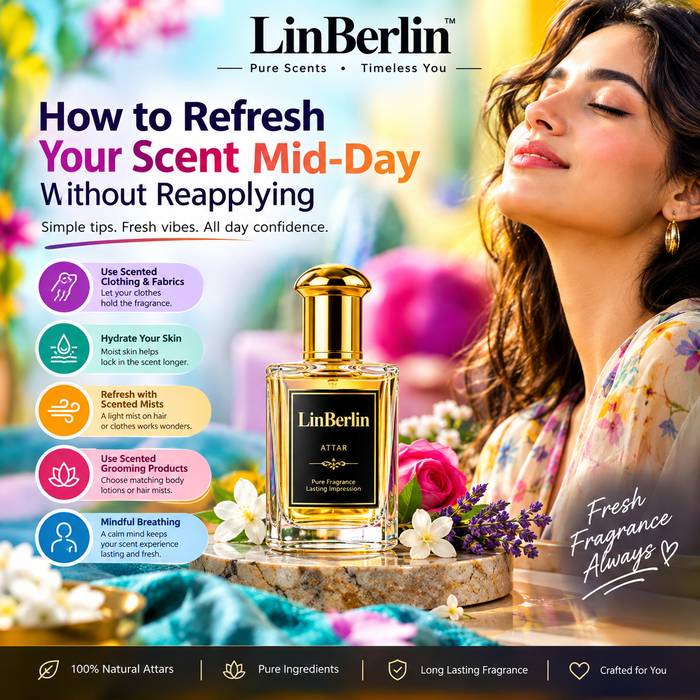
Around mid-afternoon you press your wrist to your nose, catch almost nothing, and decide the scent has quit on you. Usually it hasn't. Your nose has just stopped reporting it.
That small fact changes the whole problem. Olfactory fatigue (the brain tuning out a smell it has been handed for hours) is real, and a surprising share of mid-day reapplying is only compensation for a nose that got bored. So before you reach for the bottle, there is a quieter set of moves worth trying. They cost nothing, they don't stack a second dose onto skin that has already had enough, and most take under a minute.
What follows is the order I would actually use them in. Check first. Warm things up. Give the oil something to hold on to. And only then, if the scent really is gone, a very small dab.
Check whether it has really faded
Leave the room you have been sitting in all day. Go outside, or at least into a corridor, and give it a couple of minutes — longer if you can stand it — so your nose resets. Then smell the inside of your elbow, or the collar of your shirt, rather than the wrist you have been sniffing since lunch.
You will often find the scent is there, just softer, and sitting closer to the skin than it was at nine in the morning. That is not failure. That is a normal dry-down, especially with oil-based perfumery, which tends to hum rather than shout (attar was never designed to fill a lift).
If you still smell nothing at all, move on. If you do smell something, you may be done already.
Warm it, don't scrub it
Attar is oil, and oil lets go of its scent when it is warm. A fragrance that feels flat in an air-conditioned office can often be coaxed back with warmth alone. Cup a warm palm over your inner wrist or the side of your neck and hold it there for about ten seconds. Then breathe.
Some people will tell you never to rub your wrists together because it "crushes" the top notes. Realistically, the evidence for that is thin. I'd still press rather than rub, mostly because friction irritates skin that has been under sleeves and fabric all day, and pressing works just as well.
- Get away from the cold first: a vent, a window, a chilly corridor. Cool skin holds scent quietly, and a minute somewhere warmer does more than you would expect.
- Press warm palms or fingertips to the pulse points (inner wrists, behind the ears, the hollow of the throat) for ten seconds each.
- Breathe in.
It works. Most of the time, anyway.
Give the oil something to hold on to
Moisturised skin holds fragrance longer than dry skin, and the reason is simple: dry skin drinks oil, and the scent goes with it. If your skin was properly prepared in the morning, there is usually a faint film of attar still sitting under the surface, waiting for a reason to wake up.
A thin layer of unscented balm or lotion over the pulse points gives that film something to cling to and often brings a little of it back up. Unscented is the point here. A strongly fragranced hand cream will fight with whatever you are wearing, and what you get is a muddle that smells like neither product. If you are not sure how much oil to use in the first place, it helps to read about applying attar properly in the first place, because most mid-day fading starts with the morning routine, not the afternoon.
A light mist of plain water over the skin sometimes helps too, though I have never quite pinned down why. Warmth and moisture, probably.
Plan the refresh into the morning
The best way to refresh a scent at three o'clock is to have set it up at eight. Apply within a few minutes of a shower, once your moisturiser has sunk in but before your skin dries out. Use less than you think you need on each point, and let it settle before you dress.
The material matters as well. A base with real sandalwood scent tends to cling to skin for hours and warms back up easily, which is exactly what you want from a fragrance you intend not to touch again. Cheap substitutes go flat and powdery by lunchtime. Jasmine is another case: part of why people think it vanishes is that jasmine attar sits close and rarely projects, which you can see clearly in how jasmine perfume compares to jasmine attar.
And if you like a bright, lifted feeling later in the day, don't layer more on top. Rotate instead. Wearing something fresher on warm days and something deeper on cool ones works better than doubling up, and a small citrus and jasmine rotation covers most weeks without much effort.
Your skin type changes the answer
Dry skin loses scent fastest. It needs the moisturiser step more than anyone, and it benefits from applying attar on top of a lightly oiled surface rather than bare skin.
Oily skin tends to hold fragrance well, sometimes a little too well, and it can turn a scent heavier or sweeter by afternoon (I have watched a fresh citrus attar go surprisingly warm on someone with oily skin). If that is you, skip the extra balm and rely on warmth and a break from the room.
Sensitive skin is a separate conversation, and it is in the next section.
Combination skin, which is most people, just means the wrist and the neck may behave differently. Pay attention to which one carries the scent longer and use that as your base.
When to be careful
Natural does not mean harmless. Plant oils are some of the more common causes of fragrance reactions, and it is worth being cautious in a few situations.
- If your skin is sensitive, reactive, or prone to eczema, patch test on the inner forearm and wait a full day before wearing it on pulse points. Skip anything that stings, itches, or leaves redness. Don't apply attar to broken or freshly shaved skin, ever.
- If you use retinoids, exfoliating acids, or benzoyl peroxide, your skin barrier is already working harder. Keep attar off treated areas and leave a gap between actives and scent.
- Citrus oils, especially cold-pressed ones, can make skin more sensitive to sun. If you are in strong sunlight, apply to clothing-covered areas or choose a different base.
- If you are pregnant, or have asthma or known fragrance allergies, check with your doctor before adding new essential oil products to your routine, and keep amounts small.
One more thing about clothes. Attar on fabric can leave oil marks on silk and pale cotton, so if you are tempted to refresh a scarf, test a hidden corner first.
If it really is gone
Sometimes it is. A scent that has genuinely worn off won't come back from warming and moisturising, and I'd rather say that plainly than pretend every fragrance can be revived on demand. Heat, sweat, a long day, and skin that eats oil will beat even a well-made attar.
In that case, use a pinhead-sized dab on one point only, press it in with a warm fingertip, and leave it. One dot. Adding more does not extend the day. It just makes the first hour louder.
So here is the short version to carry into tomorrow: prepare the skin in the morning, step out of the room before deciding the scent has failed, and warm and moisturise before you reapply. Most days, that is all it takes.