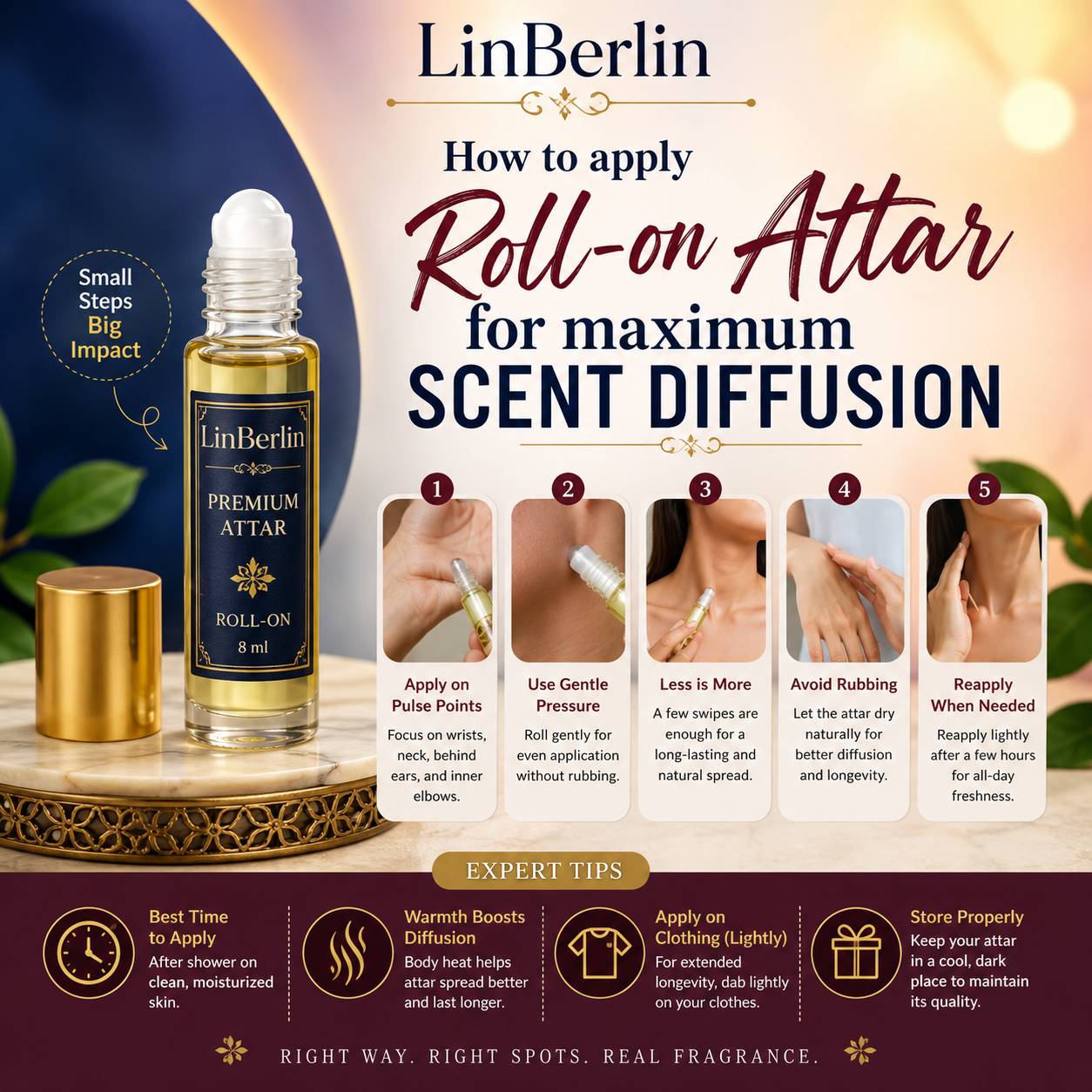
A drop of attar behaves nothing like a spray of perfume, and most people find that out the hard way — usually by dabbing it on like cologne and wondering, an hour later, why nobody noticed. Oil doesn't launch itself into the air the way alcohol does. It sits. It waits for your skin to warm it up and release it slowly, which is exactly why roll-on attar rewards patience over enthusiasm. Get the placement and the skin prep right, though, and that same quiet oil can trail behind you for the better part of a day.
Why roll-on attar diffuses differently than spray perfume
Alcohol-based perfumes are built to throw scent immediately — the alcohol evaporates fast, carrying fragrance molecules up and out into the air around you. That's the "sillage" people talk about, and it's dramatic but short-lived. Attar works on an entirely different mechanism. It's oil-based, so there's no evaporation burst. Instead, the fragrance compounds slowly diffuse as your body heat gently warms the oil sitting on your skin. So the scent builds rather than blasts. And that's not a flaw — it's the entire point of oil perfumery, a tradition that predates alcohol-based fragrance by centuries.
The tradeoff is real, though, and it's worth being honest about it: attar won't fill a room the second you walk in. What it does instead is create an intimate scent bubble — noticeable to people who lean in, who hug you, who sit close. Realistically, if you're chasing the kind of loud projection you get from a designer spray, roll-on attar will disappoint you on day one. If you understand what it's actually offering, it becomes one of the most rewarding ways to wear fragrance.
The skin prep step almost everyone skips
Here's the thing most people never get told: dry skin is the single biggest reason attar seems to vanish within an hour. Fragrance oils cling to hydrated skin cells and diffuse gradually off a moisturized surface. On dry, flaky, or under-exfoliated skin, the oil either absorbs too fast into rough patches or evaporates unevenly, and you lose both depth and duration.
A light, unscented or barely-scented moisturizer applied a few minutes before attar makes a genuine difference — not a marginal one. This matters even more in dry winter months or in air-conditioned environments, where skin loses moisture faster than you'd think. But there's a balance to strike here. Too much moisturizer, especially anything heavy with occlusive ingredients like petrolatum or dense butters, can actually smother the attar's top notes and mute the opening entirely. You want damp, supple skin — not slick, greasy skin.
If your skincare routine includes actives like retinol, vitamin C, or exfoliating acids, apply your attar afterward, and give the actives time to settle first, ideally fifteen to twenty minutes. Layering fragrance oil directly over freshly applied active ingredients can cause irritation on sensitive skin, and in some cases it alters how the scent itself develops, since active ingredients change the skin's surface chemistry. For readers building a full routine around this, our guide on applying attar correctly without wasting product covers the dosage side of this in more depth.
Where to actually roll it on
Pulse points exist for a reason — they're simply warmer than the rest of your skin, and warmth is what activates oil-based fragrance. The classic spots still work best: inner wrists, the side of the neck below the ear, behind the earlobes, and the inner elbow. Each one diffuses slightly differently.
Wrists are the most common choice, and honestly the most versatile, since you naturally bring your hands near your face throughout the day. The neck offers a steadier, more ambient release. Behind the ears is subtler still, more of a "someone standing close" note than a public statement. Chest and décolletage, if exposed, hold scent longer than almost anywhere else on the body because that skin tends to stay warm and is rarely washed as frequently as hands or wrists.
One habit to break immediately: rubbing your wrists together after application. It feels instinctive, almost ritualistic, but the friction generates heat that breaks down the fragrance's top-note molecules prematurely. Let the oil settle into skin on its own instead of speeding it along.
Hair, clothing, and the diffusion multipliers people forget
Skin isn't the only surface that holds scent. Hair, being porous and slightly textured, traps fragrance oil exceptionally well — a small roll along the ends or through a scarf tucked near the neckline can extend projection noticeably. Just avoid the scalp directly, since oil there can look greasy by midday.
Clothing fibers, particularly wool, cotton, and linen, also hold attar longer than skin does, though undiluted oil can occasionally leave a faint mark on lighter fabrics — so test on an inside seam first if you're nervous about it. A small dab on a cotton scarf or the inner collar of a jacket becomes a slow-release diffuser of sorts, working alongside your skin's own warmth throughout the day.
Layering without overwhelming yourself
Attar layers beautifully with itself — a woody base at the chest, something lighter and floral at the wrist — but layering takes restraint most beginners don't have on their first attempt. Start with one point of application. Live with it for a full day. Only then decide whether a second point adds depth or just adds noise.
People building a longer-term relationship with fragrance often develop a rhythm around this — applying at the wrist in the morning, refreshing at the neck by early afternoon, treating it almost like a small ritual rather than a single act. If that idea appeals to you, our piece on building a morning scent ritual around fragrance walks through how to structure that without it becoming a chore.
Skin type changes everything about how attar performs
Oily skin holds attar the longest, full stop — the natural oils on the skin's surface act almost like a fixative, slowing the fragrance's evaporation and extending wear by hours compared to drier skin types. But oily skin can also amplify certain base notes unpredictably, particularly heavier musks and resins, so a scent that feels balanced on a dry-skinned friend might read stronger or slightly muddier on you.
Dry skin, as mentioned, needs the moisturizing step non-negotiably. Without it, expect attar to fade within two to three hours regardless of how much you apply — and applying more isn't the fix, since excess oil on dry skin often just sits on the surface and rubs off rather than absorbing.
Combination skin sits somewhere in between and usually does best with targeted moisturizing only at the drier application points (often the neck and outer wrists), leaving naturally oilier areas alone. Sensitive or reactive skin is its own category entirely, and deserves its own section, frankly, because the stakes are different.
A caution for sensitive skin, allergies, and pregnancy
Natural doesn't automatically mean risk-free — a fact the fragrance industry doesn't always communicate clearly, and one worth stating plainly here. Attars derived from essential oils can still trigger contact dermatitis in people with sensitivities, particularly those containing citrus oils (which can cause photosensitivity in sunlight), certain florals like jasmine or ylang-ylang, or concentrated woods like oud. If you've had reactions to essential oils in skincare before, patch test any new attar on your inner forearm and wait twenty-four hours before applying it anywhere near your face or neck.
Pregnancy is another area where caution genuinely matters, not as a blanket warning but as a real consideration. Some essential oils commonly used in traditional attar blends — certain camphor-forward or emmenagogue-associated oils in particular — are generally advised against during pregnancy. If you're pregnant or breastfeeding, it's worth checking with a healthcare provider about specific ingredients rather than assuming all natural attar is automatically gentle. It usually is. But "usually" isn't the same as "always," and this is one of those cases where a five-minute conversation with a doctor beats guessing.
Making it last through the day
Attar's slow-release nature means it needs less frequent reapplication than spray perfume, but "less frequent" isn't "never." A midday touch-up at a secondary pulse point — behind the ear rather than repeating the wrist — refreshes the scent without creating an overwhelming buildup of layered notes. This is especially relevant for anyone trying to carry a fragrance through long meetings, travel days, or back-to-back commitments. Our guide on making fragrance last through a full workday goes deeper into timing reapplication without oversaturating your scent.
Storage matters here too, though it's easy to overlook. Attar kept in direct sunlight or heat degrades faster than most people expect, and a degraded oil simply won't diffuse the way a fresh one does — no amount of correct application technique fixes an attar that's already gone slightly stale in its bottle.
Common mistakes worth naming
Applying too much is probably the most frequent misstep — attar is concentrated, and a single roll per pulse point genuinely does the job. More product doesn't mean more diffusion; it often just means a scent that feels heavy up close and doesn't actually travel any further. Rubbing wrists together, already mentioned, remains a stubborn habit even among people who know better. And applying attar to bare, unmoisturized skin in winter is a near-guaranteed way to feel let down by a product that's actually performing exactly as it should — the skin just isn't set up to hold it.
One more thing, and this one's less about technique and more about expectation: attar's sillage is meant to be discovered, not announced. If you're used to spray perfume's immediate room-filling presence, the shift takes some adjustment. Give it a week of wearing before deciding whether it's working for you. For a deeper look at calibrating exactly how much presence you want to leave behind, the art of leaving the right amount of scent trail is worth reading alongside this guide, and so is our piece on wearing attar for a well-balanced scent trail, which looks at the same question from the wearer's side rather than the observer's.
The takeaway
Roll-on attar diffusion comes down to three things working together: warm, moisturized skin as the base, correct placement at your body's natural heat points, and restraint in how much you apply. Get those three right and the oil does the rest on its own — slowly, quietly, and for far longer than most people expect from a product that never announces itself the way a spray does. It's a different kind of fragrance experience, built for people who don't mind that someone has to lean in a little to notice.