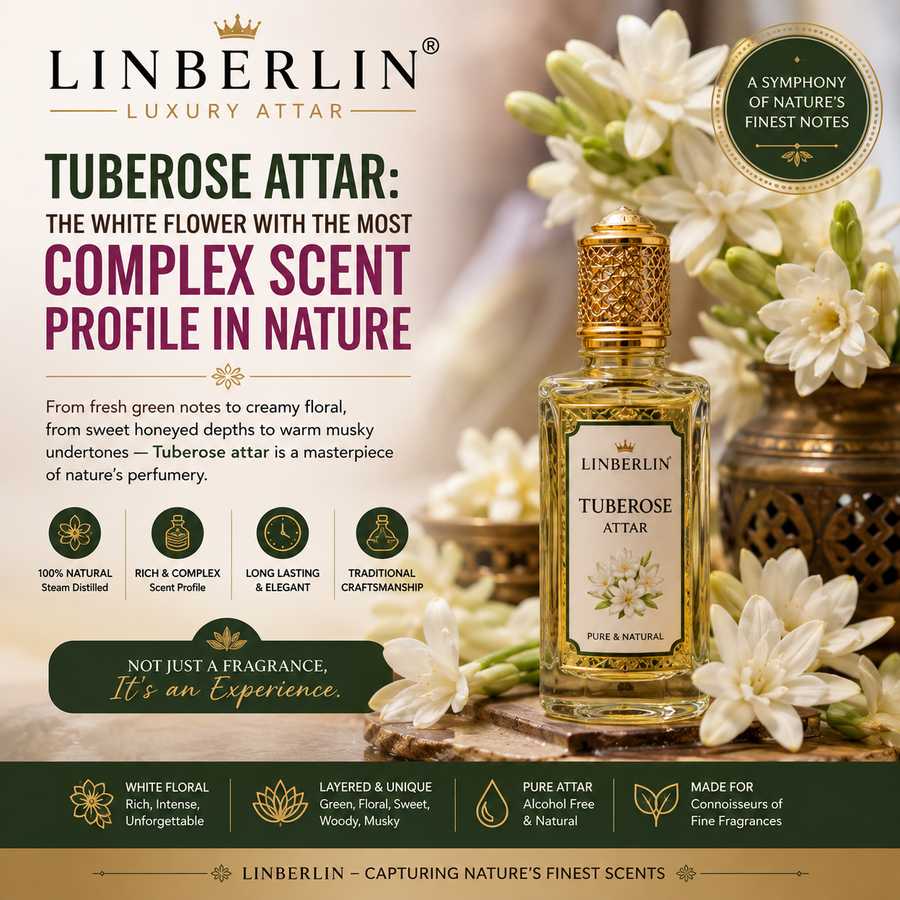
Perfumers have a complicated relationship with tuberose. Some treat it with genuine reverence — Grasse's old houses used to call it "the mistress flower," partly for how demanding it is to work with, partly for how it dominates whatever it's blended into if you're not careful. Others avoid it almost entirely, because a poorly balanced tuberose composition can tip from lush and creamy into something closer to funeral flowers within a single wear. There's no other white flower in perfumery that inspires quite this much caution and quite this much devotion at the same time.
That tension is really the whole story of tuberose. It isn't a simple, one-note white floral the way jasmine or gardenia sometimes get treated in casual fragrance writing. It's a genuinely layered material — creamy, green, faintly medicinal, sometimes rubbery, occasionally almost minty depending on extraction and dilution — and understanding why takes a bit of actual botany, not just marketing language about "luxurious white petals."
Why Tuberose Smells the Way It Does
Tuberose flowers don't release their full scent compound immediately when picked, unlike rose, which is why traditional attar extraction takes real patience with this flower. The plant continues producing aromatic compounds after harvest, meaning the scent profile actually shifts and deepens during the early stages of processing rather than being fixed the moment the flower leaves the field. This is part of why tuberose attar, done properly, has that layered, almost narrative quality — it's not capturing one static moment of the flower, it's capturing a small window of ongoing chemical change.
The molecule primarily responsible for tuberose's creamy character is methyl benzoate, alongside a compound called benzyl salicylate that contributes some of the greener, almost balsamic undertone. But — and this is where a lot of simplified explanations fall short — tuberose also contains trace amounts of indole, the same compound responsible for jasmine's slightly animalic edge. In small amounts, indole adds depth and realism. In excess, it's what pushes a white floral into that "too much" territory people sometimes describe as smelling almost like decay. Getting that balance right in extraction is, honestly, most of what separates a genuinely fine tuberose attar from a flat, one-dimensional one.
The Extraction Problem That Makes Tuberose Genuinely Rare
Here's something most fragrance content skips over entirely: tuberose doesn't yield much usable oil relative to how much plant material goes in. Rose, by comparison, is already known as a demanding crop — but tuberose asks for even more raw flower per gram of finished oil, partly because the flower's water content is high and partly because the compounds responsible for its signature scent don't extract as readily as rose's do.
This is why authentic tuberose attar tends to sit at a noticeably higher price point than most other florals, and why a lot of what's sold as "tuberose" on the mass market is actually a synthetic reconstruction built from isolated aroma chemicals rather than real flower extraction. Not that synthetic reconstructions are inherently bad — some are genuinely well-made — but they smell different. Cleaner, more one-directional, missing that slight unpredictability real tuberose has as it develops on skin or fabric across a few hours.
How Tuberose Compares to Other White Florals in Perfumery
People new to attar often lump tuberose in with jasmine as "similar white flowers," and that's — well, it's not quite right. Jasmine, particularly jasmine sambac attar, long considered a royal flower in Indian perfumery tradition, tends to read as sweeter and more immediately floral from the first moment of application. Tuberose takes longer to reveal itself and carries more textural complexity once it does — that faint rubbery-green note underneath the cream is something jasmine simply doesn't have. If jasmine is generous and open from the start, tuberose is more of a slow reveal, and some wearers genuinely prefer one approach over the other depending on how much patience they want a fragrance to demand of them.
Skin, Sensitivity, and Where Caution Actually Belongs
White florals as a category, tuberose included, sit among the more commonly flagged materials for skin sensitivity in fragrance — largely because of that same indole content and a handful of related aromatic compounds that can trigger mild irritation on compromised or reactive skin. This is exactly why LinBerlin attars, tuberose included, are formulated for fabric application rather than sustained direct skin contact. You get the full development of the scent without the same exposure risk, and fabric actually holds onto tuberose's heavier aromatic molecules for longer than skin does anyway, since skin's natural oils and sweat interact with and gradually break down some of those compounds faster than fibre does.
If you do want to test it closer to the skin, the safer route is a small patch on the inner forearm, worn for a full day away from any freshly applied skincare actives — retinol, strong acids, anything that's already thinned the skin barrier that day isn't the moment to introduce a new floral attar directly onto it. And if you're pregnant, or know your skin reacts strongly to concentrated florals generally, easing in with fabric application only, kept at a slight distance from the face, is the more sensible starting point rather than diving straight into direct skin wear.
How Tuberose Sits Alongside Rose in Indian Attar Tradition
Rose has always held the dominant position in Indian attar-making — Kannauj's reputation as a centre for rose extraction goes back centuries, and for good reason, given how Kannauj continues producing some of the finest rose oil in the world using traditional deg-bhapka distillation methods passed down through generations. Tuberose has never quite reached that same cultural centrality, but it's held a consistent, quieter place — particularly in wedding and festival garlands across North India, where its heavy, lingering scent suits celebratory, crowded settings in a way lighter florals simply don't project through.
A well-made rose attar and a tuberose attar make an interesting comparison side by side. Rose is more universally familiar, easier to place, and works across more moods and occasions. The Attar of Roses, Gul Nishan, is a good reference point for that classical, unmistakably "rose" character — bright, romantic, immediately recognisable even to someone with no fragrance background at all. Tuberose asks more of the wearer and gives back something less immediately obvious but arguably richer once you've spent enough time with it to notice the layers.
For those drawn specifically to how rose and oud interact rather than rose on its own, the rose oud attar, Oud e Gulab, offers a useful comparison point too — where rose gets pulled into a deeper, smokier register through oud rather than staying purely floral, which is honestly a closer structural cousin to how tuberose behaves than pure rose is, both of them being florals that develop real weight and complexity as they settle rather than staying flat throughout the wear.
What Enthusiasts Should Actually Look For in Tuberose Attar
A genuinely good tuberose attar shouldn't smell aggressively sweet on first application — that's often a sign of heavy synthetic reinforcement rather than real extraction. What you want instead is that slightly green, almost waxy opening that gradually warms into cream over the first half hour or so. If a tuberose attar smells identical at minute one and minute sixty, that's usually a sign there's not much real flower material behind it.
The truth is, tuberose isn't for everyone, and pretending otherwise would be dishonest marketing rather than genuine fragrance guidance. Some noses find its richness overwhelming regardless of how well it's balanced, and that's a legitimate reaction, not a failure to "appreciate" the material. But for enthusiasts who've already spent time with rose, jasmine, and the more familiar florals and are looking for something with more narrative complexity — something that actually changes character across a wear rather than sitting flat — tuberose is worth the patience it demands.