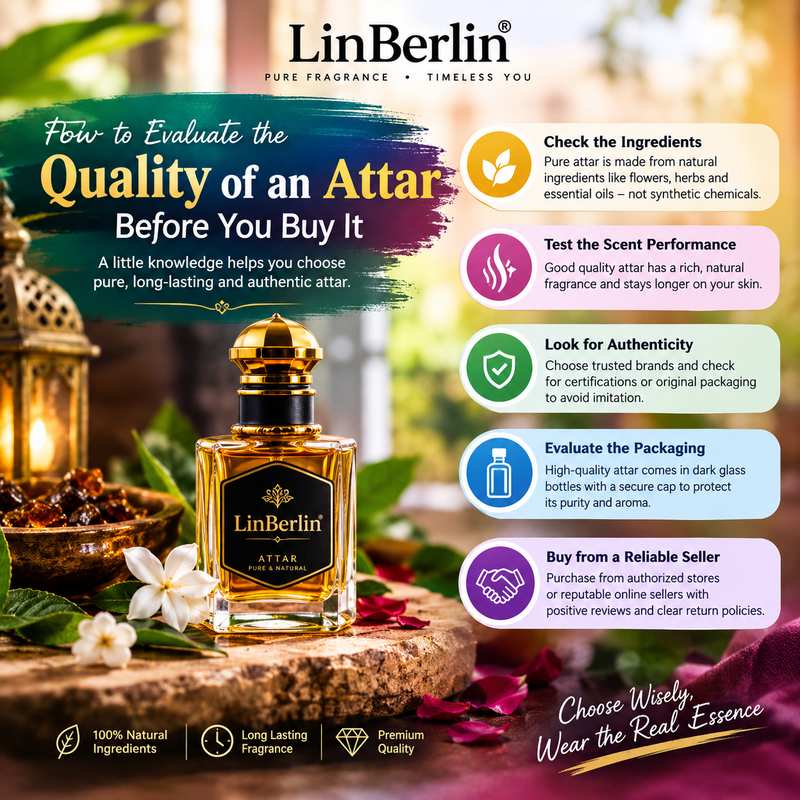
My grandmother could tell you where an attar was made just by rubbing a drop between her wrists and waiting. Not smelling it right away — waiting. She always said the first ten minutes tell you nothing. It's what happens after, once the oil warms into skin, that separates something honest from something dressed up to look expensive. I think about that a lot now, years into writing about fragrance for a living, because most buying advice online skips straight past the part that actually matters.
So this isn't going to be a checklist of things to sniff for in a shop. It's going to be closer to what she taught me, updated for a world where you're often buying attar without ever holding the bottle first.
Start with what the label is actually telling you
Before you even open a bottle, the packaging and description are doing a lot of quiet work — some of it honest, some of it not. Terms like "pure," "natural," and "concentrated" get used loosely across the industry, and not every brand means the same thing by them. If you want to actually understand what you're paying for, it helps to know how to interpret concentration percentages, note breakdowns, and origin claims on a fragrance label before you trust any of it at face value. A label that's vague about origin — just "Middle Eastern oud," no country, no distillation method — is telling you something too, even if it's not saying it directly.
And origin matters more with attar than with alcohol-based perfume, because so much of the character comes from raw materials that vary wildly by region, harvest, and even the individual tree or flower batch.
The skin test tells you more than the bottle ever will
Here's the thing — attar behaves completely differently on skin than it does in the air or on a paper strip. This is the part most buying guides get wrong, or skip entirely, because it requires actual skin contact and most online shopping doesn't allow for that.
What I've noticed, working with fragrance on real skin for years, is that dry skin burns through an attar's opening notes faster and never quite lets the base settle in the way it should. Oily skin, on the other hand, holds onto scent longer but can sometimes muddy the top notes, blending them into the base sooner than the perfumer intended. If your skin runs dry — especially in winter, or if you use retinoids or exfoliating acids regularly — a quality attar should still smell rich past the two-hour mark. If it's thin and gone by then, that's not your skin failing you. That's often a sign of dilution, or an oil cut with a carrier base heavier than the fragrance compound itself.
Moisturized skin holds scent measurably longer than dry, compromised skin, largely because fragrance molecules bind to lipids and evaporate more slowly from a hydrated surface. This is basic skincare-meets-perfumery knowledge, but barely anyone selling attar mentions it. A well-made oud or amber attar applied to bare, dry skin can smell like a different product entirely compared to the same drop applied after a light, unscented moisturizer. So before you judge a sample as "weak," ask whether your skin gave it a fair shot.
Texture and color say more than you'd expect
A genuine, well-aged attar usually has some viscosity to it — not syrupy, but not thin and watery either. Thin, pale attars that pour like water are frequently synthetic-heavy or heavily diluted with a carrier oil, even when marketed as pure. Color is trickier to judge because natural variation between batches is normal (this is actually a good sign — it means nothing's been standardized with dye), but an attar that's suspiciously bright or uniformly one shade across every bottle a brand sells is worth a second look.
Realistically, you can't judge quality by color alone, and any guide telling you otherwise is oversimplifying. It's one data point among several, not a verdict.
How the fragrance evolves over time
Cheap or artificially extended attars tend to smell almost identical from the first minute to the last — flat, unchanging, a little one-note. A well-constructed attar moves. It opens with something bright or sharp, settles into its heart over the next half hour or so, then rests in a warmer, deeper base that can linger for hours. This layered movement is part of what's known as the 50-30-20 structure that governs how top, heart, and base notes are balanced in quality perfumery, and it applies to oil-based attars just as much as it does to spray perfumes, even though the timing and intensity shift because there's no alcohol pushing the scent outward.
Amber and oud blends are a good test case here. A properly built amber-oud attar doesn't announce itself loudly the moment you apply it — it builds. If you want to understand what that slow unfolding is supposed to feel like, it's worth reading about how amber and oud interact in a well-composed blend, staying warm and unhurried rather than shouting for attention. If your amber oud smells identical at minute two and minute two-hundred, something's off with either the sourcing or the ratio.
Citrus-forward attars are the exception to almost everything above, and worth mentioning separately. Citrus notes are volatile by nature — they fade fast even in the best formulations, and no amount of skill changes that basic chemistry. But there are ways to work with that instead of expecting something citrus attars were never built to do, and layering techniques exist specifically to help citrus attar last longer on skin without changing its character.
Know what you're actually comparing it to
A lot of first-time buyers judge attar against the alcohol-based perfumes they've worn for years, and that comparison sets unfair expectations on both sides. Attar projects differently, wears closer to skin, and behaves on a completely different timeline. Before making a purchase — or a switch — it helps to look at an honest side-by-side comparison between traditional attar and synthetic spray perfume so you're evaluating quality against the right benchmark, not against a format that was never trying to do the same thing.
When to be cautious
A few situations genuinely call for more care, and I'd rather flag them plainly than gloss over them. If you have known sensitivities to essential oils — particularly to strong botanicals like oud, sandalwood, or certain florals — patch test on the inner forearm and wait 24 hours before applying anything near the neck or wrists in quantity. Pregnant readers should check individual oils with a doctor, since some essential oil compounds aren't well studied for use during pregnancy, and it's not worth guessing. And if you're using strong actives — retinoids, benzoyl peroxide, fresh chemical peels — give your skin a day or two to calm down before layering fragrance oil directly onto it, because compromised skin barriers absorb and react to fragrance compounds more intensely than healthy skin does.
None of this means attar is riskier than spray perfume. In some ways it's gentler, since there's no alcohol drying out the skin on top of the fragrance itself. But natural doesn't automatically mean harmless, and anyone telling you otherwise is selling something.
The honest limitation here
I'll say this plainly: no online guide, including this one, can fully replace smelling something on your own skin before you commit to a full bottle. Descriptions, reviews, even good photography — they get you close, but attar is personal chemistry as much as it is craftsmanship. If a brand offers samples or small trial sizes, that's usually worth more than any amount of reading.
Where this leaves you
Judging attar quality really comes down to patience — watching how it moves over hours rather than minutes, paying attention to how your own skin type changes what you experience, and reading labels with a slightly skeptical eye rather than taking every claim at face value. So test small before you buy large. Give your skin a fair chance by moisturizing beforehand. And trust the evolution of a scent over its opening seconds, because that's usually where the truth of an attar actually lives.