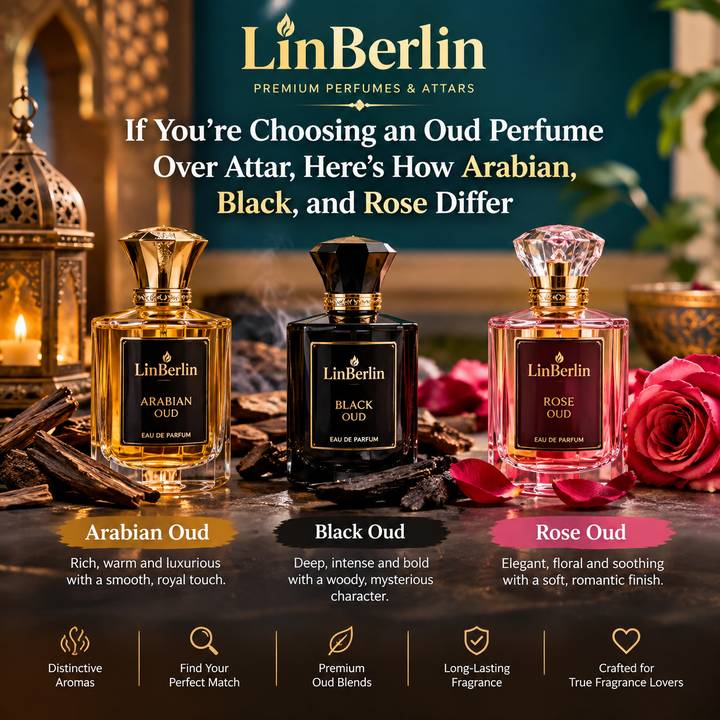
If You're Choosing an Oud Perfume Over Attar, Here's How Arabian, Black, and Rose Differ
Two people can wear the same drop of oud and smell like entirely different people by dinner. Same bottle. Same wrist, more or less. One of them smells like a carved wooden door warmed by the afternoon sun, the other like a candle snuffed out an hour ago. The gap is rarely the fragrance itself — it's the skin underneath, and which kind of oud got chosen in the first place.
That second part is what this guide is really about. If you're weighing an oud perfume against a straight attar, or buying for someone who'll wear it daily, the three styles we work with at LinBerlin (Arabian, black, and rose) behave very differently. And they behave differently on different skin. So we'll take each one in turn, then talk about wearing them without irritating anything.
Perfume or attar: what you're actually choosing between
Attar is concentrated oil, applied in a small dab, and it stays close to the skin while it unfolds over hours. An oud perfume gives up a little of that intimacy for reach: it lifts off the skin sooner and announces itself across a room. Neither is better. (I'll admit I reach for oil when the room is small and perfume when it isn't.)
The trade-off is worth understanding before you buy, and our breakdown of what changes when you choose Arabian oud perfume instead of attar goes into the detail. Here, the short version will do.
Realistically, projection and staying power depend on your skin and the weather more than on any label. The same amount can vanish in three hours on dry, unmoisturised skin and last the whole evening on skin that's been looked after. That's a limitation of every fragrance, not just oud, and no product page can promise otherwise.
Arabian oud: the classic, and the safest place to start
Arabian oud is what most people picture when they hear the word. Resinous, warm, woody, with a balsamic depth and sometimes a leathery edge that feels slightly animal in the best way. It's the style that made oud famous, and it's what The Falcon, our Arabian oud perfume, is built around.
Dry skin loves it. Fragrance clings to moisture, so oud on dry skin tends to fade faster than people expect, while a well-moisturised wrist can hold that warm resin for hours. Oily skin is a different story: it often amplifies the sweetness and makes the whole thing louder, so one application is plenty.
For gift buyers, this is the one I'd point to first. It rarely offends, it suits most ages, and it reads as "someone chose this carefully."
If the person you're buying for has never worn oud at all, it's — well, it's worth reading a beginner's comparison of Arabian, black, and rose oud before you commit.
Black oud: smoke, shadow, and a very particular mood
Black oud is drier and darker. Think charred wood, incense, and the quiet after a fire, with far less sweetness than its Arabian cousin. The Shadow, our black oud perfume, is the one for evenings, cooler weather, and people who already gravitate toward smoky or woody scents.
Here's the thing: it isn't a scent everyone wants to smell on themselves. Heat can make dark, smoky oud feel heavy, especially on oily skin, so in a Delhi summer (or anywhere humid) a single light application goes a long way. If you want a sense of how it lives in the air after dark, there's a piece on how a dark oud settles beside tobacco and velvet air.
As a blind gift, black oud is riskier. Not bad. Just personal.
Rose oud: the softer door into oud
Rose changes the conversation. Where Arabian oud is resin and black oud is smoke, rose oud pairs the dark wood with something petal-soft, so the edges round off. Ruby, our rose oud perfume, is where I'd send someone who says they "don't think they like oud."
Now the caution, because it matters. Natural rose is a well-known trigger for some people with sensitive skin, since components that occur in rose oil, such as geraniol and citronellol, are recognised fragrance allergens. It doesn't mean you'll react. But if you know your skin flares easily, patch test first. Always.
Choosing by person, not by bottle
- Someone who wears woody, warm scents and likes tradition: Arabian.
- Someone who dresses in dark colours, loves incense, and doesn't mind being noticed: black.
- Someone new to oud, or who prefers florals but wants something with more depth than a typical rose: rose oud, and it works for almost any gifting occasion from birthdays to Eid.
- Unsure? Go Arabian.
And if you're buying for yourself, ignore the list and think about the room you'll be in most. That's the whole trick.
Skin, skincare, and how to wear oud without regret
I've watched people put oud over a freshly applied retinol serum and then wonder why their neck stings by lunchtime. It happens more than you'd think. Fragrance on skin that's already working hard, or on skin that's compromised, is where most problems begin — not with the oud, but with what's underneath it.
So a few practical habits, and some of them matter more than others:
- Moisturise first with an unscented lotion or cream. Skin that's hydrated holds fragrance longer, and a light barrier means less direct oil contact if you're prone to sensitivity.
- Apply to pulse points (wrists, inner elbows, sides of the neck) and let it settle rather than rubbing it in hard, which can flatten the opening.
- Keep fragrance off skin that's freshly shaved, sunburnt, cracked, or actively broken out. It hurts, and it can leave a patch that looks worse than the irritation feels.
- If you use retinoids, exfoliating acids like AHAs or BHAs, or benzoyl peroxide, apply fragrance to clothing or a spot away from where those products sit. Or wait until they've fully absorbed.
- Patch test on the inner forearm and give it a day