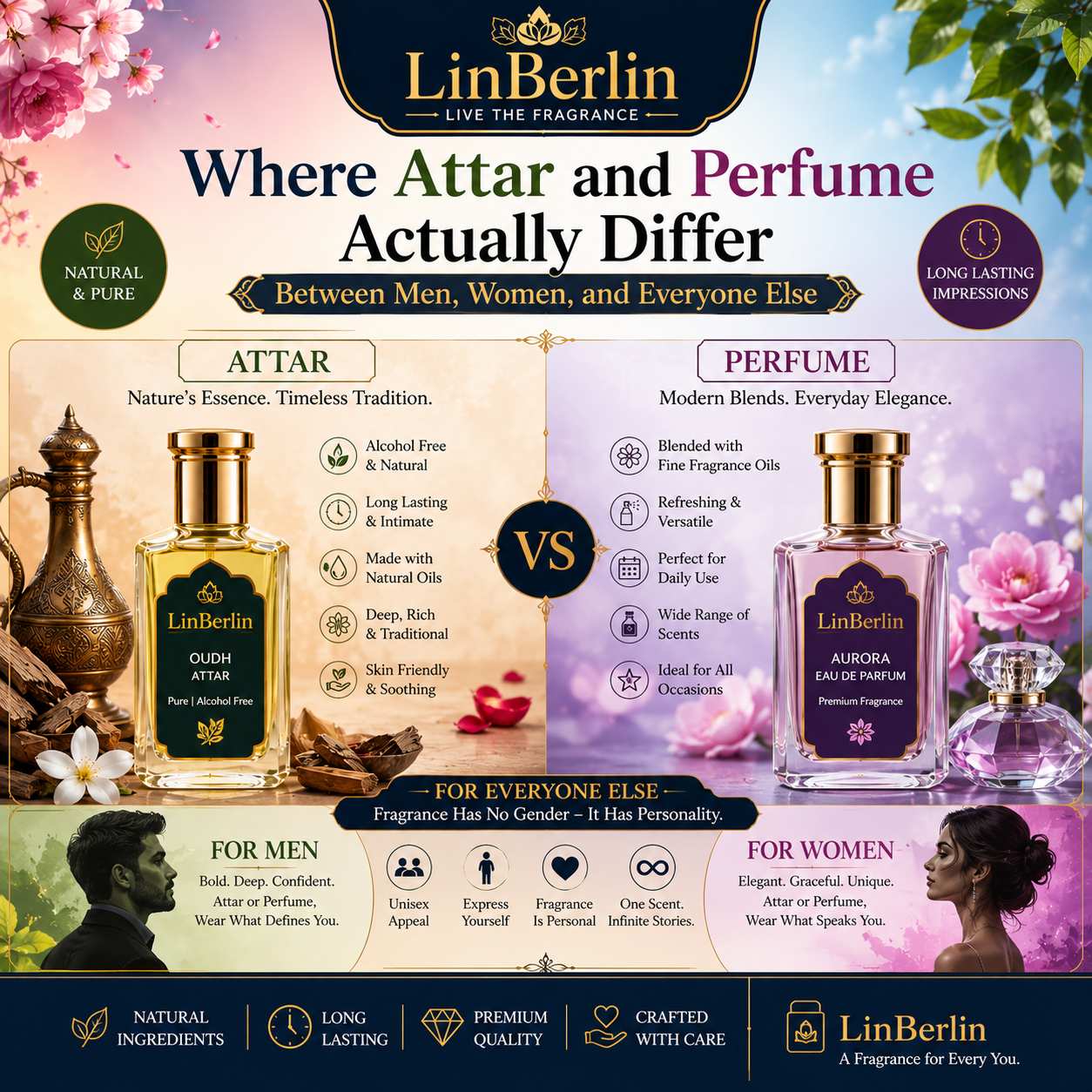
A perfumer once told me something that stuck longer than most fragrance advice does: the bottle's label is marketing, not chemistry. Musk doesn't check anyone's gender before it settles into skin. Neither does rose, or oud, or amber. What actually shifts between "men's," "women's," and everything outside that binary isn't the raw material — it's concentration, how a formula is built to sit on skin, and the cultural weight certain notes have picked up over generations of marketing that had very little to do with the molecules themselves.
That's the honest starting point for this piece. Because once you understand that the difference is mostly about formulation and framing rather than some rule of nature, choosing fragrance — for yourself or as a gift — gets a lot less complicated.
What Actually Changes Between Formulations
Traditionally, attars and perfumes marketed toward men lean into deeper, resinous, and woodier bases — oud, sandalwood, musk, sometimes leather-adjacent notes. Formulations aimed at women tend to build around florals, fruits, and lighter musks, often with more top-note movement in the first hour of wear. But — and this matters — these are patterns built by history and market habit, not by any actual rule about how skin chemistry responds differently by gender.
Skin does respond differently, just not along those lines. Oil production, hydration levels, even body temperature affect how a fragrance develops, and those variables exist across every gender, not split neatly between two categories. So a note that "reads masculine" on drier skin might behave completely differently on oilier skin, regardless of who's wearing it.
How Skin Type Actually Shapes the Experience
This is where the beauty-science side of things becomes genuinely useful, rather than decorative detail. Moisturised skin holds fragrance oils longer because attar binds into the skin's natural lipid layer — dry, under-moisturised skin has less of that layer to hold onto, so scent fades faster and can smell thinner than intended. Oily skin, on the other hand, often amplifies projection but can shorten the lifespan of delicate top notes because heat and sebum speed up evaporation.
None of this cares what's printed on the box. A man with dry skin applying a deep oud attar will notice it fading faster than he expects, the same way a woman with dry skin applying a light floral will notice hers thinning out within the hour too. Skin type, not gender, decides longevity more than anything else in the bottle.
LinBerlin's Approach — Built Around Occasion and Skin, Not Just Category
LinBerlin still organises collections around men's and women's categories, mostly because it helps people navigate faster when they already know roughly what they're looking for. LinBerlin's attar for men leans into that deeper, warmer register — oud, spice, woodier resins — built to project with intention rather than shout. It's designed for people who want presence without needing to reapply every couple of hours, assuming skin is reasonably moisturised beforehand.
On the other side, attar for women in the LinBerlin range tends to sit closer to florals, soft fruits, and lighter musk bases, though there's more overlap between the two collections than the labels might suggest at first glance. Someone drawn to warmth and depth shouldn't feel boxed into one side just because of how a category is named.
For readers who want something a little more expressive and layered, Aurora, our floral luxury perfume for women, is a good example of where the "women's" category pushes past simple sweetness into something with more structure — it opens bright, but doesn't stay one-note the way some floral perfumes do after the first twenty minutes.
And What About Everyone Else
Here's the thing that fragrance marketing has been slow to catch up on: plenty of people don't want to shop by gender category at all, and that's a completely reasonable way to approach scent. The most useful question isn't "is this for men or women," it's "does this suit my skin, my routine, and the impression I actually want to leave." A resinous oud can suit someone regardless of how they identify, the same way a soft jasmine can. Fragrance houses built the categories; skin and preference don't actually follow them.
Realistically, most people who shop outside strict gender lines end up choosing based on note families they're drawn to — citrus versus amber, floral versus woody — rather than worrying about which shelf a bottle sits on. That's arguably the more honest way to shop for scent in the first place.
Layering Attar Safely — Where Skincare and Fragrance Actually Meet
This part applies to everyone, regardless of which collection you're browsing. Attar applied straight onto compromised skin — post-exfoliation, after a retinol night, over an active breakout — tends to cause more irritation than people expect, since the skin barrier is already more permeable and the concentrated aromatic oils sit right on top of that vulnerability. It's not usually dramatic. Mostly it shows up as mild redness or a tight, slightly itchy feeling that people brush off until it happens twice.
A few practical notes worth keeping in mind:
- Apply attar after moisturiser has mostly absorbed rather than onto bare or freshly-washed skin — the slight tackiness left behind seems to help the oil bind and last longer, based on how most people describe their experience.
- If you have known fragrance sensitivities, patch test on the inner forearm and wait at least a day before applying anywhere near the face, neck, or décolletage.
- Pregnant readers, or anyone going through a period of heightened scent sensitivity for other reasons, might want to introduce new attars gradually rather than all at once — nausea and heightened smell-sensitivity aren't universal, but they're common enough to mention.
None of this is meant to scare anyone off natural attar — it's genuinely gentler than most alcohol-based sprays for a lot of people. But "natural" doesn't mean "risk-free," and pretending otherwise isn't honest marketing, it's just marketing.
A Small Caveat
Batch-to-batch consistency in natural attar can vary slightly, since raw materials like real jasmine, rose, or oud shift a little with harvest and extraction conditions. It's usually subtle. Occasionally it's noticeable enough that a bottle from one batch smells marginally different from the last. That's simply part of working with genuine botanicals rather than lab-standardised synthetics, and it's worth knowing before you commit to a signature scent you expect to be identical every single time.
For anyone who wants a deeper walk-through of how gendered fragrance categories actually work — and where the lines blur more than brands like to admit — there's a fuller breakdown in the complete guide to choosing attar and perfume by gender. And if application method — spray versus oil — is still an open question for you, the piece on what actually decides whether spray or oil suits you better covers that in more practical detail than this article has room for.
Where This Leaves You
Gendered categories are a useful map, not a rulebook. They help you find a starting shelf, not a final answer. What actually determines whether a fragrance works — for anyone — comes down to skin type, application habits, and the impression you're personally after, far more than whichever label happens to be printed on the box.