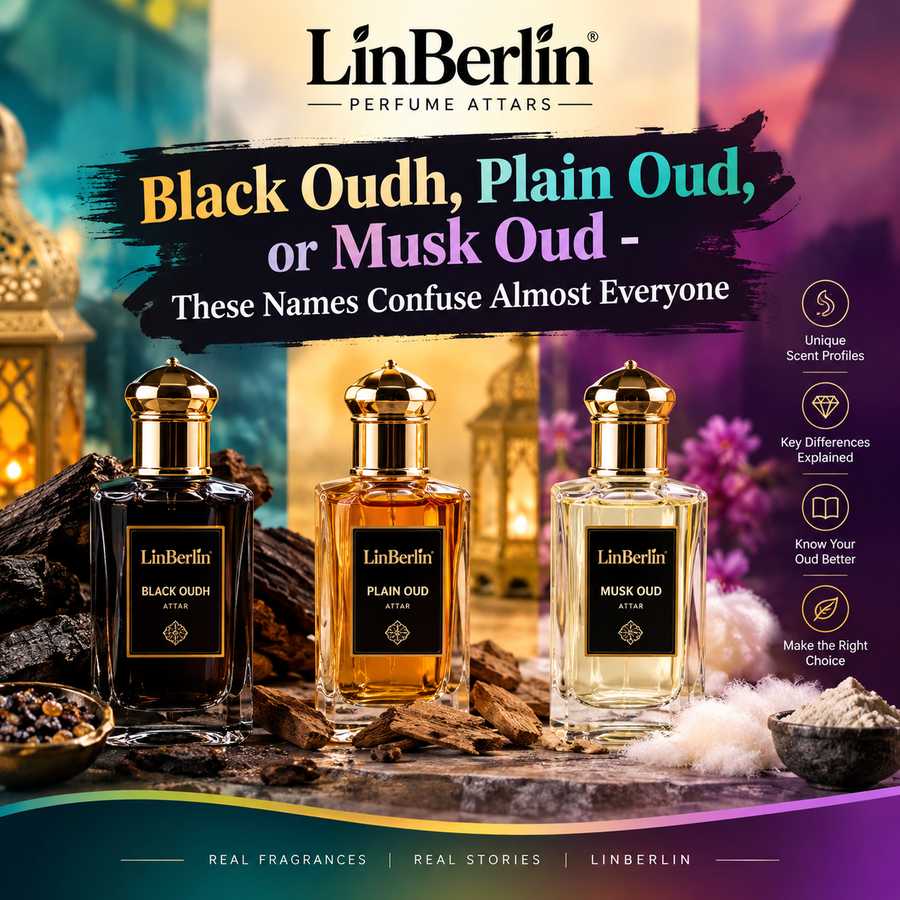
Picture a gift shop shelf with three small bottles: one labelled black oudh, one labelled plain oud, one labelled musk oud. The prices differ, the colours differ, and the shopkeeper's explanation differs depending on who you ask. Yet two of those bottles might, on a good day, share more than their labels admit. That gap between the name and what is actually inside is where most buyers get lost.
This guide is for people buying for themselves or for someone else, and it tries to do one job: make the names mean something. We will go through what each label usually signals, how the scent behaves on skin, and how to wear attar without upsetting your skincare routine. (That last part gets skipped in most oud articles, which is odd, because skin decides so much of the result.)
Why the names are so slippery
Oud has no single regulated vocabulary. Distillers, families, and sellers across the Gulf, India, and Southeast Asia have used their own terms for generations, and those terms travelled into English through trade, not through a rulebook.
So one house's "black" might describe colour, another's might describe smoke, and a third's might simply describe a price tier. Spelling adds another layer, since "oudh" and "oud" are the same word arriving via different transliterations. If that particular confusion bugs you, LinBerlin has a short piece asking whether black oudh is really a different product or only a different spelling.
Realistically, no label alone can tell you what you are buying. The description, the base oil, and the way it smells on your wrist tell you far more. Here's the thing: trust your nose over the tag, always.
Plain oud: the reference point
Start here, because everything else is a variation on it. A straightforward oud attar is built around agarwood oil carried in a traditional base, and the character you get is woody, resinous, a little animalic, sometimes with a sweet or medicinal edge that surprises first-timers.
It is not a "pretty" smell in the way a rose is pretty. It is deep, and it takes a few minutes to settle. Many people dislike it at the very first sniff and love it forty minutes later, which is why sampling on skin (not on paper strips) matters so much here.
Black oudh: darker, smokier, more insistent
When a seller says black, they are usually pointing to a heavier, darker profile, something closer to char, leather, and night air. A black oudh attar (Oud e Zulmat) leans into that shadowy side, and it tends to project more slowly but linger longer.
But, and this matters, "black" is not a protected grade. It may refer to colour of the oil, to the smoke of the scent, or to a blending style. Ask the seller what makes it black. A confident answer is a good sign; a vague one isn't.
For a side-by-side reading of all three terms, this clear guide to the three names covers the vocabulary in more detail.
Musk oud: the softer landing
Musk changes the temperament of oud entirely. A musk oud attar, Oud e Mishk keeps the woodiness but wraps it in something rounder, skin-like, and quieter. It reads warmer and closer, less like a statement and more like a habit.
That makes it the friendliest starting point for someone who has never worn oud. It also suits people who want a scent that stays near the body during the day, and there is a lovely, slightly moody account of how the two ingredients behave together in this piece on black oudh meeting musk.
The quick decision guide for buyers
- Buying for a first-time oud wearer: musk oud. It forgives, it warms, and it rarely overwhelms a room.
- Buying for someone who already loves oud, or collects it: plain oud, since they can judge the raw character and compare it against what they own.
- Buying for a person who likes evenings, leather, incense, or something with weight: black oudh. Though it is the boldest of the three, so a small bottle first is sensible, and, well, ask if they like smoke at all.
Gifts are trickier than personal buys, honestly. Scent is intimate, and even a well-chosen bottle can miss. If you can, include a note saying the recipient may swap or sample, and choose a smaller size.
How attar behaves on different skin
The same oil can smell quite different on two people. Oil-based perfume relies on skin to hold and warm it, so skin type changes both projection and staying power.
Dry skin absorbs oils fast and can make attar seem to vanish within a few hours. Moisturised skin holds scent noticeably longer, which is why applying a plain, unscented lotion first often extends wear. Oily skin tends to hold and amplify, so one small dab may be plenty, and heavier blends like black oudh can turn intense. Normal or combination skin sits in between, and the pulse points usually give the most balanced result.
And climate plays in as well. Heat lifts scent quickly, so in summer a lighter touch usually works better than a generous one (a mistake many people make with their first bottle).
Layering with skincare without trouble
Here is where things go wrong most often. Attar is concentrated, and applying it straight over strong skincare actives, or onto skin that is freshly exfoliated, can sting or leave redness. People commonly notice this as a warm prickle at the application spot that does not fade.
A simple routine tends to work. Apply skincare first, let it absorb fully, then dot the attar on with a fingertip or the glass rod, and leave it alone. Don't rub your wrists together, because friction tends to flatten the top notes.
Take extra care with retinoids, strong acids such as glycolic or salicylic, and any recent peel or laser treatment. In those cases, keep attar off the treated area and apply it to clothing edges or the hair ends instead, and even then only if you know your fabric will not stain (oils can mark silk).
When to be careful
Natural does not automatically mean gentle. Botanical and animal-derived aromatic materials can still trigger reactions in some people, and fragrance allergies are real.
- Do a patch test first: one small dab on the inner forearm, then wait a full day before wearing it properly.
- If you have eczema, dermatitis, broken skin, or a known fragrance allergy, speak with a doctor or dermatologist before applying anything scented.
- Pregnant or breastfeeding? Get your own healthcare provider's view on which aromatic materials suit you, since I can't tell you that for your body, and neither can a product page.
One honest limitation of this whole guide: I can describe how these labels are commonly used, but a specific bottle may not follow the pattern. Ingredient lists and the seller's own notes will always beat any general rule.
Reading a listing like a buyer who has been burned before
A few small habits protect you. Look for a clear ingredient or base-oil mention. Check whether the seller describes the scent in actual notes (smoke, leather, resin, soft musk) rather than only in words like "luxury" or "royal". And be a little wary of a very low price attached to the word oud, because real agarwood is costly, and pricing usually shows it.
Amber is another word you will meet on these listings, often paired with musk. If that pairing puzzles you, this read on how amber folds into musk helps explain why the two sit so comfortably together.
The short takeaway
Plain oud is the reference, black oudh is the darker and heavier variation, and musk oud is the softer, closer one. Start with a small size, test on clean, moisturised skin, and give the scent a full hour before deciding. If you are still torn, the musk version is the easiest yes.