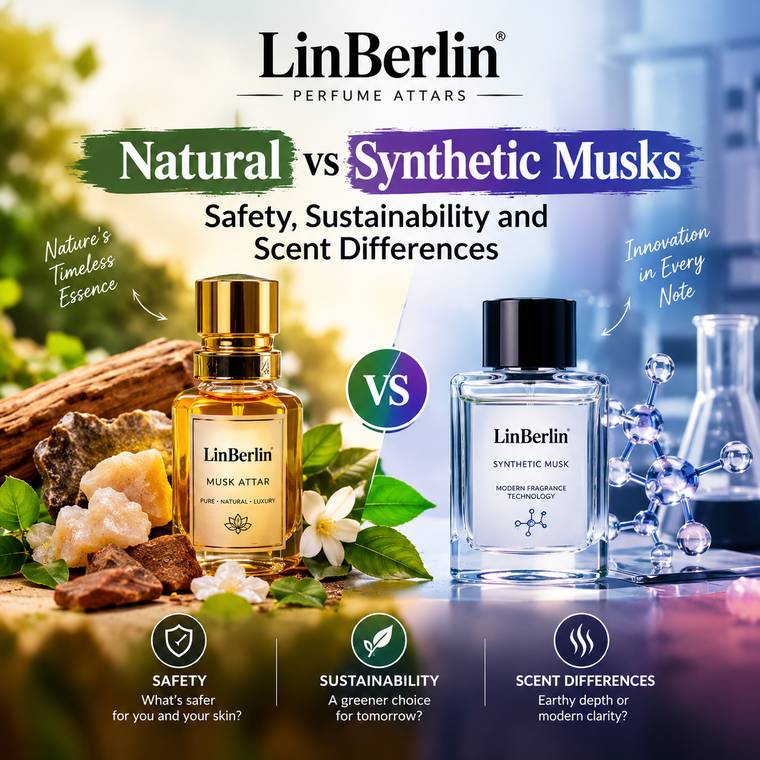
Sanskrit had a blunt word for the dark, waxy gland of a small Himalayan deer, and that word travelled through Persian and Arabic into almost every perfume vocabulary on earth. We still say musk a thousand years later. What we mean by it has changed completely.
Today, almost nothing sold as musk comes from the animal. The deer is protected, the trade is tightly restricted, and the smell has been rebuilt from plants and from laboratory chemistry. So when you choose between a plant-derived musk and a synthetic one, you're really choosing between two different stories: one about your skin, one about rivers and farms, and one about how the scent behaves at hour six. Here's how they compare, in plain terms.
Where musk comes from now
Musk matters because it's the quiet layer that makes everything else sit on the skin instead of floating above it. Rose, oud, amber: they all lean on it, whether or not the label says so.
There are three sources worth knowing. The oldest, animal musk, is effectively history for responsible perfumery. The plant route is the most interesting to me: ambrette seed (a relative of hibiscus, grown in India and a few other warm regions) gives a warm, slightly boozy, skin-like note, and angelica root adds an earthy, rooty depth. And then there's the lab.
Synthetic musks come in families, which is where beginners usually get lost. Nitro musks are the old generation and are now mostly phased out. Polycyclic musks, the ones behind that clean-laundry, fabric-softener smell, took over next. Macrocyclic musks are the newest group and the closest to the real thing, warm and a little animalic. One small trap: a nitro musk was once sold under the name musk ambrette, which has nothing to do with the plant. Different thing entirely. Most people never need to untangle that, but it explains why ingredient lists can confuse.
How they actually smell on skin
Natural musk notes move. Ambrette seed opens a little green and nutty, with a rough edge, then softens and warms as your body heat works on it. It's never quite the same twice, because your skin, the weather and the oil base all have a say.
White musks stay put. They smell soft, powdery and clean, and they're built to last for days on a paper strip, which is why they show up in everything from shampoo to designer fragrance. Nothing wrong with that. But it can feel flat if you're expecting a scent to develop.
Here's the thing: synthetics genuinely win at one job, and that job is consistency. A bottle bought today smells identical to one bought next year. Plant materials can't promise that, and honestly, shouldn't, because a harvest is a harvest. If you want to know what a musk does when it's allowed to be unpredictable, try one of the deep, mysterious musk attars and wear it for a full day before deciding. Not an hour. A day.
Safety, and what your skin has to say about it
A lot of people assume natural means gentler. It doesn't, necessarily. Plant oils contain naturally occurring compounds such as linalool and limonene, which are listed as fragrance allergens in the EU precisely because they can sensitise skin in some people (even though they come from flowers and citrus peel). Synthetic musks have their own history: some older ones were restricted over concerns about skin reactions to sunlight, and the modern ones are generally considered low-risk for sensitisation. Generally. Individual skin is individual.
What I see people get wrong most often isn't the musk at all. It's the skin underneath. Fragrance on dry, tight skin vanishes in an hour or two, and people blame the perfume. Moisturised skin holds scent noticeably longer, because oils cling to a hydrated surface instead of sinking into a thirsty one. This is especially true with attar, which is oil-based and behaves like a rich, scented balm.
Skin type changes the experience more than most guides admit:
- Dry skin: moisturise first with something unscented, wait a few minutes, then apply. Without that step, even a strong musk fades fast.
- Oily skin: scent tends to project more and can turn sharper or sweeter through the day. One small dab is plenty, and you may find a lighter hand suits you better.
- Sensitive or reactive skin: patch test, always, and keep the application area small. Redness, itching or a warm prickling that doesn't settle means stop. And sensitive skin is where plain, unscented layering products matter most, so a heavily fragranced body lotion underneath is usually a mistake.
There are situations where caution really is warranted. If you're using retinoids, exfoliating acids (AHAs or BHAs) or benzoyl peroxide, your skin barrier may be thinner than it looks, and fragrance on freshly treated skin can sting or trigger irritation. Wait, or apply to clothing hems or the back of the hair instead. (Oils can mark silk and pale fabrics, so test a hidden spot first.) Skip broken skin, sunburn and active eczema entirely. If you have a known fragrance allergy, ask for the full ingredient list before buying, because "natural" tells you nothing about your triggers.
Pregnancy is a softer area. Skin often becomes more reactive and the sense of smell sharper, and there's limited research on fragrance ingredients specifically in pregnancy. Using small amounts and checking with your doctor or midwife is sensible, not dramatic.
Sustainability, without the slogans
Sustainability is where this comparison gets muddy, and I'd rather say so than pretend there's a clean winner.
Ambrette seed is an annual crop, so it can be grown and replanted year after year, which already puts it in a better position than slow-growing trees. But farming still uses land and water, and whether the growers are paid fairly depends entirely on the supply chain. Scarcity is the real warning sign in perfumery. Look at what demand did to sandalwood, where real sandalwood scent is getting harder to find, or at the confusion around oud and agarwood, where a wild resource became a luxury commodity. Musk was the original cautionary tale.
Synthetics aren't villains either. They protect wild species, and they avoid the land pressure of farming. The environmental concern is mostly with the polycyclic group, which doesn't break down easily and has been detected in waterways, fish and even human tissue, which is why regulators in Europe have tightened rules on some of them. Macrocyclic musks are generally considered to biodegrade better. Extraction methods matter too, but that's a conversation for another day.
The honest caveat: nobody has a tidy, complete life-cycle comparison, and long-term data on low-level exposure is still incomplete. Anyone telling you one side is simply green and the other simply harmful is selling something.
What you pay for
Synthetic musks are cheap, stable and endlessly repeatable, so the price of a bottle usually reflects branding and packaging far more than the musk. Plant-based oils cost more to grow, distil and age. If you want to see where the money goes, this breakdown of luxury synthetic perfume versus pure attar is a fair place to start, and first-time buyers weighing both sides might like the side-by-side comparison of attar and synthetic perfume. Neither is better in the abstract. They just want different things from you.
How to try a musk safely
- Patch test on the inner forearm and leave it for 24 hours before wearing it anywhere else.
- Moisturise with an unscented product, wait a few minutes, then apply a very small amount of attar to a pulse point such as the wrist or the base of the throat, where warmth lifts the scent gradually rather than all at once.
- Wait.
Rubbing wrists together is the habit I'd drop first. It's — well, it's mostly friction, and it can blur the top notes before they've had a chance to open.
The takeaway
Choose a synthetic musk if you value consistency and a clean, quiet finish. Choose a plant-based one if you enjoy a scent that shifts with your skin and you're happy to accept some variation. Either way, look after the skin first, test before you commit, and stay honest about what your own skin tells you. At LinBerlin, that's the way we'd suggest anyone begin: one small dab, one patient day, and a clear opinion by evening.