The first sign of Diwali in most homes isn't the diya, and it isn't the sound of a broom either. It's a smell — turmeric water on the floor, mustard oil in a half-forgotten corner, and somewhere underneath it, the faint memory of last year's attar bottle that never got fully used up. Long before the mandir is decorated or the rangoli is drawn, the house starts smelling like it's expecting someone. And in a way, it is.
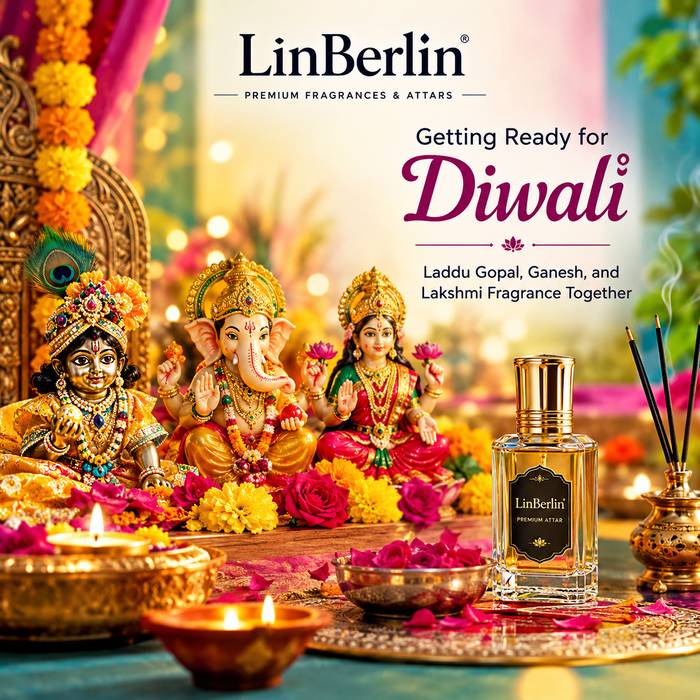
This is the part of Diwali that doesn't make it into most guides. Everyone talks about lights, sweets, and firecrackers. Almost nobody talks about the fact that three separate deities — Laddu Gopal, Ganesh ji, and Maa Lakshmi — each have their own fragrance moment during this festival, and each one calls for something slightly different. Getting this right isn't about following rules for the sake of it. It's about understanding what each deity's puja actually asks of the person doing the seva.
Why Laddu Gopal's Fragrance Comes First
If Laddu Gopal is part of your daily seva, Diwali doesn't change the routine so much as it raises the occasion. The shringar becomes a little more deliberate. Clothes are new, or at least freshly washed and pressed. And the attar — this is where people tend to either overthink it or not think about it at all.
A festive shringar fragrance needs to do two things at once: feel celebratory without being loud, and last through a longer-than-usual puja without turning sharp on the skin or the vastra as hours pass. This is where something like the Raj Shringar attar tends to work better than a heavier, more traditional oud-forward blend — it has enough richness for the occasion but doesn't overwhelm a small mandir room, especially one that's already got dhoop, flowers, and prasad competing for the same air.
Here's the thing — a lot of people apply attar to Laddu Gopal's vastra the same way they'd apply it to their own wrist, in one heavy dab. It doesn't work the same way on fabric. Fabric holds and releases scent differently than skin does, so a little goes further, and reapplying too soon just muddies the fragrance rather than refreshing it.
Ganpati's Puja Has Its Own Fragrance Rhythm
Ganesh ji's sthapana usually happens earlier in the sequence of Diwali preparations, sometimes days before the main night. The fragrance chosen here tends to be a little brighter, a little more floral-forward, because Ganpati puja often involves fresh flowers, doob grass, and modak — and the attar shouldn't compete with any of that, it should sit underneath it.
Ganesh Pushp attar for Ganpati Puja is built around this idea — a floral base that reads as fresh rather than sweet, which matters more than people realize in a room that already has marigold and hibiscus in it. Too sweet a fragrance next to fresh flowers can actually make the flowers smell duller by comparison. Odd, but true.
One small caution worth mentioning: if your Ganpati sthapana includes very young children handling the puja items — passing flowers, holding the aarti thali — go easier on the amount of attar used near fabric they'll be in close contact with. Some children have mild sensitivities to concentrated florals, and a puja room is not the place to discover that the hard way.
Maa Lakshmi's Evening: Where the Fragrance Actually Matters Most
Lakshmi puja on Diwali night is, realistically, the fragrance moment most people get wrong — not because they choose badly, but because they choose too late. The evening is already busy. Diyas need lighting, guests are arriving, someone's forgotten where the kumkum is. Fragrance becomes an afterthought, sprayed or dabbed in the last five minutes.
But Lakshmi puja fragrance deserves earlier attention than that. Lakshmi Kamal attar for Maa Lakshmi puja is built around lotus and warm florals, which is fitting — Maa Lakshmi's iconography is inseparable from the kamal, and a fragrance that echoes that feels less like decoration and more like continuity. If you're unsure what else belongs in that evening's ritual setup, this guide on what to burn or wear during Lakshmi puja goes into more detail on pairing dhoop with attar without one overpowering the other.
A short list, and not a tidy one, because these things rarely apply equally:
- Apply Lakshmi Kamal attar to pulse points at least twenty minutes before the puja begins, not right as guests arrive — it needs a few minutes to settle and stop smelling "fresh-applied."
- If you're also lighting dhoop or incense in the same room, use less attar than you normally would, since the two will blend in the air whether you plan for it or not.
- Silver or gold jewellery worn during puja can hold onto attar scent longer than skin does, which is either a nice bonus or mildly annoying by the next morning, depending on how strong the blend was.
The Skin Part Nobody Mentions
So here's something worth saying plainly, because it rarely gets said: how long any attar lasts during a long Diwali evening has less to do with the attar itself and more to do with the state of your skin underneath it. Dry skin — and by Diwali, in most of North India, the weather has already started drying things out — doesn't hold fragrance nearly as well as moisturised skin does. Attar molecules bind to oils and hydration on the skin's surface. Skip the moisturiser, and even a beautifully rich attar can fade within an hour or two, especially somewhere as warm as a puja room lit with diyas and surrounded by people.
A thin, unscented moisturiser applied to wrists and neck before the attar goes on makes a real difference. Not a heavily fragranced body lotion — that will fight with the attar rather than support it — just something plain that gives the oil a surface to hold onto.
And if you're someone with sensitive skin, or you're pregnant, or you're currently using strong actives like retinol or a fresh chemical peel on your skin that day (it happens, especially with everyone trying to look their best for Diwali), it's worth patch-testing any new attar on a small area first, or applying it to clothing rather than skin directly. Natural doesn't automatically mean gentle. Concentrated florals and oud bases can still cause irritation on compromised or reactive skin, and a festival evening is not the time to find that out on your neckline.
What Changes as the Season Turns
Diwali sits right at that seasonal hinge — the last warm afternoons giving way to genuinely cool evenings. This matters more for fragrance than people assume. Warmer skin projects fragrance more; cooler skin holds it closer and quieter. A blend that felt just right in early October can smell noticeably different, and often better, by the time Diwali actually arrives in late October or November. If you're rotating Laddu Gopal's shringar fragrance across the year already, there's a fairly detailed breakdown on choosing Laddu Gopal's shringar fragrance as the seasons change that's worth reading alongside this one.
A Few Honest Mistakes People Make
Not everyone gets this right on the first try, and that's fine.
Layering too many scents in one room — dhoop, attar on three separate deities' vastra, incense sticks, and someone's perfume all going at once — is probably the single most common misstep. The room ends up smelling confused rather than festive. Or people buy one large bottle of a single attar and try to make it work for all three deities, which technically works but flattens what could otherwise be three distinct, meaningful fragrance moments across the evening.
Storage matters too, though it's easy to forget until the bottle's gone cloudy or thin-smelling a year later. Attar should be kept away from direct sunlight and heat — not in a car, not on a sunny windowsill — because heat breaks down the natural oils faster than most people expect.
Bringing It Together for the Evening
None of this needs to be complicated, even though it might read that way laid out step by step. In practice, it's three small, intentional moments spread across a busy evening: a fresh shringar fragrance for Laddu Gopal, something floral and light for Ganpati's sthapana, and a lotus-warm attar saved specifically for Maa Lakshmi as the diyas are lit. Get the skin preparation right, don't overcrowd the room with competing scents, and let each deity's puja keep its own fragrance identity rather than borrowing from the others.
That's really the whole idea behind it — not more fragrance, just fragrance placed with a little more thought than usual. Which, if you think about it, is a fairly good description of Diwali itself.