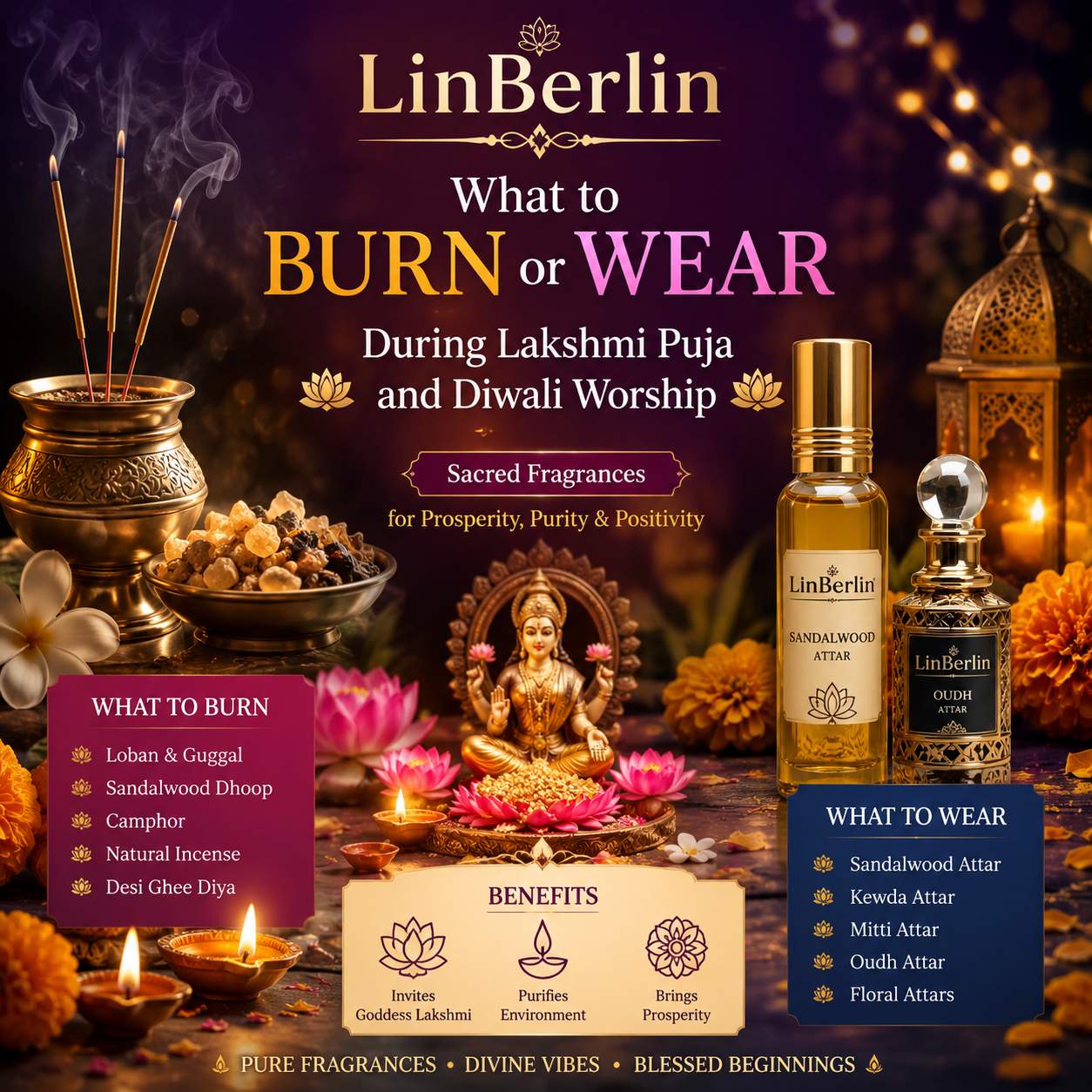
My grandmother never used a diffuser. She used a small brass dhoop dani, a cotton wick, and whatever attar had survived the year in her almirah. The night before Diwali, she'd sit on the floor with all of it spread out — three or four small bottles, a box of guggal, some sandal chips — and decide, almost ritually, what the house needed that year. Not what smelled nicest. What the house needed.
That distinction matters more than most people realise when they're standing in front of a shelf of attars on Dhanteras evening, unsure what to pick. Lakshmi Puja isn't really about fragrance selection in the way a perfume counter is. It's about what a scent is meant to do in a room, on a body, in a moment of worship. And that's a different question entirely.
Why Fragrance Carries Weight During Diwali
Diwali worship treats smell as an offering, not decoration. When you light a diya or burn dhoop before Maa Lakshmi, the fragrance rising with the smoke is understood to travel — to carry intention upward, the way sound does in a temple bell. This is old thinking, and it isn't sentimental. Sandalwood, lotus, saffron, and rose have been used in Indian devotional practice for centuries specifically because they hold their character even at low heat, releasing slowly rather than burning off in a single sharp note. A synthetic spray does the opposite — it announces itself and disappears. Attar, by contrast, unfolds. That slow unfolding is closer to what puja actually asks for.
There's also a practical layer here that often gets skipped in cultural writing about Diwali: what you put on your skin during a two-to-three-hour puja session, often near open flame and incense smoke, behaves differently than what you'd wear to a party. Skin absorbs heat, sweat changes slightly with the stress of standing and sitting through aartis, and any attar applied to warm pulse points will project more than usual. Worth knowing before you overdo it on the wrists.
What to Wear on the Body for Lakshmi Puja
For personal wear during the puja itself, most families lean toward warm, grounding notes — sandalwood, saffron-rose blends, or a lotus-forward attar that echoes Lakshmi's iconography without being overtly sweet. The Lakshmi Kamal attar for Maa Lakshmi puja was built around exactly this idea — lotus as the central note, since the flower is so tied to how Lakshmi is depicted, seated on or holding one. Apply it to the inner wrists and the base of the throat about twenty minutes before the puja begins, not right as you sit down. Attar needs a little time on skin to move past its opening notes.
Skin type actually changes how this plays out, and it's rarely mentioned. Drier skin doesn't hold onto oil-based attars as long — the scent tends to fade within a couple of hours because there's less natural moisture on the surface to slow evaporation. If your skin runs dry, moisturise lightly before applying attar; a thin, unscented layer underneath gives the oil something to sit on rather than sink into nothing. Oily or combination skin, on the other hand, often amplifies attar — sandalwood and musk-heavy blends can read stronger and last considerably longer, sometimes into the next day faintly. If that's you, a single dot rubbed thin is usually enough; two dots can tip into overwhelming in a closed puja room full of incense already.
One caution worth stating plainly: if you have sensitive or reactive skin, patch-test any new attar on the inner forearm the day before, not the morning of. Rose and saffron are generally gentle, but real saffron-infused oils can occasionally cause mild irritation in people prone to fragrance sensitivity, and pregnant readers should check with their doctor before wearing concentrated attar for extended periods in an enclosed, incense-heavy room — smoke inhalation and strong essential oil exposure are a different conversation than a light dab of perfume.
What to Burn: Dhoop, Loban, and the Room Itself
Burning is a separate decision from wearing, though people often conflate the two. For the space itself — the puja room, the entrance, near the diyas — heavier, smoke-friendly resins do more work than delicate florals. Guggal and loban are traditional choices because they're antimicrobial in a mild, old-fashioned way and they fill a room without needing much quantity. Sandalwood dhoop sticks are gentler and safer for smaller apartments where ventilation is limited. If you're using an attar-soaked cotton wick or a bakhoor-style burner instead of sticks, sandalwood or a saffron-oud blend tends to sit well with the ghee lamps already burning nearby, rather than competing with them.
Realistically, most Indian homes end up burning two or three things across the evening without much planning — incense at the entrance, dhoop near the idol, maybe a rose or lotus attar dabbed onto cotton and placed near the prasad. That layering isn't a mistake. It's actually closer to how devotional fragrance has always worked, building rather than choosing one note to represent the whole night. For a fuller sense of how different households and traditions approach this, this guide to attar for pooja and devotional worship covers the broader logic behind matching scent to ritual, beyond just Diwali.
Lakshmi's Own Fragrance Language
If you want to go a little deeper into why lotus and Lakshmi are so tied together — and how vaibhav, or prosperity, is thought to be invited through fragrance and not just decoration — there's a longer piece on the story behind Lakshmi's puja, devotion, and fragrance that gets into this properly. It's less a how-to and more a cultural unpacking — useful if a family member asks why lotus specifically, and you want an answer beyond "it just is."
Common Mistakes People Make
A few things come up every year. People apply too much attar too early, so by the time the actual aarti happens, the scent has already peaked and gone slightly flat — better to apply closer to the ceremony than hours before. People also mix strong synthetic room sprays with natural dhoop, which muddies both; the synthetic top notes clash with the slow-burning resin underneath, and neither reads clearly. And a smaller one — people forget that lit diyas plus dhoop plus attar in a small room is a lot of combined scent load, so cracking a window slightly isn't disrespectful, it just keeps the whole thing from turning heavy by the second hour of puja.
Choosing Based on Who You're Worshipping
Diwali evenings often involve more than one deity — Ganesh before Lakshmi, sometimes Kubera alongside her for wealth, occasionally a broader family puja that folds in other gods entirely. If your evening extends beyond Lakshmi specifically, it's worth knowing that different deities are traditionally paired with different fragrance families in devotional practice. There's a useful breakdown on matching fragrance to the specific deity you're worshipping, which is handy if your Diwali puja isn't Lakshmi-only.
A Closing Thought
The truth is, no single attar is "correct" for Lakshmi Puja — that's not really how this tradition has ever worked. Families carry forward whatever scent memory their own home holds, and that's arguably more important than any expert recommendation, including this one. What actually helps is understanding what each note is doing — grounding, sweetening, purifying — so you can build an evening that smells like intention rather than habit. Light the dhoop early enough to let the smoke settle before guests arrive. Apply the attar close to the puja, not hours before. And leave a little room in the air for the ghee lamps to do their part too.