A wool coat left on a hook in a bakery will smell of bread for a week. Nobody planned that outfit, and yet everyone who stands next to it gets the message.
Clothes hold scent. Fabric, skin and fragrance end up telling one story, whether you edit it or not. So the smarter move is to choose the scent the way you choose the jacket: on purpose, and with some sense of the whole picture.
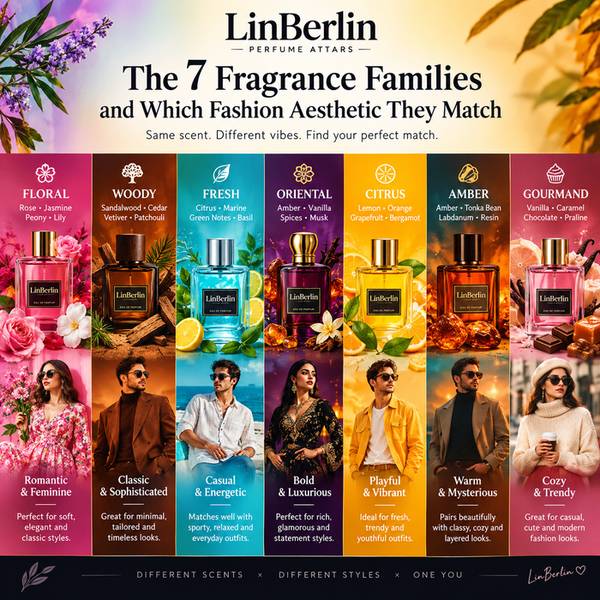
What follows is a guide to seven fragrance families, each paired with the fashion aesthetic it tends to flatter. I've also added a few notes from the skin side of things, because a scent that sits beautifully on one person can turn sharp or vanish within an hour on another. Fabric matters. Skin matters more.
Before You Match Anything: A Word About Skin
Moisturised skin holds fragrance noticeably longer than dry skin (dry skin drinks oils and lets the scent evaporate fast). If your attar disappears by lunchtime, try an unscented balm on the pulse points first, then apply the attar over it. Oil-based attars in particular sit close to the skin and warm up slowly, so they reward this small habit.
Oily skin behaves differently, projecting a little louder and lasting longer, so you need less. Sensitive skin needs patience: test a dot on the inner forearm and wait a full day before committing. And if you're pregnant, using retinoids or strong exfoliating acids like glycolic or salicylic, or have any history of contact dermatitis, apply fragrance to clothing hems or scarves rather than directly to skin, and check with your doctor or dermatologist if you're unsure. Fresh chemical exfoliation plus perfume on the same patch of skin is a combination that stings, and I've watched people blame the perfume when the peel was the actual culprit.
1. Floral: For the Romantic Dresser
Rose, jasmine, tuberose, champaca. Floral is the largest family and the easiest to misjudge, because people picture a garden when a good floral attar smells more like a warm petal pressed between two fingers.
It suits romantic and vintage-leaning wardrobes: silk blouses, midi skirts, lace trims, anything with a soft drape. But it also works against type. A heavy jasmine beside a crisp white shirt and tailored trousers looks a bit unexpected, and that tension is often what makes an outfit memorable.
Caution for the sensitive: rose and jasmine absolutes are among the more common fragrance allergens, so patch test first.
2. Fresh and Citrus: For the Clean, Minimal Wardrobe
Bergamot, vetiver, green tea, cut grass, sea air. Fresh scents are quick, bright and — honestly — the hardest to make last, since citrus oils are the first to evaporate. That is chemistry, not a flaw in the product.
They belong with linen, cotton poplin, neutral palettes, white sneakers, the sort of capsule wardrobe where every piece has a job. Wear one to a summer office or a weekend market. Reapply once, midday, and don't feel bad about it.
If you like to dress by the calendar, this season-by-season approach to matching perfume with outfits shows how a fresh scent shifts from spring to a heavier winter wardrobe.
3. Woody: For Quiet Luxury and Dark Academia
Sandalwood, cedar, oud, cypress. Woody fragrances are the ones people describe as "expensive" without being able to say why. The reason is usually depth: they change slowly on skin, moving from dry and pencil-shaved to creamy and almost sweet.
Pair them with cashmere, camel coats, tweed, loafers, old leather bags. Anything that looks better after ten years. They suit the quiet-luxury look because neither the clothes nor the scent are shouting.
Realistically, a true sandalwood attar is not cheap, and anyone offering it for a very low price should make you a little suspicious.
4. Amber and Oriental: For the Maximalist and the Evening Dresser
Resin, labdanum, vanilla, spice, musk. This is the family of velvet, embroidery, jewel tones, gold jewellery, layered textures. Warm and enveloping. It can also be overwhelming, and that's the trade-off.
One sensible rule: the more ornate the outfit, the fewer sprays you need. Amber blooms with body heat, so a single dab at the wrist and one behind the ear is plenty in a heated room. Cold air mutes it, which is why it feels so right in autumn and winter.
5. Chypre: For the Tailored, Structured Dresser
Bergamot on top, oakmoss and patchouli underneath, labdanum holding it together. Chypre carries a certain polish, a little shadowy, a little severe in a good way. It fits sharp blazers, wide-leg trousers, silk scarves, and anyone whose wardrobe reads as decisive.
If the name is new to you, the history and structure of the chypre family is worth a short read, because knowing where it came from explains why it still feels so composed today. Note that oakmoss is a known sensitiser for some people, and modern formulations often restrict it.
6. Fougère: For the Classic, Heritage Wardrobe
Lavender, geranium, coumarin, a herbal green edge. Fougère is the barbershop scent, which sounds dated until you put it beside a well-cut denim jacket, a rugged boot, a navy knit. Then it reads as timeless.
It suits workwear, smart-casual and heritage looks. It also happens to be one of the more forgiving families on mixed skin types, although lavender can irritate very reactive skin, so I'd still test first.
7. Leather and Smoke: For the Edge
Birch tar, cade, suede accords, incense, sometimes a little animalic musk. This family is for black denim, biker jackets, boots with some mileage, oversized dark tailoring. It is the loudest personality on this list. But — and this is a genuine caveat — it polarises a room, and what reads as "magnetic" to you may read as "too much" to a colleague, so be honest about where you're wearing it.
Where the Matching Breaks Down
Here's the thing: none of this is a rulebook. A floral doesn't need lace, and a woody doesn't need a tweed jacket. Plenty of people wear a smoky leather with a floral sundress and look better for it. The pairings above are starting points, not fences.
And your own body chemistry will edit the result regardless. Diet, hormones, medication, even the humidity in Meerut versus Berlin (or wherever you happen to be) will nudge a scent somewhere you didn't expect. So trial an attar for a full day before you build an outfit around it.
Finding Your Own Rotation
Most people don't fit one family neatly. Two or three usually cover a life: something fresh for work days, something woody or amber for evenings, one wildcard for the mood you can't name. If you want a sturdier framework for building that small collection, five scent profiles a wardrobe actually needs breaks it down by clothing type. And for the personality side of the question, what your fragrance quietly says about your style is a good companion read.
A Simple Way to Start
- Look at what you wear most often, not what you wish you wore. Match the family to that.
- Moisturise first, apply attar to pulse points, and keep it modest. You can always add.
- Patch test anything new, and skip direct skin application if you're using strong actives or are pregnant.
Pick one family from this list, wear it for a week with the clothes you already own, and notice which outfits suddenly make more sense. That's usually the answer.