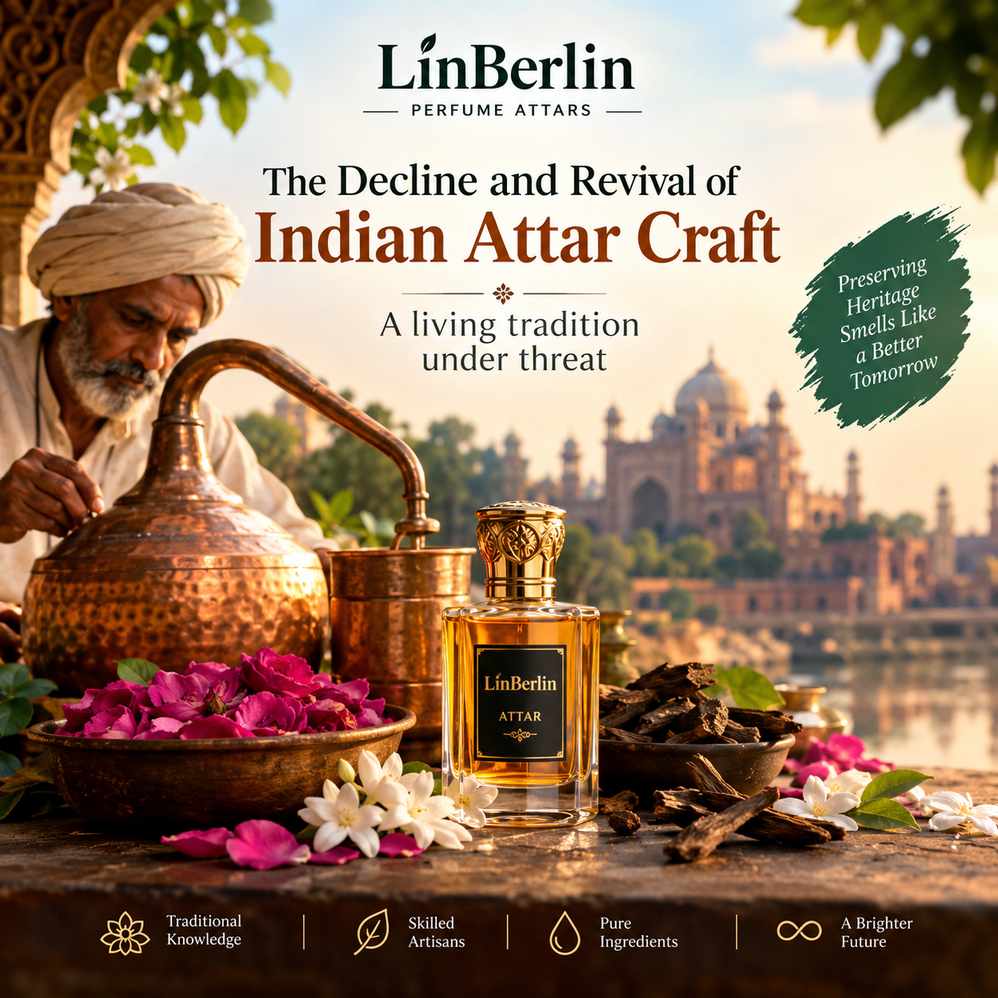
The first thing you notice in a Kannauj distillery isn't the scent. It's the sound, a low and patient hiss from a copper pot that has been sitting over a wood fire since before dawn.
The scent comes later, slowly, and it never arrives the way a spray does. It settles into your clothes, your hair, the back of your throat. You leave smelling of a place. That, more than any single note, is what attar has always been: a place, bottled by people who knew how to wait.
And right now, that knowledge is thinner than it should be.
What the copper pot actually does
The traditional method is called deg-bhapka. Flowers or herbs go into a copper still (the deg), and the vapour travels through a bamboo pipe into a receiving vessel (the bhapka) that sits in cool water. What condenses is caught not in alcohol but in sandalwood oil, which acts as a base and a keeper. Nothing is rushed. A batch can take many hours, and the distiller judges the fire by feel, by the colour of the steam, by the sound. There is no dial.
It is a method built around patience, and patience is exactly what modern markets punish.
Take Kannauj's rose attar, which depends on a short harvest season and flowers that must be picked at dawn and distilled the same day, or they begin to turn. A late truck, a hot afternoon, and a batch is simply worse. Nobody can fake that with a deadline.
How the slow slide began
There wasn't one blow. It was — well, it was several, arriving over decades, each one small enough to survive on its own.
Synthetic aroma chemicals came first, cheaper and steadier and available in any quantity. Then alcohol-based sprays, which smell loud immediately and are priced for the mass market. Genuine sandalwood oil became scarce and costly, so many producers began using paraffin or other fillers as the carrier instead, and the word "attar" on a label quietly stopped meaning what it used to. Buyers who had never smelled the real thing had no way to tell.
Then the quieter loss, which gets mentioned least. Distilling is a trade learned through the hands, and the hands are ageing. Plenty of younger family members looked at long hours, uncertain income and a smoky workshop, and chose a different career. Can you really blame them? I can't.
Realistically, some of what has gone will not come back. Certain regional blends exist now only as a description in an old ledger or a grandfather's memory. That's a loss, and it's better to say so plainly than to pretend revival fixes everything.
What disappears when an attar disappears
It isn't only fragrance. Each attar carries a piece of how people lived. Consider the ritual of jasmine and sandalwood in Indian mornings, a scent that belongs to temple steps, wet courtyards and the first cup of tea. Lose the real material and you keep the word while the morning changes.
Then there is mitti attar, made by distilling baked clay, which is perhaps the most Indian idea in all of perfumery: bottling the smell of the first rain on dry ground. Paired with sandalwood it becomes something close to memory itself, and sandalwood and wet earth quietly remembering the rain is not a poetic exaggeration. It's chemistry and culture agreeing for once.
A craft this old does not need to be preserved like a museum object. It needs customers.
Even the flowers are an economy. Kewra, the screw-pine blossom that smells somewhere between honeyed flowers and fresh rain, supports small growers who have few other buyers. And oud, which many readers connect only to the Gulf, has its own Indian chapter through Assam's agarwood trade. Those blends are explored in this look at black and royal oud together, if you want to see how far the tradition reaches.
Signs the tradition is breathing again
Not everything is grim. There's a small, stubborn movement of younger perfumers, some from distilling families and some outsiders, who are asking buyers to smell before they decide. Transparent sourcing, real sandalwood bases, honest labels. It isn't a flood. But it's real.
The people sustaining it are, mostly, ordinary buyers. Every bottle of properly made attar bought means a distiller keeps a fire lit another season. The truth is that this craft will survive or fade according to what we choose to spend money on, and no heritage grant is going to change that by itself.
Wearing attar well, and wearing it safely
If you're going to support the craft, enjoy it properly. Attar is concentrated oil, so it behaves differently from spray perfume. It sits close to the skin and warms with you.
Moisturised skin holds scent noticeably longer than dry skin. A thin layer of unscented moisturiser before application gives the oil something to cling to, which is why people with dry skin often find attar lasts all day while those with very oily skin may find it turns stronger and shifts faster. Normal skin sits comfortably in between. And on very oily skin, a single dab on the wrist or behind the ear goes further than you'd expect.
Caution is warranted in a few cases:
- Sensitive skin or known fragrance allergies: patch test on the inner elbow and wait a full day before wearing it properly.
- Pregnancy: essential oils and some natural extracts are worth running past your doctor first, because "natural" does not automatically mean "gentle".
- Skin using retinoids, strong exfoliating acids or recently treated with peels: it's thinner and more reactive, so apply attar to clothing or the hair ends rather than directly on the skin.
Never apply to broken or freshly shaved skin. If something stings, wash it off with mild soap and don't try again until the skin settles. I'm not a dermatologist (and no article can substitute for one), so persistent redness deserves a proper opinion.
One more thing people get wrong: layering attar over a heavily fragranced body lotion. The result is muddy, and sometimes irritating. Choose one scented layer, not two.
Where to begin
Start small. Pick one attar that connects to a memory of yours, whether a rose, a morning, or the smell of rain, and wear it for a week. Notice how it changes through the day.
That's how a tradition survives, really. Someone smells it, remembers something, and buys another bottle.