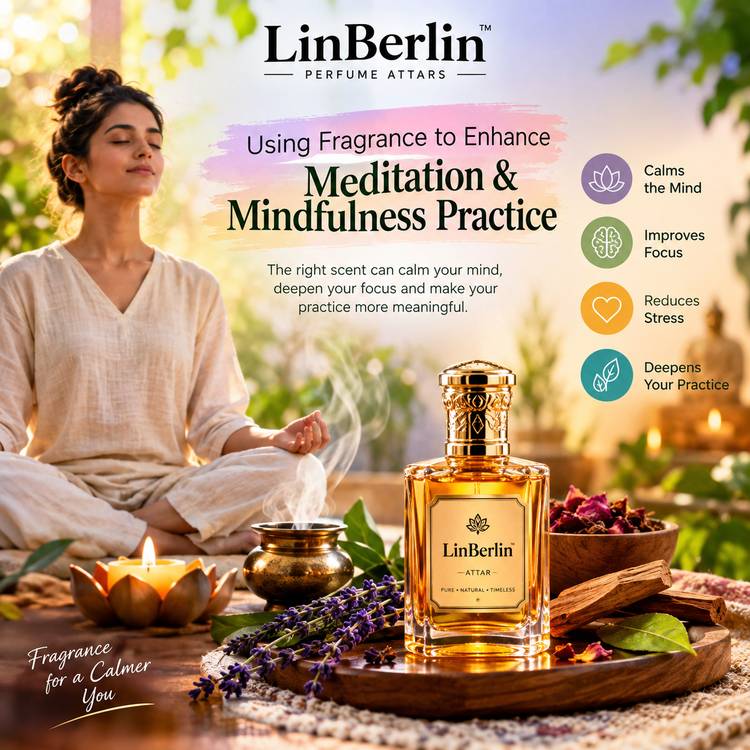
Most people who abandon meditation don't abandon it because sitting still is hard. They abandon it because the room never feels like a place for it.
The cushion smells like the sofa. The corner smells like yesterday's dinner, or a damp towel, or the laundry that's been waiting since Tuesday. Your nose files all of that under "ordinary life" before you've even closed your eyes, and the mind follows the nose.
So this isn't really a piece about making a room smell nice. It's about giving your practice a threshold, a scent you meet only when you sit, so the body learns the cue faster than the mind can argue with it.
Why a scent can work as a doorway
Smell is wired unusually close to the parts of the brain that handle memory and emotion. That's why a whiff of rain on hot earth can drop you into a childhood afternoon without asking permission. Meditation borrows the same mechanism: repeat one scent alongside one practice, again and again, and the scent starts to carry the practice with it.
Realistically, no fragrance will quiet a restless mind on its own, and the research on scent and meditation specifically is modest (a lot of it is small studies on relaxation, not on formal sitting practice). What I can say from experience is narrower and more useful: a consistent scent shortens the runway. Five minutes of settling becomes two.
People have known this far longer than the studies have. Fragrance sat at the centre of devotional life in many traditions, and if you want the long view, the history of itr in Sufi tradition shows how a drop of oil on the wrist became part of remembrance itself, not decoration around it.
Why oil-based attar suits stillness
Alcohol perfumes announce themselves. The first spray is bright and sharp, then it collapses, and you spend your sit waiting for the dry-down. Attar behaves differently. It's an oil, it sits close to the skin, and it moves slowly through its notes, which is exactly what you want when your attention is meant to stay in one place.
There's also the practical matter of scale. One small dab is enough. A meditation scent should be something you find only when you lean in and breathe, not something that fills the room and demands attention. If you notice it constantly, it's too much.
Matching the scent to the kind of practice
Different sits ask for different things. A rough guide, and it is only a guide:
- Breath-focused sitting usually wants something clean and steady: sandalwood, vetiver, a quiet white musk. Nothing that changes dramatically every ten minutes.
- Body scans and evening wind-downs suit softer, rounder notes. Lavender does the calming, vanilla does the wrapping, and the pairing is explained well in this piece on where lavender calms the mind and vanilla adds warmth.
- Walking meditation, or a morning sit when you're fighting sleepiness? Something with a little lift. Citrus peel, green notes, a touch of rose.
- Devotional practice, such as japa or daily puja, is its own tradition with its own expectations, and if that's your path, the notes on choosing fragrance for daily worship are worth reading before you pick anything.
If you'd rather start from a shortlist than a theory, LinBerlin has collected some attars that deepen stillness and calm the mind. Pick one. Not three. The whole point is repetition, and a rotating collection defeats it.
Skin comes first: how to apply it properly
Here's where my skincare background matters, because most scent advice ignores the skin the scent is sitting on. Fragrance doesn't hover in the air over you. It lives on your skin, and your skin decides how it behaves.
Dry skin lets scent fade fast. The oil has nothing to cling to, so it disappears within a couple of hours and people conclude the attar is weak. It isn't — well, usually it isn't. The skin was just thirsty. Moisturised skin holds fragrance noticeably longer, which is why a thin layer of unscented lotion or a neutral oil beforehand makes such a difference. If you want to go further, the guide to body oils that sit under an attar covers what pairs well.
Oily skin does the opposite. It amplifies and warms the scent, so notes can turn heavier than you expected. Use less. Combination skin is the awkward middle: the wrists may hold scent for hours while the chest turns it sweet and loud.
Sensitive skin needs a slower approach altogether. Which brings us to the honest part.
Where caution is genuinely needed
Natural does not mean harmless. Plant-derived oils contain compounds that can irritate or sensitise, and rose, jasmine, sandalwood and citrus oils all show up on allergen lists for some people. Patch-test first: one small drop on the inner forearm, wait 24 hours, and watch for redness, itching or warmth. Skipping this step is the mistake I see most often, and it's the one people regret.
A few other situations deserve a pause:
- Skin using retinoids, exfoliating acids or prescription treatments is often more reactive than it looks. Apply the attar to clothing at the collar or to a scarf instead, and keep it away from freshly treated areas.
- Never put attar on broken, sunburnt or freshly waxed skin, or anywhere near the eyes.
- If you're pregnant, ask your doctor or midwife before using concentrated essential-oil-based products. Guidance varies, and I'm not going to pretend one rule fits everyone.
- Asthma or fragrance sensitivity? Keep it strictly personal, in tiny amounts, and never in a shared meditation space where others can't opt out.
One limitation worth admitting: I can't tell you how your skin will respond. Nobody can from a screen. Your forearm can.
A ten-minute ritual you can actually keep
- Moisturise the spots you'll use, wrists or the side of the neck, with an unscented product. Give it a minute to absorb.
- Touch a single drop of attar to one wrist, then gently press the other wrist against it. Don't rub. Rubbing bruises the top notes and warms the oil too quickly.
- Sit. Lift your wrist and take one slow breath of the scent before you begin, then let the hand rest.
- Practise. When your mind wanders (it will, and that's the practice, not the failure), the scent is there to come back to.
- When you finish, take one more breath of it and stay a moment before you get up.
That last step matters more than it looks. It closes the loop, and closing the loop is what teaches your body that this scent means this state.
Mistakes that quietly undo the effect
Wearing the same scent all day is the big one. If it follows you into the office, the commute and the supermarket, it stops meaning anything special. Keep it for practice, or at least for the evening.
Layering several fragrances is another. A scented body wash, a perfumed lotion, then an attar on top: your nose can't find the one note you meant to anchor to. And using too much, always too much. If the scent is louder than your breath, dial it back.
Changing scents every week feels like variety. It's actually reset. Give one attar a month before you judge it.
Where to start
Choose one attar, patch-test it, and pair it with one short sit at the same time each day. Two weeks in, notice what happens when you first smell it. That small softening is the whole point, and it belongs to you.