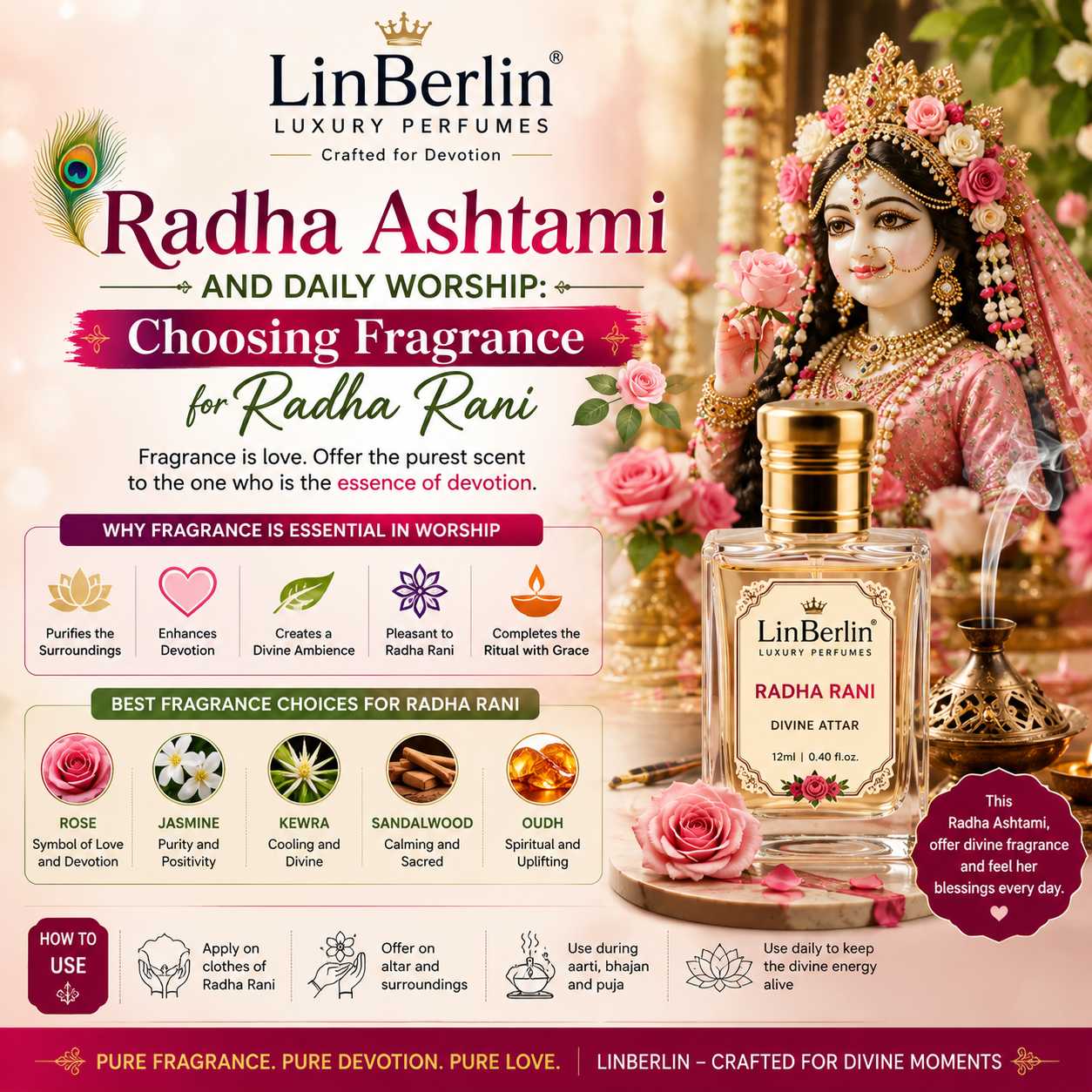
There's a moment right before the aarti begins where nobody is watching except the person doing the shringar. The bells haven't started. The room is still half-lit. And somewhere in that quiet stretch, a drop of attar gets touched to the hem of a small vastra, or dabbed near the edge of a shringar cloth, almost as an afterthought — except it isn't one. That small, unhurried gesture is where fragrance actually earns its place in worship, long before anyone else in the household even notices the room has started to smell different.
Radha Ashtami sits at the center of that gesture for many households, but the deeper truth is that the care shown on that one day is really just a more elaborate version of something meant to happen daily. Choosing fragrance for Radha Rani isn't a one-time festival decision. It's a small, repeated act of attention — and understanding why attar specifically fits that role, rather than incense or bottled perfume, says something about how sensory devotion actually works in this tradition.
What Makes Radha Ashtami Different From an Ordinary Day of Worship
Radha Ashtami marks the appearance of Radha Rani, and in most households that observe it, the day carries a heightened version of everything that happens in daily seva — more elaborate shringar, more time spent on adornment, often a specific richness in the fragrance chosen that wouldn't necessarily be used on an ordinary weekday. The truth is, this isn't unique to Radha worship. Most devotional traditions scale up sensory offering on significant days while keeping things simpler day to day. But Radha Ashtami has a particular emotional texture to it — the day leans toward tenderness and devotion rather than grandeur, and that changes what "elaborate" actually means here.
An elaborate shringar for Radha Rani isn't necessarily about intensity of fragrance. It's about care — layering rose, perhaps something floral and soft rather than reaching for something heavy or overpowering. Devotees who've done this for years tend to describe it less as "choosing the strongest attar" and more as choosing the one that feels closest to how they imagine tenderness smelling. That's a subjective, personal judgment, and it should stay that way — there isn't one correct fragrance profile for this, whatever any single guide might suggest.
Why Attar Specifically, Rather Than Incense or Bottled Perfume
Incense fills a room. Attar, by comparison, stays close — it lives on the fabric itself rather than dispersing into the air and fading within the hour. For daily seva, where the same shringar cloth or vastra might be handled and re-folded multiple times through the day, that closeness matters. An attar-scented cloth still carries fragrance hours later, in a way loose incense smoke simply doesn't. And there's a quieter reason too, one that doesn't get discussed often: attar is oil-based, applied in small measured drops rather than sprayed or burned, which suits the unhurried, deliberate rhythm of shringar itself. It's not something you rush through. Each drop is placed, not sprayed on indiscriminately — and that small physical act of placing rather than spraying fits the devotional pace better than people usually credit it for.
There's a broader explanation of this worth reading if the reasoning interests you further — why oil-based attar still holds its place in pooja traditions despite how common incense has become covers the practical and cultural reasoning in more depth than fits naturally here.
Choosing a Fragrance Built Specifically for Radha Rani's Shringar
Generic floral attars work in a pinch, but there's a real difference between a fragrance blended with Radha Rani's shringar specifically in mind and one that's simply "rose-scented" without much further thought behind it. A dedicated Radha Shringar attar for Radha Rani puja is built around that specific tenderness rather than a broad, all-purpose devotional scent — which matters more than it might seem to someone browsing options for the first time, because the wrong fragrance profile can feel oddly mismatched even if nobody in the room could explain exactly why.
How This Differs From Choosing Fragrance for Other Forms of Worship
Fragrance choice in Hindu devotional practice isn't one-size-fits-all, and this is where a lot of first-time buyers get a little lost. Surya Dev worship tends to lean toward brighter, more energizing notes given the associations with dawn and vitality. General daily pooja, when it isn't tied to one specific deity, often uses a simpler, more neutral floral base. If you're navigating multiple forms of worship in the same household — which is common, since many families maintain a broader daily practice alongside deity-specific seva — it helps to see how these choices differ side by side, and there's a clear breakdown of how fragrance should differ between Radha Rani, Surya Dev, and general daily pooja practice worth reading if your household observes more than one form of worship.
The Connection to Krishna Seva Worth Knowing
For many devotees, Radha Rani's shringar doesn't exist in isolation — it sits alongside the seva of Laddu Gopal Ji, and the two practices often echo each other in tone even when the specific rituals differ. Anyone deepening their understanding of shringar attar as a practice, rather than just picking something for one occasion, will find it useful to look at how Laddu Gopal Ji's seva uses attar within Kanha's shringar tradition, since the underlying philosophy — fragrance as an offering of care rather than decoration — carries across both practices.
A Few Practical Notes Worth Knowing Before You Buy
A little honesty here, since a devotional article shouldn't skip the practical side just because the subject feels sacred. LinBerlin's attars, including those blended for deity shringar, are designed for use on fabric and clothing — the vastra, the shringar cloth — rather than directly on human skin. This matters for two reasons: first, because that's simply how the oils are formulated and concentrated, and second, because anyone handling these attars with sensitive skin, known fragrance allergies, or during pregnancy should be a little more careful even with incidental contact during application. If a drop lands on your hand while dressing the deity, that's ordinarily nothing to worry about for most people — but if you know you react to concentrated florals or oud-based oils, it's worth washing your hands promptly rather than letting the oil sit against skin for an extended period.
None of this changes the ritual itself. It's a small, practical footnote rather than a warning against the practice — the kind of detail a careful seller mentions honestly instead of glossing over.
Building a Fuller Understanding of Attar in Worship
If Radha Ashtami is your entry point into thinking more seriously about fragrance in devotional practice generally, rather than just this one occasion, it's worth stepping back and reading something broader before narrowing in again. There's a fairly thorough complete guide to attar for pooja and devotional worship that covers the wider context — different deities, different occasions, different fragrance families — which pairs well with the more specific focus of this piece.
Where This Actually Leaves You
Choosing fragrance for Radha Rani, on Ashtami or any ordinary Tuesday evening, was never really about finding the "correct" scent in some technical sense. It's about paying attention — noticing what tenderness might smell like, and trying, imperfectly and quietly, to bring a little of that into the shringar. That's the whole practice, really, dressed up in fewer words than the ritual itself ever needs.