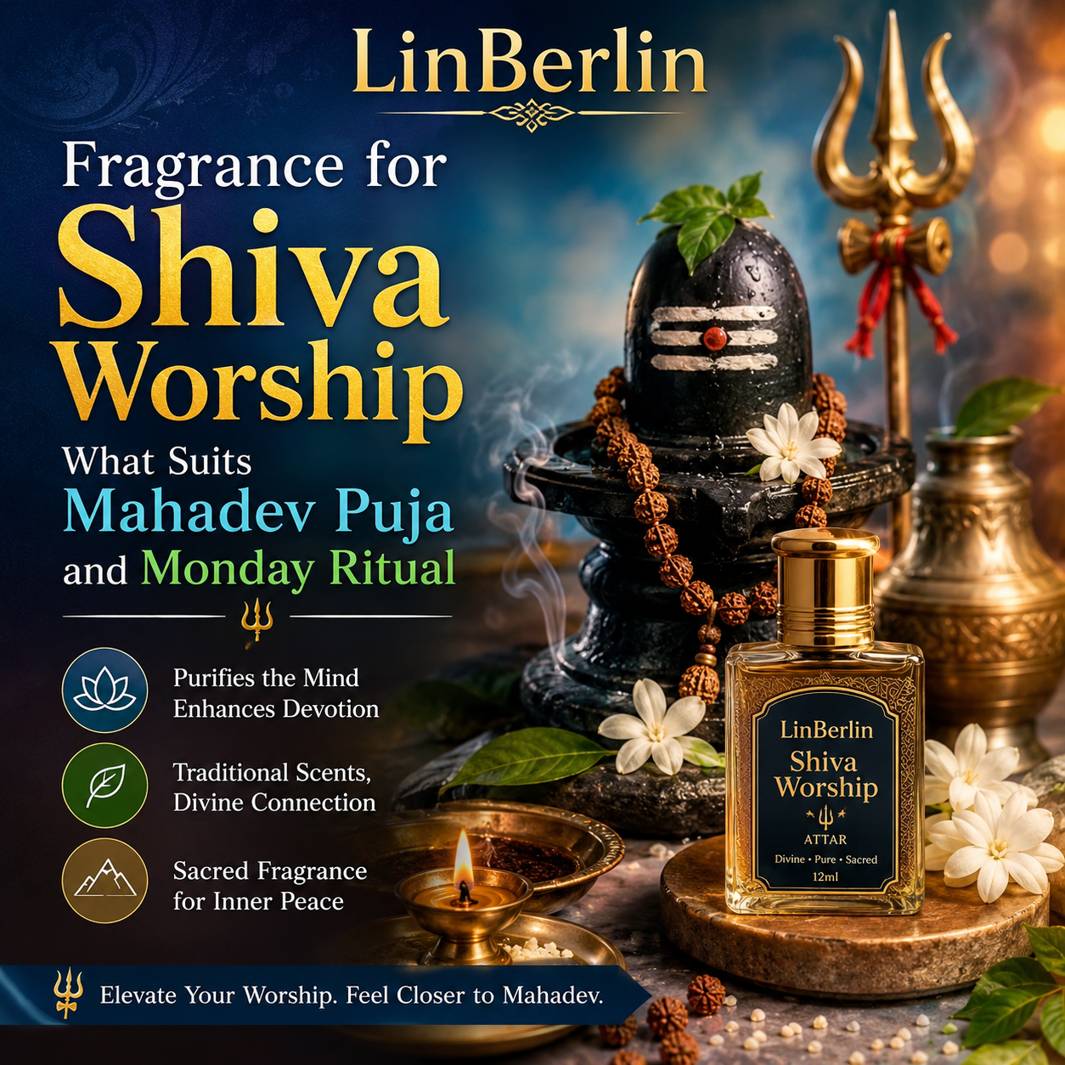
My grandmother kept a small brass box of sandalwood shavings next to her puja mandir, not because any scripture told her to, but because she said Mahadev's temple always smelled like wet stone and something older than incense sticks could explain. That smell — cool, mineral, slightly bitter under the sweetness — turned out to be the closest thing to what sandalwood attar does on skin. It doesn't announce itself. It just settles in, the way a mountain settles into a landscape rather than standing out from it.
That's really the starting point for understanding fragrance in Shiva worship. Most devotional fragrance guides talk about what to burn or wear as if it's a checklist. With Mahadev, the logic runs the other way — you're not choosing a scent to please a deity so much as choosing one that matches the temperament he's associated with. Ascetic. Unbothered by ornamentation. Drawn to the raw over the refined.
Why Shiva's Fragrance Language Is Different
Vishnu worship leans toward tulsi and warm florals. Devi worship, especially during Navratri, calls for something layered and celebratory. Shiva sits apart from both. He's depicted covered in ash, wrapped in animal skin, living on a mountain rather than in a palace — and the fragrances associated with him follow that same austerity. Sandalwood, or chandan, isn't a decorative choice here. It's cooling, it's used to calm the third eye symbolically, and its scent profile — dry wood, faint milk, a trace of something almost medicinal — mirrors the stillness Shiva is meant to represent. Bael leaves, datura, and dhatura flowers get offered physically at his shrines for similar reasons: not because they're beautiful, but because they're unglamorous plants that still hold sacred weight.
If you've read our guide on choosing fragrance by deity, you'll know each god in the Hindu pantheon carries a distinct olfactory identity. Shiva's is arguably the most restrained of them all — and that restraint is exactly what makes it hard to get wrong, but also easy to over-decorate if you're not paying attention.
Sandalwood: The Fragrance Mahadev Actually Wears
Ask any priest at a Shiva temple what scent dominates the sanctum and the answer is almost always chandan. It's mixed into the abhishekam water sometimes, applied as a paste to the lingam, and burned as incense during aarti. On skin, natural sandalwood attar behaves in a way synthetic sandalwood simply doesn't — it opens dry and slightly sharp, then rounds out over twenty or thirty minutes into something creamy, almost like warm milk over wood. That transformation is part of why it's so tied to meditation and worship. It gives you time to settle into stillness alongside it.
This is where our Shiv Chandan attar for Mahadev puja comes in — a blend built specifically around that cooling, unhurried sandalwood character rather than a generic "woody" note. Realistically, a lot of attars marketed for puja use lean too sweet or too loud, chasing a perfume-counter appeal that has nothing to do with what devotional fragrance is supposed to do. The point of chandan on a Shiva devotee isn't to be noticed by other people. It's to help you notice your own breath.
Monday and the Rhythm of Ritual
Monday — Somvar — belongs to Shiva in the Hindu week, and a lot of households treat it as the day for a more deliberate puja than usual. Fasting, a visit to the temple, an extra round of the Rudrashtakam or Om Namah Shivaya. Fragrance plays into that rhythm quietly. Applying attar before a Monday puja isn't strictly mandated anywhere, but it's become customary in many families as a way of marking the day as different from the other six. A dab of sandalwood on the wrist or behind the ear before you sit for aarti does something small but real: it signals to your own senses that this hour is set apart.
There's also a practical layer worth mentioning, and it's the kind of detail that gets left out of most spiritual writing on this topic. Attar applied to pulse points — wrists, the base of the throat, behind the ears — lasts longer and diffuses more evenly than attar applied to clothing, because body heat activates the oil gradually rather than releasing it all at once. For a puja that might run forty minutes to an hour, that slow release matters. You want the scent still present, not gone, by the time you're offering the final aarti.
What Doesn't Belong in Shiva Worship
Heavy florals, anything overtly sweet or musky, synthetic ambers that read as more nightclub than temple — these clash with the whole point of the ritual. It's not that they're wrong in some cosmic sense. It's that they pull attention toward themselves, and Shiva worship, more than most, is about pulling attention inward. A rose attar might be gorgeous for a Lakshmi puja or a Durga Navratri celebration, and honestly it should be — those are festive, abundance-oriented forms of worship where richness fits the mood. But wearing something floral and heavy to a Somvar puja tends to feel, to a lot of devotees at least, slightly off-key. Like showing up to a monastery in sequins.
So the rule of thumb, if there is one: match the fragrance's emotional register to the deity's. Shiva is quiet. Chandan is quiet. That pairing isn't accidental.
Skin, Attar, and the Practical Side Nobody Talks About
Here's the thing most devotional fragrance content skips entirely — how the attar actually behaves on your particular skin, and whether it's even a good idea for everyone. Sandalwood attar is generally well tolerated because it's oil-based rather than alcohol-based, which means less immediate irritation for most people. But "generally" isn't "always." If your skin runs dry, sandalwood attar tends to last beautifully — dry skin has less natural oil to compete with the attar's own base, so the scent sits closer to the surface and reads slightly stronger for longer. Oily or combination skin does something different: natural sebum actually helps diffuse the fragrance, so it can smell fuller in the first hour but fade faster overall, sometimes within three to four hours instead of six or more.
And then there's the layering problem. People with an active skincare routine — retinoids, vitamin C serums, exfoliating acids — sometimes apply attar directly over freshly treated skin and wonder why their wrist stings or turns pink. Compromised skin barrier plus concentrated essential oils is not a good combination. If you've used a retinol or a strong acid that morning, apply attar somewhere the product hasn't touched, or wait a few hours until the skin has calmed down. It's a small adjustment but it prevents a lot of unnecessary discomfort.
People with sensitive skin, eczema, or a history of fragrance allergies should patch test any attar — including pure sandalwood — on the inner forearm before applying it near the face or wrists in a puja setting. Pregnant readers should also check with their doctor before regular use of concentrated essential oil attars, since some naturally occurring compounds in sandalwood and other botanicals aren't fully studied for safety during pregnancy. This isn't meant to alarm anyone; it's just the kind of caution that gets left out of most spiritual fragrance articles, and it shouldn't be.
How to Apply It Before Puja
Keep it simple. A small amount goes further than people expect with pure attar — one or two drops on each wrist, pressed together rather than rubbed (rubbing can break down some of the oil's finer aromatic compounds), and perhaps one drop at the base of the throat. Moisturised skin holds scent noticeably longer than dry, flaky skin, so if your hands or wrists are parched, a light unscented moisturiser underneath will extend the attar's staying power without muddying its character.
Some devotees also apply a trace to the third eye area, echoing the tilak tradition, though this should be done carefully and only with attars known to be gentle, since the skin near the eyes is thinner and more reactive.
Beyond Monday: Fragrance Across the Devotional Calendar
Shiva worship doesn't stay confined to Mondays, of course. Maha Shivratri calls for a similar chandan-forward approach but often with more offering of the fragrance itself — burned as incense through the night rather than just worn. For readers exploring fragrance choices tied to other festivals and deities, our broader guide to attar for pooja and devotional worship covers how these choices shift across the ritual calendar, and our piece on Hanuman worship on Tuesdays and Saturdays is a useful comparison point — since Hanuman, like Shiva, tends to call for something grounded rather than ornamental, though the two aren't identical in character.
The truth is, fragrance in worship was never meant to be a performance for anyone watching. It's closer to a private cue — something that tells your own mind it's time to slow down, sit still, and pay attention. Sandalwood does that job for Shiva devotees better than almost anything else, not because it's the most impressive scent in a bottle, but because it's the one that asks the least of you and gives the most back in return.
If you're building a Monday ritual around fragrance for the first time, start small. One attar, applied with intention, will teach you more about how scent and stillness work together than a shelf full of options ever could.