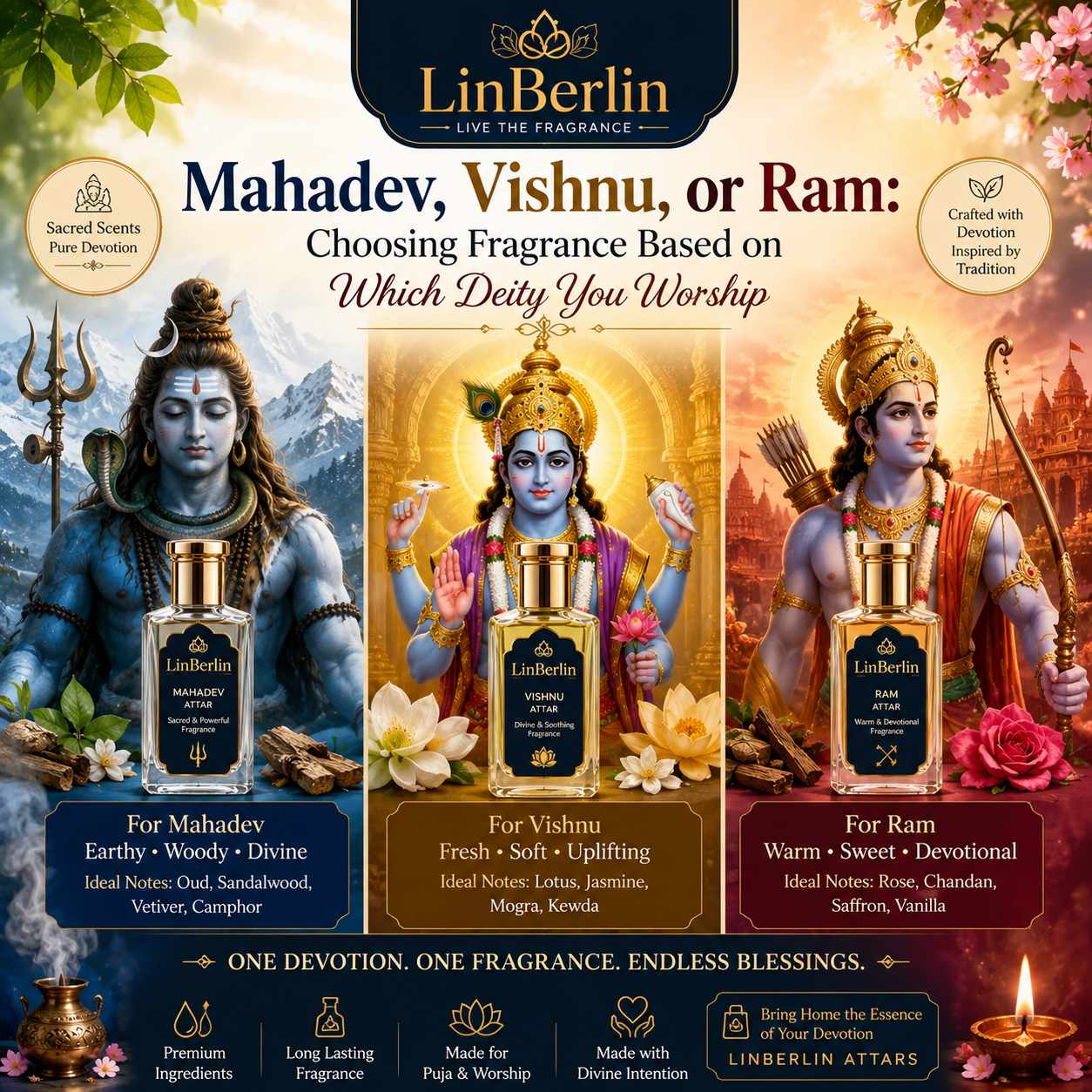
My grandmother kept three small bottles on the same shelf as her puja thali, and for years I assumed it was habit, nothing more — a woman who liked her rituals tidy. It wasn't until I started working with attar professionally that I understood what she actually knew: the fragrance offered to a deity is never really separate from the fragrance that touches the devotee's own skin first. She dabbed a drop on her wrist before she ever opened the bottle near the idol. That small, almost invisible gesture is where this entire guide begins.
Choosing a scent for Mahadev, Vishnu, or Ram isn't only about tradition or which flower belongs to which god, though that matters too. It's also about how that oil behaves once it meets your own skin — how long it lingers, whether it sits well on dry or oily skin, and whether it's gentle enough for daily shringar without irritation. Most guides skip this part entirely. We won't.
Why the Deity's Nature Shapes the Scent Family
Each of these three forms carries a different temperament, and attar tradition has always tried to mirror that rather than fight it. Shiva is associated with restraint, coolness, the ash-smeared ascetic who sits beyond the noise of the world. Vishnu is the preserver, calm but active, associated with abundance and gentle sustaining energy. Ram is maryada purushottam — dignified, disciplined, but also deeply human, a prince who is worshipped with daily care almost like a family member. So the fragrance families that suit them aren't interchangeable, even if a casual shopper might assume "attar is attar."
And this is where the skin conversation actually starts to matter, because a cooling sandalwood attar behaves very differently on oily skin than it does on dry, flaky skin in winter.
Mahadev: Cooling, Grounding, and Skin-Friendly Sandalwood
Chandan — sandalwood — is almost synonymous with Shiv puja, and there's a physiological reason it has survived thousands of years of use beyond just symbolism. Sandalwood oil is naturally soothing on skin, low in irritation potential compared to many synthetic musks, and it tends to sit close to the skin rather than projecting loudly. For someone doing daily abhishek or evening aarti, that's actually practical. You don't want a scent that overwhelms a small puja room. The Shiv Chandan attar for Mahadev puja is built around this exact idea — cooling, woody, unhurried.
Here's the honest part, though: pure sandalwood attar, even good quality, can feel slightly drying on already parched skin, especially in colder months. If you're applying it directly to your wrist or the centre of your forehead before puja, a thin layer of an unscented moisturiser underneath helps the oil sit smoother and last longer without tugging at dry patches. Moisturised skin holds onto attar significantly better than bare, dry skin does — this isn't folklore, it's simple chemistry, since oils and moisturised skin cells bond and evaporate more slowly than oil sitting on flaky, dehydrated surface skin.
Vishnu: Lotus, Saffron, and a Slightly More Layered Profile
Vishnu worship tends to lean toward softer floral-resinous notes — lotus, a whisper of saffron, sometimes a touch of tulsi in blended attars — reflecting abundance without excess. It's a gentler, rounder profile than Shiva's austere sandalwood, and honestly, that roundness makes it a little more forgiving on sensitive skin too, since there's usually less concentrated wood-resin content that can sometimes cause a warming or tingling sensation on reactive skin. The Vishnu Seva attar for Lord Vishnu puja was blended with this daily-use gentleness in mind, since Vishnu bhakti in many households isn't occasional — it's a quiet, near-constant practice.
But not all skin reacts the same way to saffron-adjacent blends. People with genuinely reactive or eczema-prone skin sometimes notice a mild flush around the application site, particularly if the attar carries a higher percentage of natural essential oil concentrates. It's rarely serious. Still, if you've never used a saffron-forward attar before, a patch test on the inner forearm — twenty-four hours, no rushing it — tells you more than any product description ever will.
Shri Ram: Floral Shringar for Daily, Personal Devotion
Ram bhakti often has a domestic, almost intimate quality to it. Many households dress and adorn a small Ram idol daily, the way one might care for a family elder — fresh clothes, fresh flowers, fresh scent. So the fragrance profile leans floral: rose, a touch of kewra, sometimes mogra layered in for brightness. It's less austere than Mahadev's sandalwood, less resinous than Vishnu's lotus-saffron blends, and built for frequent, close-contact application. The Ram Shringar attar for Shri Ram puja was designed around this daily-shringar rhythm rather than one big ceremonial moment.
Floral attars, rose especially, are generally well tolerated by most skin types. Or at least that's the reputation they carry. In practice, natural rose attar is a fairly low-irritant option, but it isn't zero-risk — people with true floral allergies (not the vague "I think I'm sensitive to flowers" kind, but diagnosed pollen or fragrance allergies) should still be cautious, since natural doesn't automatically mean hypoallergenic. That's a distinction worth repeating because so much fragrance marketing blurs it.
Matching Attar to Skin Type, Not Just Deity
This is the part most articles skip completely, and it's the part that actually determines whether your puja fragrance lasts through the whole ritual or fades within twenty minutes.
- Dry skin holds attar poorly on its own — oils evaporate faster off dehydrated skin cells, so a light unscented moisturiser applied first, then the attar dabbed on top, extends wear noticeably, sometimes by several hours.
- Oily skin actually holds fragrance longer in most cases, but it can also amplify certain heavier resinous notes like sandalwood or agarwood-blended attars to the point of feeling too strong in a small room — so apply slightly less than you think you need.
- Sensitive or reaction-prone skin does best with floral or single-note attars applied to clothing, a mala, or a small cotton wick near the idol rather than directly on skin, sidestepping the irritation question altogether while still honouring the tradition.
None of this is complicated once you've done it a few times. It just isn't explained anywhere, so people learn it the hard way — usually by noticing their attar has vanished by mid-aarti, or worse, by a small rash the next morning that they can't quite place.
Safe Application: What Skincare Actually Teaches Us Here
A few practical rules, gathered less from theory and more from watching people actually get this wrong over the years.
Never apply attar over freshly exfoliated skin, freshly waxed or threaded areas, or skin currently using retinoids, AHAs, or benzoyl peroxide — the barrier is compromised in all of these cases, and concentrated natural oils can sting or cause redness that has nothing to do with the attar's quality. Wait at least a few hours, ideally apply attar to clothing or a cotton pad instead on those days. And if you're pregnant, it's genuinely worth checking with your doctor before regular skin application of any concentrated essential-oil-based attar, sandalwood and saffron blends included — not because there's strong evidence of harm, but because caution costs nothing and pregnancy skin sensitivity shifts unpredictably.
Here's the thing though — most people don't need to overthink this nearly as much as ingredient lists make it sound. A tiny dab, tested once, on skin that isn't already irritated, is fine for the overwhelming majority of people. The caution is for edge cases, not for daily worshippers doing their normal routine.
If you'd rather sidestep the skin question altogether on certain days, oil-based attar still has a role even alongside incense and diffusers — dabbed onto a cotton wick, a bead mala, or the corner of a cloth near the idol, which the guide on why oil-based attar still has a place in pooja covers in more depth than we can here.
A Few Common Mistakes
People over-apply, assuming more oil means more devotion. It doesn't — it just means a headache-inducing room by the third day. Some also switch attars too often, chasing novelty, when consistency actually deepens the ritual's meaning over time; the scent becomes a signal to the mind that puja time has arrived, and that association weakens if the fragrance keeps changing. And a smaller mistake, easy to miss: storing attar bottles near sunlight or heat, which degrades natural oils faster than people expect, sandalwood and saffron blends especially.
Bringing It Together
The truth is, choosing between Mahadev's sandalwood, Vishnu's lotus-saffron warmth, or Ram's daily rose shringar isn't really a decision you make once and forget. It shifts with the season, with your own skin's condition that month, sometimes even with your mood on a given morning. For readers exploring devotional fragrance more broadly, or building out a full puja routine across seasons and deities, the complete guide to attar for pooja and devotional worship is a useful next stop, and households that also keep a Laddu Gopal shringar practice might find the seasonal shringar fragrance guide genuinely helpful too.
What matters most, realistically, is paying attention — to the deity's nature, yes, but also to your own skin's response, because a fragrance that irritates you before you even reach the puja room isn't serving devotion, it's just getting in its way.