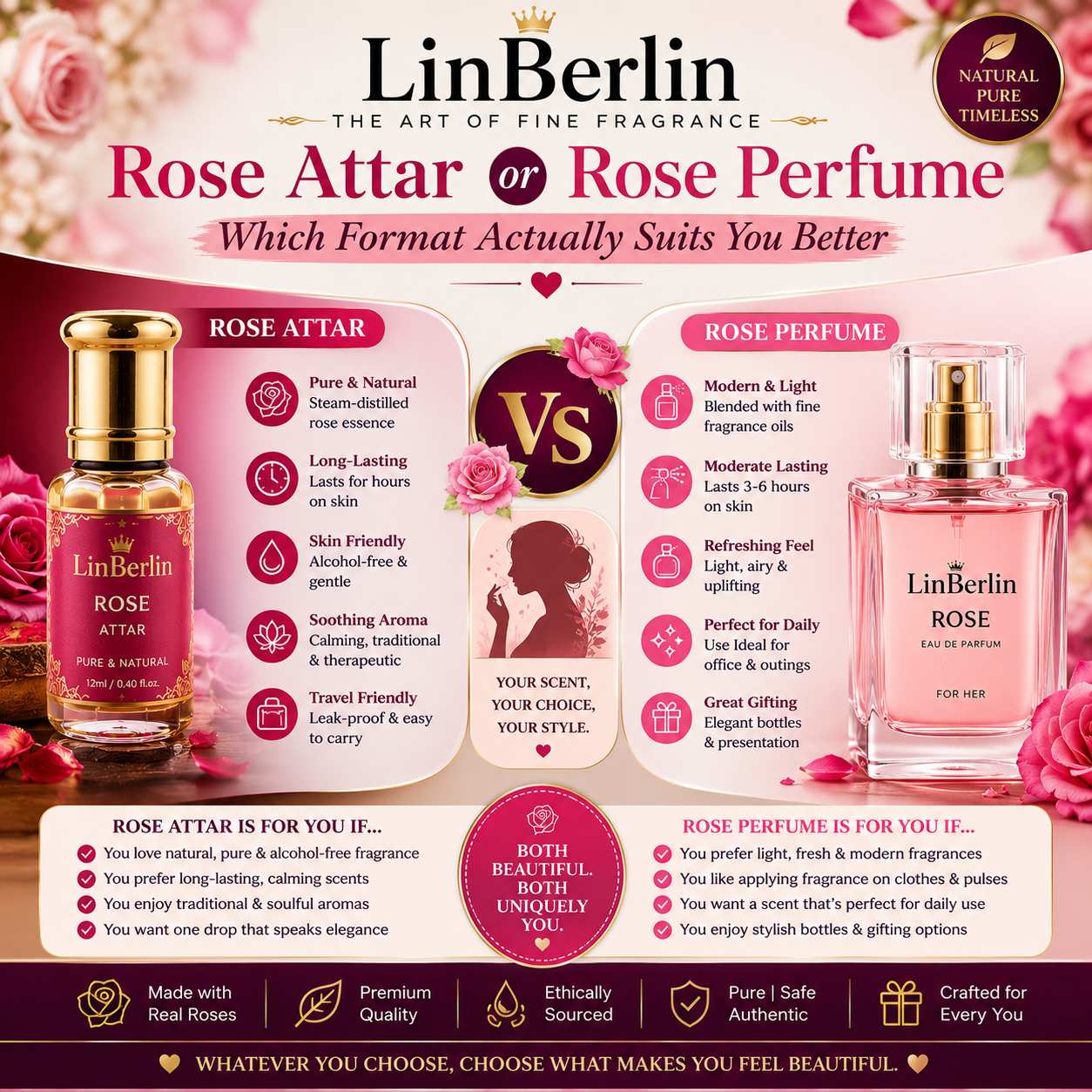
A woman in her sixties once told me she'd worn the same rose fragrance her whole adult life — a spray, always the same brand, replaced every year without a second thought. Then her skin changed after menopause, drier than it used to be, and the rose she'd loved for decades suddenly seemed to vanish within two hours. She assumed the formula had changed. It hadn't. Her skin had, and nobody had ever told her that the format she was wearing it in might need to change along with it. That story is really the whole argument for this piece. Rose attar and rose perfume aren't just two price points or two packaging choices — they're built on genuinely different mechanics, and which one "suits you" has almost everything to do with your skin and almost nothing to do with which one is objectively better.
Two different ways of carrying the same flower
Rose perfume, spray format, is built on an alcohol base. The alcohol disperses the fragrance quickly on application, carries the top notes out into the air where you (and everyone near you) can smell them immediately, and then evaporates — usually within the first fifteen to twenty minutes, taking a portion of the scent's brightness along with it as it goes. Rose attar works differently, and — this is worth being specific about — not just slightly differently. Real rose attar, distilled the traditional way, has no alcohol carrier at all. The rose oil sits in a base oil, usually sandalwood, and releases gradually through skin warmth rather than through evaporation. Less initial lift into the air around you. But considerably more staying power once it settles in, sometimes six to eight hours longer than the same rose note in spray form. Neither one is a lesser version of the other. They're built for different jobs.
Why rose attar specifically comes from one small town
Here's something worth knowing if you're buying rose attar seriously rather than casually: the vast majority of genuinely fine rose attar traces back to Kannauj, a town in Uttar Pradesh with a distillation tradition that goes back centuries and a specific climate — cool winters, particular soil — that produces rose petals with an unusually high oil yield. There's a properly detailed piece on exactly why this small Indian town produces the world's finest rose oil, worth reading if you want the fuller picture behind the raw material itself. Attar of Roses, Gul Nishan, draws from that same tradition — deg-bhapka distillation, sandalwood carrier, the kind of depth that a quick alcohol-based extraction simply can't replicate. It smells noticeably different from a rose spray from the very first moment — warmer, less green, closer to the actual flower crushed between fingers than to a polished, filtered version of it.
How skin type actually decides this for you
Dry skin and rose spray don't always get along. The alcohol in a spray formula can pull existing surface moisture as it evaporates, and on skin that's already short on natural oil, that often shows up as a rose fragrance that reads thin — pleasant for the first hour, then almost gone by lunch. It's not that the perfume was weak. Dry skin simply has less to hold the fragrance molecules onto once the alcohol carrier disappears. Rose attar tends to solve this cleanly, because the sandalwood base brings its own oil richness along rather than depending on what's already on the skin. On dry to normal skin, attar of roses can easily outlast the equivalent spray by several hours. Oily and combination skin flips the equation somewhat. Skin with more natural sebum acts as its own fixative, so spray perfume that fades quickly on dry skin can genuinely perform beautifully here — sometimes light application is all that's needed. Bluma, our rose perfume, was built with exactly this kind of skin in mind — a brighter, more immediate rose experience that doesn't need attar's slow build to feel complete, and that suits skin already inclined to hold fragrance well on its own.
What happens when rose meets your skincare routine
Moisturised skin holds rose fragrance longer, regardless of format, but the effect is more pronounced with spray perfume specifically — hydrated skin gives the alcohol something to settle into rather than evaporating straight off a dry surface almost immediately. But there's a caution worth being direct about. Layering alcohol-based rose spray directly over freshly applied retinol, glycolic acid, or other strong actives can sometimes cause stinging or heightened redness, since those actives leave skin more permeable for a window of time afterward. It's not usually dangerous, just uncomfortable, and it's avoidable — give active skincare twenty to thirty minutes to properly absorb before reaching for spray. Rose attar tends to be gentler in this specific scenario since there's no alcohol involved, though caution around any concentrated floral oil on freshly treated skin still applies generally. And rose itself, whatever the format, is one of the floral notes worth being slightly more careful with if you have a history of skin sensitivity — rose absolute in high concentration can occasionally irritate reactive skin, so a patch test on the inner arm before full application is a reasonable habit, particularly for anyone new to a specific formulation.
If rose alone feels like too much (or too little)
Realistically, not everyone wants rose worn completely on its own, and that's fine — it pairs beautifully in either format. There's a lovely piece on how rose meets jasmine in a quiet, woven-together way, worth exploring if you want more floral depth without losing rose's identity entirely. And for something at the opposite end of the spectrum entirely — brighter, sharper, built for warm weather when a heavy floral can feel like too much — citrus attar, Itr e Fawakih, is genuinely worth having on rotation alongside a rose. Some women wear rose in cooler months and switch to citrus through peak summer, when a lighter, sharper profile simply sits better on warm, humid skin. It's a small wardrobe-style approach, but it works.
Format beyond the spray-or-oil question
If you're weighing this decision more broadly — not just rose specifically, but how spray and oil formats differ for you as a woman in general, across skin types and lifestyles — there's a fuller breakdown in this guide to what actually decides spray or oil for you. And if it's specifically about the practical, day-to-day question of application format — roll-on attar versus a spray bottle in your bag — this comparison of roll-on attar against spray perfume covers the lifestyle side of the decision rather than the skin-chemistry side this piece has focused on.
Being honest about the limits
None of this is a guarantee, and it shouldn't be treated as one. Skin changes — with age, with seasons, with new skincare habits — and a format that suited you perfectly two years ago might not suit you the same way now. That's not a flaw in either rose attar or rose perfume. It's just the nature of wearing something on a living, changing surface rather than testing it on a paper strip.
Where this leaves you
If your skin runs dry, if you moisturise lightly or not at all, and if you want rose to actually last through a full day rather than fading by afternoon — rose attar is very likely your better match. If your skin runs oily or combination, and you like the immediate lift of a fragrance announcing itself the moment you apply it — rose perfume in spray form can genuinely serve you just as well, sometimes better. Try both on your actual skin before deciding, not on a card at a counter. That's really the only test that tells you anything true.