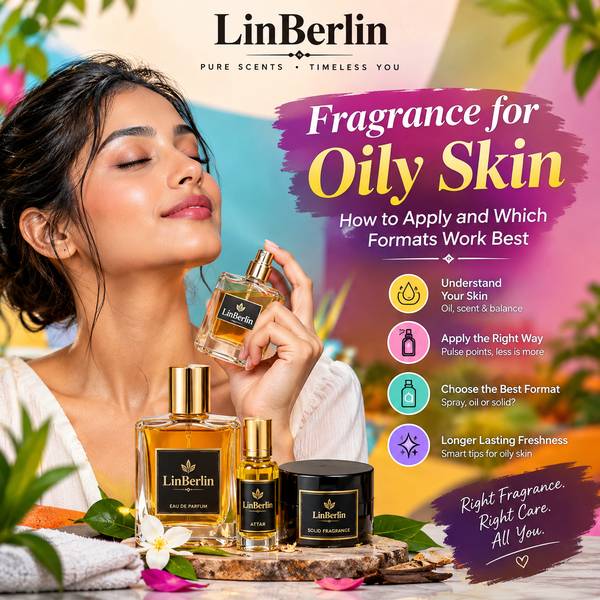
Spray a perfume strip and a pulse point on the same afternoon, and the strip will be sweeter, sharper and flatter by evening, while your wrist will have gone somewhere else entirely. Skin isn't paper. It's warm, it's alive, and on oily skin it's also a slightly slippery stage that changes how every note performs.
Most advice treats that oiliness as a problem to be managed. I'd argue it's closer to a feature, once you know what it does.
What oil on your skin actually does to a scent
Fragrance molecules need something to cling to. Dry skin offers very little, which is why perfume on parched wrists seems to evaporate before you've finished your tea. Oily skin offers plenty. Sebum holds on to scent, so base notes such as sandalwood, amber and oud tend to stay close and last well past what the same bottle manages on a drier arm.
But there's a catch, and it's the one people notice first. Sebum also warms and "cooks" a fragrance, which pushes the top notes out fast and can make the heart of the scent turn heavier or slightly sour by mid-afternoon. Citrus can go bitter. Light florals can smell a bit like warm lotion. It isn't that the perfume is bad — it's that your skin is amplifying certain parts of it and muting others.
Realistically, no skin type is "better" for fragrance. Oily skin gives you longevity and takes away some subtlety. Dry skin gives you a cleaner, quieter wear and takes away staying power. Normal and combination skin sit somewhere between, and combination skin is the tricky one (your forehead and your forearm may behave like two different people).
Why format matters more than the brand name on the bottle
Alcohol-based sprays were designed for skin that needs a lift. They throw the scent into the air, they smell bright in the first ten minutes, and they fade. On oily skin the alcohol evaporates quickly, the sebum takes over, and the scent you get at hour four is not the scent you sprayed at hour zero. Some people love that evolution. Others find it unpredictable.
Oil-based attar behaves differently. It's concentrated, it's applied in tiny amounts, and it sits on the skin rather than leaping off it. Because the carrier is usually a base like sandalwood oil, it blends with your natural oils rather than fighting them. The scent develops slowly and stays closer to you. On oily skin this is where attar tends to shine, and a small dab can do the work of several sprays.
That doesn't mean every attar suits every oily-skinned person. The question of format is really a question of what you want the scent to do, and if you're weighing it up for a particular note, this comparison of rose attar against rose perfume shows how differently the same flower can wear depending on how it's made.
How to apply it: the unglamorous details
Start with clean skin. Not stripped skin, just clean. If you've been blotting midday shine with powder, brush it off first, because powder and oil together make a paste that muddies the scent.
Moisturiser helps, even on oily skin, which surprises people. A light, non-comedogenic gel cream or a few drops of a fast-absorbing serum gives fragrance a stable base so it doesn't just ride on raw sebum. Wait until it has absorbed. Layering a fragrance over a still-wet product is the single most common mistake I see, and the result is a scent that smells slightly off, a bit sticky, and gone by lunch. So give it two or three minutes.
- Dab attar with a fingertip or the glass rod, using far less than you think you need. One small touch per spot is plenty on oily skin, because your skin will project it for you.
- Choose pulse points that run warm but aren't greasy: the inner wrists, behind the ears, the base of the throat. The T-zone and the sides of the nose are best avoided, and the back of the neck, where oil and sweat collect, can turn a perfectly lovely scent a little murky.
- Don't rub your wrists together. The friction heats the oil and flattens the top notes (I know, everyone does it).
Timing matters too. Applying right after a shower, when your pores are open and your skin is warm and slightly damp, can work beautifully, though on very oily skin you may want to let the surface settle first. And if you're trying to build a gentle, lingering presence rather than a loud one, the principles in this guide to leaving just the right scent trail translate especially well to oilier skin, where restraint really pays off.
Choosing notes that behave on oily skin
Heavy, resinous and woody notes tend to be the friends of oily skin. Sandalwood, amber, vetiver, musk and oud have the structure to hold their shape against sebum. Earthy, smoky or leathery blends often smell richer rather than muddier.
Very sweet profiles, think heavy vanilla or sugary gourmand blends, can become cloying faster, because oil amplifies sweetness. Bright citrus is the usual disappointment. It vanishes quickly on any skin and turns slightly sharp on oily skin. If you love citrus, go for it as a morning layer over a woody base, and accept that it's a short-lived pleasure.
Rose deserves a mention as an exception. A good rose attar on oily skin is often lovelier than on dry skin, deeper and more jammy, as long as the base is solid rather than thin.
Skin type by skin type: a quick honest map
Oily skin gets longevity and a risk of heaviness. Dry skin loses scent fast and benefits most from moisturiser underneath. Combination skin needs placement strategy: use the wrists and chest, skip the shiny zones. Sensitive skin needs patch testing before anything else, which brings us to the part that deserves a straight answer.
When to be careful
Natural does not automatically mean harmless. Essential oils and absolutes can still trigger reactions in some people, and rose, jasmine, citrus oils and some resins are common culprits. Do a patch test on the inner forearm and wait a full day before wearing something new on your pulse points.
If you use retinoids, exfoliating acids such as glycolic or salicylic, or benzoyl peroxide, your skin barrier may be more reactive than usual, and fragrance on those areas can sting or redden. Apply attar to clothing, hair ends or the inner elbow instead, and keep it off freshly treated skin. If you're pregnant or breastfeeding, check with your doctor before using concentrated oils regularly, since not every essential oil is considered safe during pregnancy. Anyone with eczema, dermatitis or a known fragrance allergy should speak to a dermatologist first. I should say plainly that I can't tell you what your skin will tolerate, and no article can.
Making it last through a long day
Oily skin helps here, but it won't do all the work. Spend a little time understanding what your scent does at hour two versus hour eight, and a simple fragrance journal makes this easy. Note the weather, what you applied it over, and how it smelled by evening. Within two weeks you'll know your own skin better than any chart can tell you.
For the practical side of stretching a scent through a full day, this advice on making fragrance last through a long workday covers reapplication without overdoing it. With attar on oily skin, though, you'll often find you need it less than you expected.
The short version
Moisturise lightly, let it absorb, apply attar sparingly to warm, clean pulse points, and favour woody, resinous or musky bases. Patch test anything new. And if a scent turns sour on you, try it again in a month or switch the format before you blame the bottle.