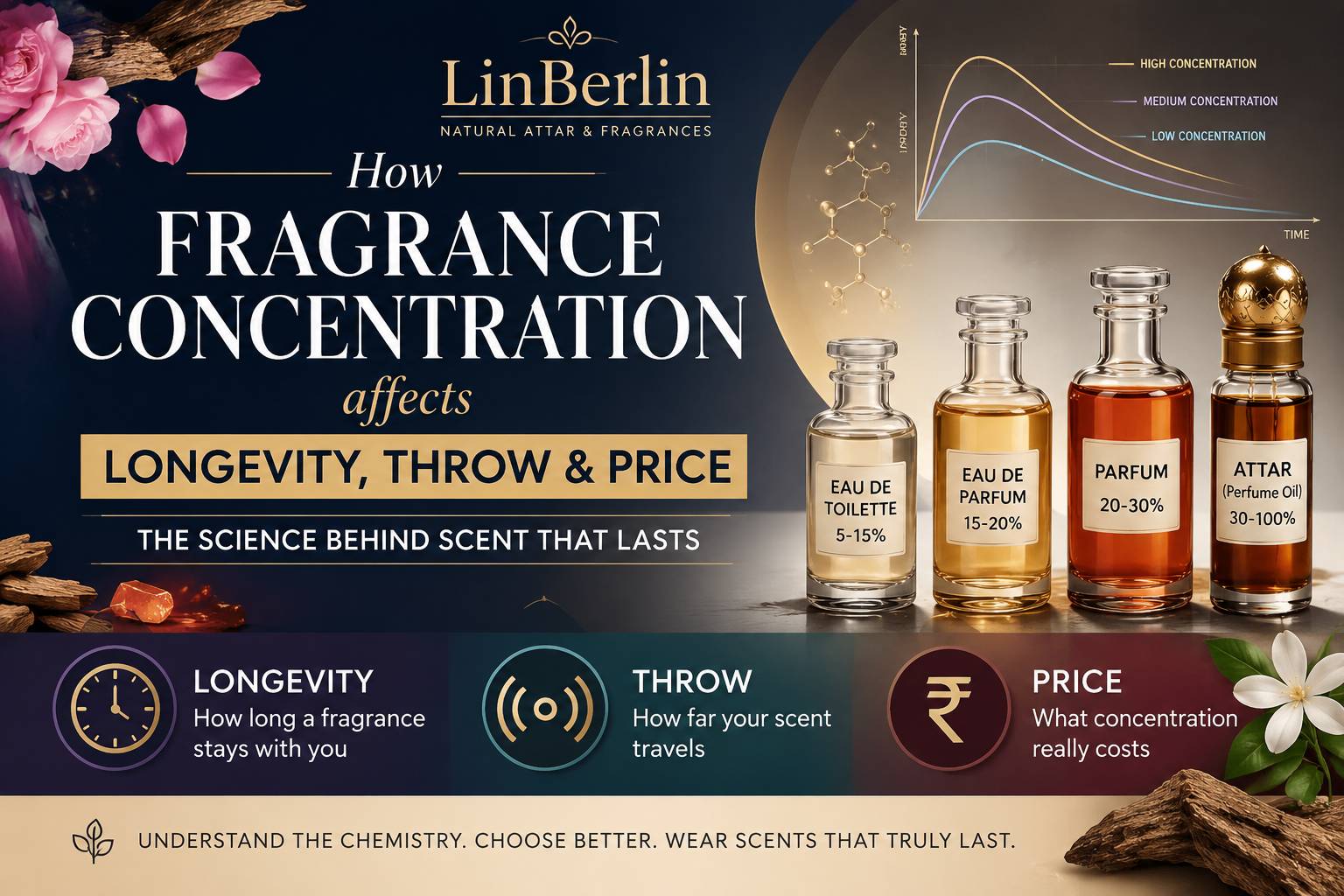
A tiny drop of natural attar warming on the skin can sometimes stay noticeable longer than several sprays from a perfume bottle. That small everyday surprise is where the science of fragrance concentration affects longevity, throw and price becomes interesting. Many people assume a stronger smell always means a better perfume, but scent behaviour depends on chemistry, ingredients, skin interaction and the structure behind the formula.
The same fragrance may feel powerful on your friend yet become softer on you within hours (something almost every fragrance lover notices eventually).
Understanding why this happens helps you choose scents more thoughtfully instead of only chasing higher percentages.
The science explained clearly
The amount of aromatic material inside a fragrance changes how it performs, but concentration alone doesn't tell the entire story. Perfumes are mixtures of volatile molecules, meaning their scent comes from compounds that gradually evaporate and travel through the air until our nose detects them.
Inside the nose, these molecules interact with olfactory receptors. These receptors send signals to the brain, where we recognise different scent impressions such as floral, woody, smoky, sweet or earthy notes. The way a fragrance develops depends on which molecules reach those receptors first and which ones remain behind for hours.
And this is where evaporation rate becomes essential.
Small, lightweight molecules usually evaporate quickly. Many fresh citrus materials, green notes and bright aromatic compounds create a noticeable opening but naturally disappear faster. Heavier molecules, often found in woods, resins, balsams, musks and oud materials, evaporate slowly and stay closer to the skin for longer.
A fragrance formula works like a carefully balanced structure — the lighter materials create the first impression while deeper molecules support the lasting character.
This explains why many traditional oil-based attars behave differently from alcohol-based perfumes. Natural attars usually place aromatic oils directly onto the skin without alcohol carrying them outward. Alcohol evaporates quickly, helping fragrance molecules spread into the surrounding air. Oil slows evaporation and often creates a more intimate scent experience.
But does more oil automatically mean better performance?
Not always. A perfume with 30% aromatic concentration can still fade faster than a 15% formula if it mainly contains highly volatile materials. The molecular structure of ingredients matters just as much as the percentage written on the bottle.
Fixatives also influence longevity. In perfumery, fixatives are materials that slow down evaporation or help maintain the character of a scent. Natural ingredients such as certain resins, woods and deep base materials have traditionally played this role because their heavier molecular profiles remain present longer.
The truth is, concentration matters greatly, but judging fragrance quality only by percentage ignores the deeper science happening on your skin.
Skin chemistry adds another layer. Temperature, natural skin oils, moisture levels and even environmental conditions affect how quickly scent molecules leave the skin surface. This is why two people wearing the exact same fragrance may experience different results.
What this means in practice
Choosing a fragrance becomes easier once you understand what concentration actually changes. Higher concentration usually means more aromatic material compared with the carrier, which can increase richness and lasting power. It often changes the feeling of the scent too.
A light eau de toilette may create a brighter impression because the most volatile notes move quickly into the air. A concentrated perfume oil or attar may reveal itself slowly and stay close, creating a personal scent bubble rather than filling an entire room.
Projection, sometimes called throw, describes how far a fragrance travels from your body. People often connect projection only with strength, but the relationship is more complex. Some strong natural oils last beautifully yet remain close because heavier molecules don't spread as easily through air.
So a fragrance can last a long time without announcing itself loudly.
Price also connects with concentration, although not perfectly. More aromatic material generally increases production cost because fragrance ingredients are often the most expensive part of the formula. Natural materials can be especially demanding due to farming, harvesting, extraction methods and limited availability.
For example, genuine oud materials require careful sourcing because they come from resin formation inside agarwood. High-quality botanical extracts may need large amounts of raw material to produce a small amount of aromatic oil.
At LinBerlin, the focus on oil-based perfumery comes from respecting these traditional methods rather than simply increasing numbers on a label. A well-created attar depends on ingredient harmony, patience and balance.
Realistically, a higher-priced fragrance should be judged by ingredient quality, craftsmanship and how it performs for your preferences, not concentration alone.
Common misconceptions about this
Many beginners believe the highest concentration fragrance is automatically the best choice. The idea makes sense because more fragrance material sounds like it should mean more value, but scent design isn't that simple.
A very concentrated fragrance can become heavy if the formula isn't balanced. Perfumers consider evaporation behaviour, ingredient relationships and how the scent changes over several hours (known as the dry-down).
Another common belief is that a fragrance disappearing from your own awareness means it has completely vanished. Sometimes it has faded, but sometimes your brain has adapted to the smell. This process is connected to olfactory adaptation, where constant exposure makes your brain pay less attention to a familiar scent.
And your fragrance may still be noticeable to others even after you stop detecting it yourself.
People also often confuse longevity and projection. They are connected, but they aren't identical. Longevity describes how long fragrance remains detectable. Projection describes how far it travels.
A soft oud attar may remain on the skin overnight but only be noticed by someone nearby. A fresh alcohol-based fragrance may fill a room early but become faint much sooner.
There is also a belief that natural fragrances always last longer than synthetic ones. The reality is more detailed: some natural materials have excellent staying power, while some modern aroma molecules are specifically designed for impressive longevity. Natural and synthetic ingredients both contain molecules with different behaviours.
How to use this knowledge
Once you understand fragrance concentration, choosing and applying scent becomes much more intentional. Instead of only searching for the strongest option, think about where and how you'll wear the fragrance.
For quiet settings, personal moments or traditional scent appreciation, concentrated natural attars can create a beautiful close-wearing experience. For situations where more projection is preferred, the fragrance structure and application style matter.
Applying scent to moisturised skin can sometimes help because fragrance molecules may evaporate more slowly from a hydrated surface. Placement also changes the experience — pulse areas with natural warmth can encourage scent movement.
Give fragrances time before judging them. The opening minutes only reveal part of the formula, while the deeper materials show their character later.
Ask yourself: do you want people across the room to notice your fragrance, or do you want a scent that stays personally connected to you?
Both experiences have value.
Closing
The science behind concentration shows that fragrance performance is not just about making something stronger. Longevity, throw and price come from the relationship between chemistry, ingredients, concentration and the person wearing the scent.
A better understanding of molecules, evaporation and skin interaction helps you recognise quality beyond simple numbers.
LinBerlin's approach to natural attar follows this idea: respecting the material, understanding the science and appreciating how a fragrance slowly reveals itself. Next time you test a scent, don't only ask how long it lasts. Notice how it lives.