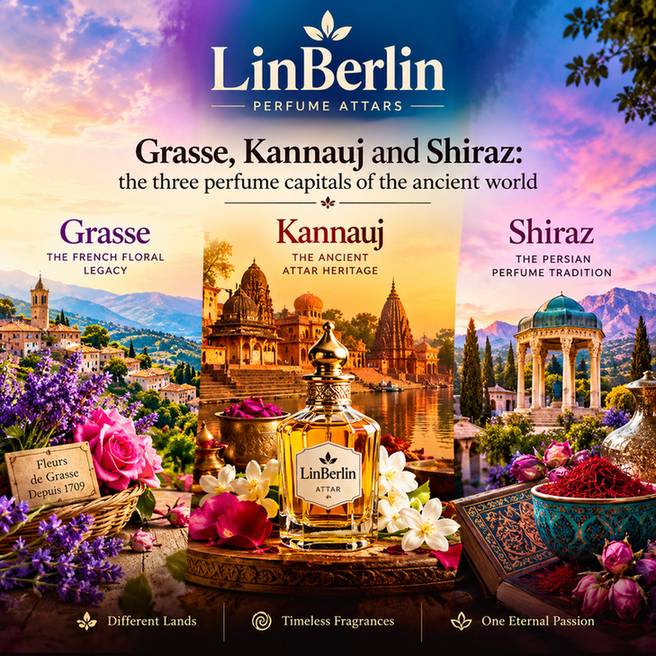
Before perfume was a bottle, it was a glove. Sixteenth-century Grasse tanned leather, and tanneries smell exactly as bad as you imagine. So the town's craftsmen began scenting the gloves, and one small town's answer to a stink became a European fashion. (Catherine de' Medici's court helped, though historians still argue over how much.)
That slightly absurd beginning is worth holding onto. Perfume capitals were never born from romance. They came from geography, from trade, from some stubborn local problem that needed solving. Put three of them side by side, Grasse in Provence, Kannauj on the Ganges plain and Shiraz in the hills of Fars, and a pattern starts to show.
Why a place becomes a perfume capital
Flowers don't make a capital. Plenty of valleys bloom. What does it is a mix of three things that rarely line up: a crop that grows in abundance, a craft refined across generations, and a road that carries the result to people willing to pay for it. Remove one and you have a pretty place with nice air.
The truth is, the ancient story is messier than any tidy "three capitals" list suggests. Egypt was blending scented unguents long before these towns mattered, a story told well in this piece on the first fragrance culture of the Nile. And the roads did the rest, with resins, spices and rose water moving along routes we now lump together as the Silk Road (a thread picked apart in how ancient trade routes shaped modern perfumery). So think of the three capitals as chapters, not the whole book.
Shiraz and the rose that travelled
Start in Fars, because that is where the rose enters the story with real seriousness. Shiraz sits in a province whose gardens became a byword for Persian beauty, and the Firuzabad area nearby was known across the medieval Islamic world for rose water, sent in quantity to distant courts. I'd treat the exact tonnage figures you sometimes see quoted with suspicion, since they tend to be round numbers nobody can source.
Persian distillers also pushed steam distillation toward real precision. Ibn Sina, working roughly a thousand years ago, is often credited with refining rose distillation, though he worked further north, not in Shiraz itself. That's — well, it's a reminder that "capital" is a loose word. Shiraz stands for a whole tradition of golab, rose water as daily life, more than one town's output.
The method moved. Rose water went west toward Baghdad and east toward India and China, and the techniques went with it or followed close behind. How exactly the know-how reached the Gangetic plain? Still debated, honestly.
Kannauj, where the still stays copper
Kannauj makes the question practical. It was a royal seat in the seventh century under Harsha, long before its name sat on a bottle. Its perfumers took the idea of distillation and bent it around local materials: copper stills called deg, bamboo-piped receivers called bhapka, and sandalwood oil as the base that catches the scent, where a European house would reach for alcohol or fat. It is slow work. A batch can burn for many hours over a wood fire, and the distiller reads the heat by hand and ear rather than by gauge.
The rose is the famous product, and for good reason. Rose attar from Kannauj has a depth that shows how a small town ended up so far above its weight. But the rain may be the stranger achievement. Kannauj bakes clay and distils the smell of it into oil, an attar of the first monsoon shower. Paired with sandalwood, it feels like sandalwood and wet earth remembering the rain, and that is very hard to fake with a synthetic.
Nor did the craft stay in a museum. In many Indian homes the day still opens with jasmine meeting chandan, a pairing that treats scent as part of devotion, not decoration.
Grasse, the glovemaker's flower fields
Grasse arrives later and does something different. The leather trade turned to scented gloves, glovemakers and perfumers were formally recognised together in the early 1600s, and by the 1700s the hillsides carried jasmine, May rose, tuberose and orange blossom. The favoured method became enfleurage, pressing petals into fat, and later solvent extraction. Where Kannauj kept the hand-run still, Grasse industrialised early. Chemists arrived. Houses grew large. UNESCO placed the region's perfumery knowledge on its intangible heritage list in 2018, which tells you how seriously the craft is now treated.
Here's the thing, said plainly: modern Grasse leans on modern perfumery, with synthetics and global brands, while Kannauj still leans on the old oil-and-copper method. Neither is lesser. They answer different questions, one about scale and consistency, the other about slowness and place.
What the three share, and where they part
All three began with an agricultural surplus and a trade that could move it. All three built guilds or families that guarded their methods. And all three used flowers as a kind of local currency.
Where they part is the carrier. Persia leaned on water, Provence on fat and later solvents, Kannauj on oil. That choice shapes everything you smell, from how a rose opens to how long it sits on skin.
Wearing the history, safely
Reading about attar is one thing; wearing it is another, and skin gets a vote. Oil-based attars sit close and last longer on moisturised skin, so a thin layer of unscented balm before you apply makes a real difference. Dry skin lets scent fade fast without that help. Oily skin holds it well but can push it outward sooner than you expect, so go lighter than you think.
Sensitive skin deserves care. Patch test a tiny drop on your inner forearm and wait a full day before using it on pulse points. Skip broken or freshly exfoliated skin, and be careful on days you've used retinoids or strong acids, since irritation tends to show up there first. If you're pregnant or have known fragrance allergies, speak to your doctor before wearing any concentrated oil. Realistically, "natural" does not mean "harmless", and rose and sandalwood can still irritate some people.
Where to begin
Pick one tradition and start small. A tiny vial of Kannauj rose will teach you more about this history than a shelf of books, and you can test it slowly, on your own skin, in your own time.