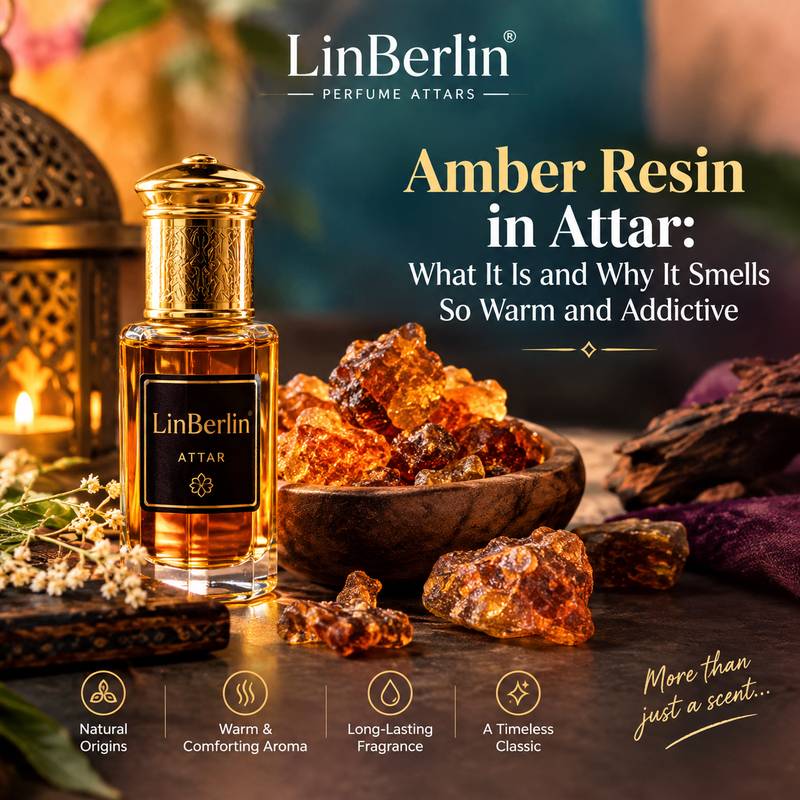
A lump of resin left on a sunny windowsill smells better by afternoon than it did in the morning. Nothing has been added. Nothing has been refined. The warmth just coaxes the scent out, slowly, the way it has for as long as people have burned, rubbed and pressed these hardened saps into cloth and skin.
That small observation explains most of what makes amber in attar so hard to put down. It was never built to shout. It was built to bloom on a warm body.
What "amber" actually means in an attar bottle
Here's the part most descriptions skip: there is no single ingredient called amber that you can simply buy and distil. Fossilised amber, the golden stone in jewellery, has almost no scent until it is heated, and it is not the source of that deep, sweet glow. What perfumers and attar makers call amber is a composition (a family, really) built from several balsamic resins, often softened into a sandalwood or other base oil.
So when you open a bottle labelled amber attar, you are smelling a craft decision. Someone chose the resins, the ratio and the carrier. Two makers can both say "amber" and hand you completely different things.
The resins doing the quiet work
Labdanum is the backbone. It comes from the rockrose shrub, gathered as a sticky gum, and it smells leathery, honeyed, a little animalic and faintly like dried fruit. Benzoin brings a creamy, vanilla-like sweetness that rounds off labdanum's rough edges. Styrax and Peru balsam add a smoky, cinnamon-tinged depth, and a touch of any of them can tip the whole blend darker.
Some makers add a little musk or woods, and that's where it gets — well, it gets personal, because every house balances these differently.
One more point on the resin side: the better ones are slow to dry down and stubborn to wash off a scarf. That is the viscosity talking.
Why it reads as warm, physically and emotionally
Warmth in fragrance is partly a metaphor and partly chemistry. Resinous molecules are heavy. They evaporate slowly, which means they stay close to skin instead of floating off in the first ten minutes like a citrus top note. Heavy, slow, close: your nose interprets that as soft and enveloping.
And then there is sweetness without sugar. Benzoin and labdanum carry vanillic, balsamic facets that trigger the same comfort associations as baked sugar or warm milk, but with a dry, almost smoky edge that keeps them grown-up. It is sweetness with a spine.
Oil-based attar amplifies all of this. Without alcohol to flash off, the oils sit and warm with your pulse points, and the scent shifts hour by hour. Some people describe it as the perfume "waking up" after a while.
Why people get hooked
The truth is, addictive is a strong word, but I understand why people reach for it. Amber smells a little like skin, a little like a place you've been loved in. It overlaps with memory in a way that sharper, greener notes rarely manage. Realistically, that is what keeps people refilling the same small bottle every winter.
There's also the practical hook. Amber lingers on clothing, on a wool collar, on the inside of a wrist the next morning. You keep catching it. So you keep wanting it.
Whether that's brain chemistry or just good oil, I couldn't say for certain.
How amber behaves on different skin
Skin decides a lot, and I've watched the same drop of amber attar go in three completely different directions on three people.
- Dry skin drinks oil-based perfume fast. The scent can fade within a few hours, and amber that seemed rich in the bottle may feel thin by lunchtime. Moisturising first, with an unscented lotion or a light balm, gives the attar something to cling to. Moisturised skin genuinely holds scent longer, and it is the simplest fix there is.
- Oily skin holds amber well, sometimes too well. The sweetness can turn heavier and stickier, so use less than you think you need, one small dab rather than a swipe.
- Normal and combination skin usually gets the most balanced version, with a gentle opening and a long, soft dry-down.
This variation is exactly why the same blend feels different from person to person, a theme explored further in this piece on why amber and oud attar smell different on everyone.
Where caution is warranted
Resins are natural, but natural does not mean harmless. Balsam of Peru and benzoin sit on many fragrance allergen lists, and people with a known balsam or fragrance allergy should patch test first, on the inner forearm, and wait a full day. Sensitive or eczema-prone skin can react to resinous oils even if everything else is fine, and compromised skin (cracked, sunburnt, freshly exfoliated) is not the place to apply any perfume.
Be careful layering over retinoids, strong acids or prescription topicals, since those can leave skin more reactive for hours. If you are pregnant or breastfeeding, it is sensible to check with your doctor or midwife about essential oil and resin exposure. I can't tell you what is right for your body, and neither can a product description.
Pairing amber with other notes
Amber loves company, which is half the fun. It has a long, comfortable history alongside patchouli, where earthiness and balsamic sweetness lock together, and you can read more about that relationship in this look at how amber and patchouli keep turning up together.
Oud is the other classic partner. Where amber leans into it, the result is rarely loud, more a slow, unhurried warmth that stays long after the first impression. And if full-strength oud feels like too much, white oud softens the picture, giving you amber's glow with a cleaner, almost silky backdrop; that gentler style is the subject of amber warmth meeting white oud.
Not sure amber is even your warm note? Sandalwood and vanilla are close cousins, and sorting out which one suits you is easier with a guide on picking between amber, sandalwood and vanilla.
Amber doesn't announce itself. It settles in, and eventually it's simply part of the room.
A few honest limits
Amber is not for everyone. Some people find it cloying in heat, and in a humid summer a heavy resinous attar can feel like wearing a blanket. It also won't give you much sparkle, so if you want something bright and airy, this is the wrong shelf. And I'll admit I've skimmed over the finer chemistry of individual resin fractions here, because it deserves its own article.
How to wear it well
Start small. Warm the attar between your fingertips, press it onto a pulse point (the wrist, the base of the throat, behind the ear if your skin is happy there), and don't rub, which breaks the oils down faster. Moisturise first if your skin runs dry. Then give it twenty minutes before judging it, because amber is a slow starter and an even slower finisher.
Patch test, wear it on clean, intact skin, and let it develop. That's the whole method. The rest is just paying attention to how it settles on you.