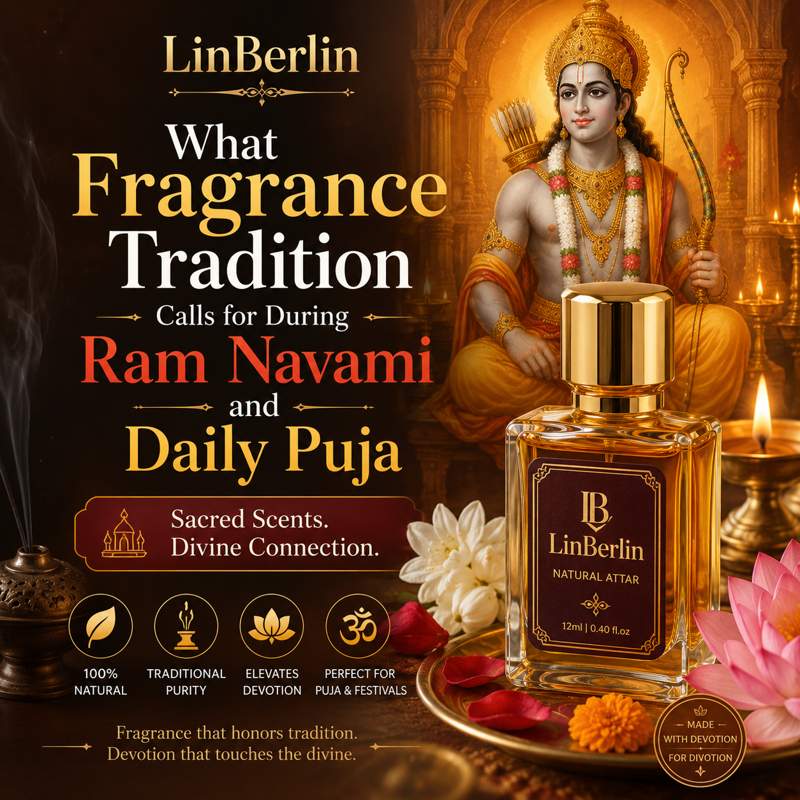
Walk into almost any home during Ram Navami and the first thing that reaches you isn't the bhajan playing softly in the background or the marigolds strung across the doorway. It's the smell. Before you've even seen the small idol dressed for the occasion, the fragrance has already told you something is different today — that this isn't an ordinary Tuesday morning aarti, but a day the whole household has been quietly preparing for.
That's the part outsiders to the tradition often miss. Fragrance in Hindu worship isn't decoration. It's communication — a way of marking time, signalling occasion, and, in a sense, inviting the deity into a space that's been made ready for them.
Why Scent Carries Weight in Worship
Sound has bells and mantras. Sight has the murti, the diyas, the colours of the offerings. Touch has the act of aarti itself, hands moving in circles carrying flame. Smell is the sense that lingers after everything else has stopped — the incense that still hangs in the room an hour after the puja has ended, the attar on a garland that outlasts the flowers themselves.
This is why attar, specifically, has held its place in devotional practice for centuries where synthetic perfumes never quite have. Attar is made through slow distillation, often the same methods used generations ago, and that continuity matters in a ritual context. You're not just offering a pleasant smell. You're offering something made the way it's always been made, which is — well, it's part of what gives an offering its sincerity, honestly. A shortcut doesn't feel like an offering in the same way.
Ram Navami: What the Occasion Actually Calls For
Ram Navami marks the birth of Lord Ram, and the fragrance tradition around this festival tends to lean toward compositions that feel regal without being heavy — sandalwood forward, sometimes lifted with a touch of saffron or rose, never overly sweet or smoky. The idea is dignity, not indulgence. Ram is remembered as maryada purushottam, the ideal of righteous conduct, and the scent chosen for his shringar (adornment) is expected to reflect that restraint.
Households that observe daily puja to Ram, not just on Navami but year-round, often keep a dedicated attar for exactly this purpose rather than reaching for whatever's on hand. Ram Shringar attar for Shri Ram puja is built specifically around this expectation — a composition designed for the idol and the space around it, not for personal wear, and formulated to sit quietly in the background of a ritual rather than dominate it.
And that distinction — devotional versus personal — is one that gets lost on people newer to this practice. Puja attars aren't cologne. They're not meant to be dabbed on the wrist before you leave the house. They're meant for the murti, for the prasad tray, for a few drops on cotton near the diya, for the garland before it's offered. The intention behind the fragrance is different, so the fragrance itself is built differently too.
Daily Puja Is a Different Rhythm Than a Festival
Festivals are loud, communal, layered with extra ritual. Daily puja is quieter. It's five minutes before work, sometimes less. But the fragrance element doesn't disappear just because the occasion is smaller — if anything, it becomes more of a marker precisely because everything else about the routine stays so consistent.
A lot of families use the same attar for morning aarti every single day, and there's something to that consistency: the scent becomes tied to the ritual itself, so that smelling it, even outside the context of puja, brings the moment back. This is not unlike how a particular incense can transport someone straight back to a grandparent's home. Scent memory is unusually durable, more so than most other kinds of memory, and devotional practice has been using that fact long before anyone had a scientific name for it.
Choosing Fragrance Based on the Deity
One thing that surprises newcomers to structured puja practice: not every deity is offered the same fragrance family. Shiva tends toward cooler, more austere notes — sandalwood, vetiver, sometimes a plain mitti base. Vishnu and his avatars, including Ram, lean toward warmer, more composed florals and woods. Devi forms often call for something richer, more layered. None of this is arbitrary; it's built from centuries of temple practice and regional tradition, adapted household by household.
If you're building out a puja shelf with more than one deity, it's worth reading through how fragrance choice shifts depending on which deity you're worshipping, since using one all-purpose attar across a Shiva idol and a Ram idol tends to flatten a distinction the tradition actually cares about. Hanuman ji, closely tied to Ram in most households' devotional calendars, has his own fragrance conventions too — usually leaning stronger and more grounded, reflecting his character rather than Ram's — and that's covered in more depth in the piece on Hanuman ji's puja and the world of devotional fragrance around him.
A Few Honest Notes on Getting This Right
Realistically, most people learn this through trial and error, or by watching how their own family has always done it, rather than reading it in a guide. So a few practical points, gathered from how households actually practice this rather than how it's written about in theory.
First — don't overapply. A common mistake, especially with richer attars, is treating the puja space like it needs saturation. It doesn't. A few drops go further than people expect, especially in a smaller room where the scent has nowhere to dissipate.
Second, keep devotional attar separate from anything you'd wear personally. Not because there's a rule against it exactly, but because the meaning shifts once a fragrance becomes associated with an activity outside the ritual. Or, put more simply: you don't want your Ram Navami attar smelling identical to what you wore to a wedding last month.
And third — if you're newer to structured daily puja and unsure where to start beyond the Navami season, the broader landscape of devotional fragrance is worth exploring properly rather than picking based on packaging alone. A fuller guide to attar for pooja and devotional worship covers how these choices connect across different deities and occasions, which is more useful groundwork than trying to figure it out festival by festival.
One limitation worth being upfront about: fragrance tradition varies meaningfully by region and by family lineage, and nothing written here should be read as the single correct way to do this. What's described above reflects fairly common North Indian devotional practice, but a family in Tamil Nadu or Bengal may follow different conventions entirely, and that's not a contradiction — it's the tradition being alive rather than fixed.
Carrying the Practice Forward
Ram Navami will pass, as festivals do, but the daily ritual continues long after the decorations come down. What stays consistent is the small act of choosing a fragrance with intention rather than convenience — recognising that what you offer during worship is meant to be different from what you wear to work. That distinction, more than any specific note or blend, is really what the tradition is asking of you.