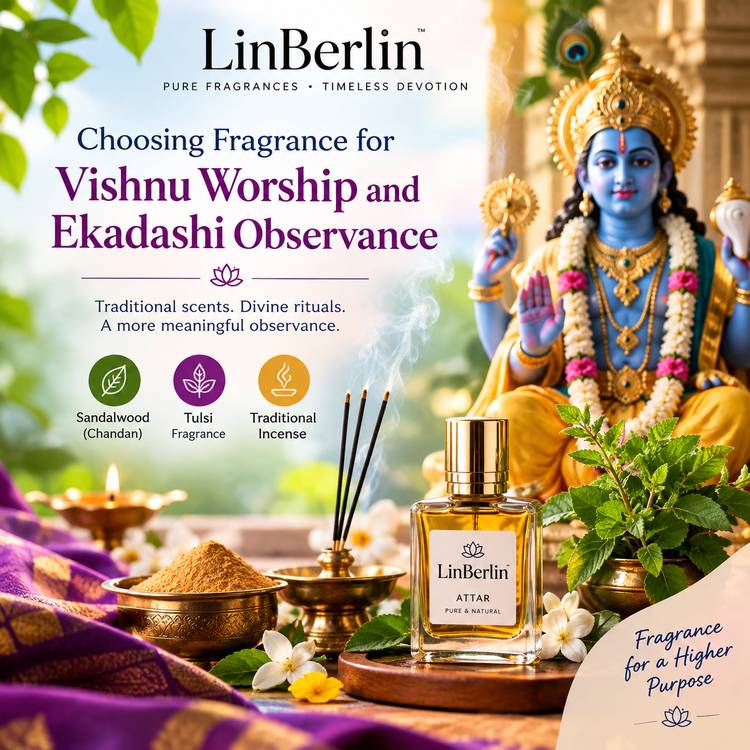
There is a particular quiet that settles over a house on Ekadashi evening. No onion, no garlic in the kitchen that day, the diya burning a little longer than usual, and somewhere under all of it — a smell that has nothing to do with food at all. That's usually the first thing people notice when they walk into a home observing the fast properly. Not the absence of certain dishes. The presence of a specific scent hanging near the altar, one that's been chosen, not accidental.
Fragrance in Vishnu worship isn't decoration. It's part of the offering itself, standing alongside the tulsi leaf and the lit lamp as something the deity is understood to actually receive. And that changes how a person should think about picking one — not as a finishing touch to a puja room, but as an ingredient in the ritual with its own weight and meaning.
Why the Fragrance Chosen for Vishnu Feels Different From Other Deities
Ask any priest who's spent years around temple worship and they'll tell you Vishnu's preferred fragrance profile sits apart from Shiva's or Devi's. Where Mahadev worship often leans into cooling, ascetic notes — vetiver, sandalwood in its rawer form, sometimes bhasma-adjacent earthiness — Vishnu's is warmer. Softer at the edges. Sandalwood still shows up, but paired with saffron, lotus, and sometimes a whisper of jasmine, building something closer to royal serenity than austerity. It makes sense once you sit with it. Vishnu is the preserver, the one associated with order, stability, sustained grace rather than dramatic renunciation. The scent language follows that temperament.
This is exactly the kind of distinction covered in a deeper guide on matching fragrance to the deity you worship, and it's worth reading if your household moves between multiple forms of worship through the week. But for Vishnu specifically — and for Ekadashi observance in particular — a few notes come up again and again across regional traditions.
Sandalwood, Saffron, and the Logic of Ekadashi Scent
Ekadashi isn't just a fasting day. It's a day of heightened sattva — of trying to keep the mind and body in a state that's lighter, cleaner, less agitated. So the fragrance worn or offered on this day tends to mirror that intention. Heavy, musky, animalic notes are generally avoided. Realistically, most families gravitate toward pure sandalwood, saffron-forward blends, or attars built around lotus and white flowers, because these read as calm rather than assertive.
Saffron deserves a mention on its own. It's tied to Vishnu iconography quite directly — his complexion is often described in shades that saffron and turmeric echo, and the spice itself carries associations with purity and auspiciousness in a way few other ingredients do. A well-made saffron attar, applied before the Ekadashi puja or lit as incense near the tulsi plant, does something subtle: it doesn't announce itself the way oud or musk would. It sits back. That restraint is, in a sense, the whole point of the day.
For households looking for something purpose-built rather than improvised, this is where a dedicated Vishnu Seva attar for Lord Vishnu puja earns its place on the altar shelf. It's formulated with exactly this temperament in mind — sandalwood as the base, saffron and lotus layered over it — so there's less guesswork involved for someone new to selecting fragrance devotionally.
Tulsi, Lotus, and the Ingredients Devotees Keep Returning To
Three ingredients keep surfacing in conversations with families who've practiced Ekadashi observance for decades. First, tulsi itself — not always distilled into the attar, but almost always present physically near it, and its green, slightly peppery freshness complements sandalwood well rather than competing with it. Second, lotus, which contributes a soft, watery floral note that avoids feeling cloying even after hours of wear, which matters on a day when the puja might stretch from early morning through a late-evening breaking of the fast. And third, and this one surprises people, a touch of vetiver — used sparingly, mostly to ground the sweeter notes so the overall composition doesn't drift into something overly perfumed for a place of worship.
Some households pair Vishnu worship with occasional Lakshmi puja too, particularly around Kartik month and Diwali, given how closely the two deities are tied in tradition. If that's part of your practice, a separate guide on what to burn or wear during Lakshmi puja covers that pairing in more detail than fits here.
Where Skin Comes Into It
Here's the part most articles on devotional fragrance skip entirely, and it's — well, it's more relevant than people assume. How an attar behaves on your skin during a full day of fasting and worship depends heavily on your skin type, and Ekadashi is often a day when people are more dehydrated than usual, which changes how fragrance sits.
On dry or dehydrated skin, natural attars — being oil-based rather than alcohol-based — tend to last noticeably longer, because there's more surface texture for the oil to cling to and less rapid evaporation. But dry skin can also feel tight or slightly irritated after a day of fasting, so applying attar directly onto bare, unmoisturised skin isn't always comfortable. A thin layer of a fragrance-free moisturiser first, dabbed in and allowed to settle for a few minutes, gives the attar something to bind to and actually extends wear time. This is one of those small habits that experienced devotees pick up over years without ever really talking about it.
Oily or combination skin behaves differently. Sandalwood and saffron-based attars tend to project a bit stronger here initially, then fade faster than expected because oilier skin has more surface activity — more natural turnover, more subtle warmth — that breaks down fragrance compounds quicker. A very light touch, applied to pulse points rather than broad areas, usually works better than a generous application.
And for anyone with genuinely sensitive skin, or a history of reacting to synthetic fragrance oils — this is the caveat worth taking seriously. Even natural attars can occasionally cause irritation in people with compromised skin barriers, eczema-prone skin, or active dermatitis. Saffron itself is generally gentle, but any concentrated botanical extract carries some risk for a small percentage of users. A patch test on the inner wrist, 24 hours before Ekadashi, is a reasonable precaution rather than an overreaction. Pregnant devotees, too, sometimes find their sensitivity to scent shifts noticeably during pregnancy — stronger notes that were fine before can suddenly feel overwhelming — so it's worth applying less than usual and adjusting based on how the body responds that day, rather than assuming last year's amount will feel the same.
Common Mistakes People Make Choosing Fragrance for This Day
A few patterns show up often enough to mention. People reach for whatever attar is already open in the house, regardless of whether it fits Vishnu's temperament — a heavy oud or a musk-forward blend meant for evening wear ends up on the altar simply out of convenience. Others apply far too much, assuming more fragrance signals more devotion, when a lighter, well-chosen application generally reads as more considered. And some skip the fragrance step for the deity entirely while still wearing perfume themselves, which — depending on the tradition your family follows — can feel slightly out of step with the day's intention of offering something specifically to Vishnu, not just smelling nice yourself.
None of these are serious errors. But small adjustments here tend to make the whole observance feel more intentional, and intention is really what the day is built around.
A Broader Starting Point, If You're New to This
If Ekadashi and Vishnu worship are relatively new additions to your routine, it helps to step back and look at devotional fragrance more broadly before narrowing in on any one deity. The complete guide to attar for pooja and devotional worship walks through the fundamentals — how attars differ from alcohol-based perfumes, how to store them near an altar, basic application etiquette — in a way that makes the Vishnu-specific choices here easier to place in context.
What matters most, in the end, isn't finding the single "correct" attar. It's paying attention — to the day, to your own skin and how it's holding up under the fast, to the mood the fragrance is meant to support rather than dominate. Sandalwood and saffron get you most of the way there. The rest is just noticing what your household actually responds to, year after year, and letting that guide the next bottle you choose.