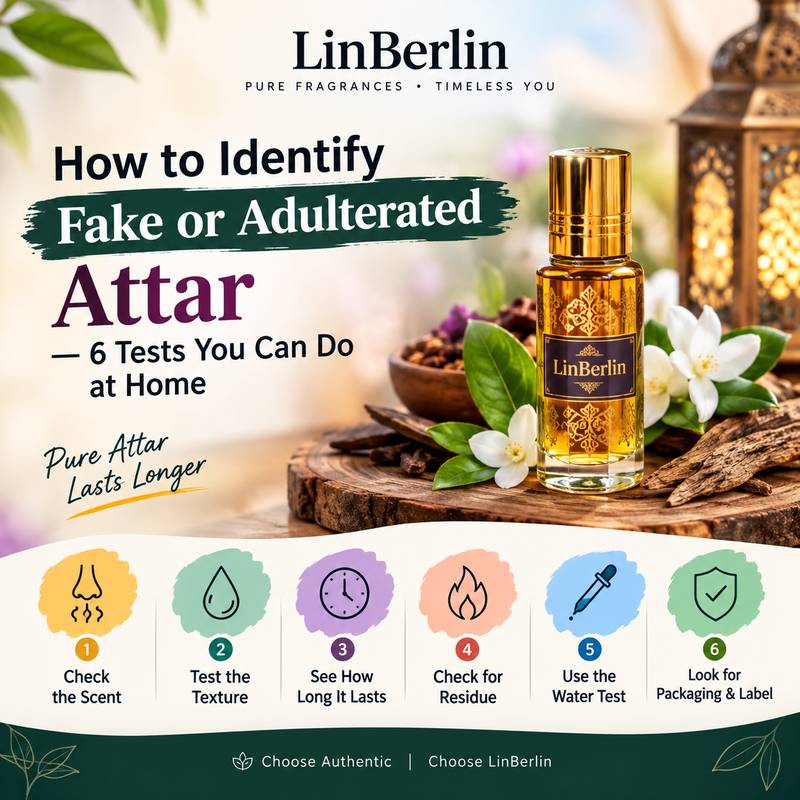
My grandmother used to rub a drop of attar between her palms before touching it to her wrist — never straight from the bottle. I didn't understand why until years later, when a bottle I'd bought from a roadside stall in Old Delhi left a thin, greasy ring on my skin that never quite dried. That ring was the first real lesson I ever had in telling genuine attar from something dressed up to look like it. No lab equipment. No perfumer's nose. Just skin, patience, and a bit of attention.
Attar is oil. That single fact is the thread that runs through almost every test in this article. Real attar — whether it's rose, oud, sandalwood, or a blended composition — is built on a base of natural oil, traditionally sandalwood or a similar carrier, into which flower and wood essences are slowly distilled through the deg-bhapka process. Adulterated versions cut corners: synthetic aroma chemicals dissolved in cheap carrier oils, or worse, alcohol-based perfume oils sold under the attar name because the word carries prestige. The tests below won't turn you into a perfumer overnight. But they will save you from the more obvious fakes, and that's realistically most of what's floating around in the market right now.
Test 1: The paper strip evaporation test
Dab a small amount on a plain white blotting paper or even a strip of printer paper. Real attar, being oil-based, spreads slowly and leaves a faint translucent stain that lingers for hours, sometimes days, even after the scent itself has faded. Synthetic or alcohol-diluted "attars" tend to evaporate fast, leaving little to no oil mark behind — the paper dries clean within twenty or thirty minutes. If you're testing something like rose oil sourced from India's traditional distillation towns, the stain should still carry a soft rose note the next morning. If it smells like nothing by evening, be suspicious.
This test isn't perfect, by the way — some very light florals leave a faint stain too, so don't rely on it alone.
Test 2: The skin-warmth test
Apply a drop to the inside of your wrist and let your body heat do the work. Natural oil-based attar reacts with skin chemistry over the next few hours — it opens up, shifts character, and settles into what perfumers call a dry-down. You'll notice the top notes fade first, then something deeper and warmer emerges underneath, often thirty minutes to an hour later. Synthetic versions, on the other hand, usually smell exactly the same at hour four as they did at minute four. Flat. Static. No evolution.
Here's the thing about this test — it requires you to actually wait. Most people spray or dab and judge within the first five minutes, which is exactly when a well-made fake and a genuine attar smell most alike. If you want to do this properly, there's a slower method worth following; the 30-minute skin-test approach gives you a structured way to track how a scent actually behaves on your own skin rather than guessing.
Test 3: The water float test
Add a drop of attar to a small glass of room-temperature water and watch what happens. Pure oil-based attar will sit on the surface, forming a distinct droplet or thin film, because oil and water don't mix. If the drop disperses, clouds the water, or dissolves partially, there's likely alcohol or a synthetic diluent in the mix — something that shouldn't be there in a true attar. This is one of the simplest tests to run at home and one of the hardest for a mislabeled product to fake, since adulterants that make a fragrance cheaper to produce almost always change how it behaves in water too.
Test 4: The sandalwood giveaway
If you're testing anything labeled as sandalwood-based — and a huge number of Indian attars are, since sandalwood oil has historically been the default carrier — this one matters more than most. Genuine Mysore-style sandalwood has a creamy, almost milky sweetness with a woody depth that lingers for what feels like forever on skin. It's also, and this is worth being upfront about, increasingly rare and expensive due to decades of overharvesting and export restriction. So if a bottle claims pure sandalwood attar at a price that seems too reasonable, that price is telling you something. Synthetic sandalwood substitutes (santalol-based aroma chemicals) can smell convincing in the bottle but usually collapse into something thin and slightly plasticky after a few hours on skin. For a closer breakdown of what the real thing should actually smell like, this guide on identifying genuine sandalwood aroma walks through the sensory markers in more detail than we have room for here.
Test 5: Color and consistency, but don't over-trust it
Natural attars vary. That's actually a good sign, not a bad one — batch-to-batch differences in color, from pale gold to deep amber, happen because natural raw materials shift slightly with harvest season, soil, and distillation conditions. A suspiciously uniform, water-clear liquid across every bottle of a supposedly handcrafted attar line is a red flag. And so is a color that seems artificially vivid — a rose attar that looks bright pink instead of amber-gold has almost certainly been dyed, since pure rose oil doesn't naturally carry that shade. That said, color alone can mislead you too; some brands do add trace natural coloring agents that are harmless but not strictly traditional, so treat this as a supporting clue rather than a verdict on its own.
Test 6: The longevity and sillage pattern
Genuine oil-based attar tends to sit close to the skin — what perfumers call low sillage — but lasts an unusually long time, often eight hours or more, because oil molecules evaporate slowly. A fake dressed up with synthetic aroma chemicals in alcohol will often do the opposite: loud and diffusive for the first hour, then gone by hour three. If you dab attar in the morning and it's still faintly there when you go to bed, that's a strong sign of authenticity. If it's shouting at 9am and silent by noon, something's off.
Putting the tests together
No single test here is bulletproof on its own — a clever adulteration can pass one or two of these checks. But run three or four together, and a fake usually reveals itself somewhere along the way. The water test catches obvious alcohol dilution. The skin-warmth test catches flat, non-evolving synthetics. The sandalwood check catches the specific scam of selling cheap santalol as real Mysore oil. Together they cover most of what's actually circulating in the market.
A note on skin and safety before you test anything
Because this involves applying oils directly to skin, a little caution is worth building in. Attar is concentrated — far more so than alcohol-based perfume — so patch-test on the inner forearm first, especially if you have eczema, dermatitis, or generally reactive skin. People with fragrance allergies should be particularly careful with attars containing high concentrations of natural isolates like eugenol (common in rose and spice-forward blends) or cinnamates, which are recognized skin sensitizers even in their natural form. Pregnant readers should check with a doctor before regular use of any concentrated essential-oil-based product, since some — clary sage and certain florals among them — carry precautions during pregnancy that synthetic fragrance doesn't always carry the same way.
Moisturized skin also holds attar longer and more evenly than dry skin — the oil has something to bind to, so the scent doesn't just sit on the surface and fade fast. But layering attar over an active-ingredient skincare routine (retinoids, strong acids, benzoyl peroxide) can occasionally cause irritation or a stinging sensation, since concentrated oils sitting on top of already-sensitized skin barriers don't always play nicely. If you're using actives, apply attar to clothing or hair instead of directly onto treated skin, or wait until your skincare has fully absorbed.
There's also a cultural layer to all this that's easy to miss if you're new to attar. In many Indian households, attar isn't just perfume — it's woven into ritual, into mornings, into the specific way certain scents mark certain occasions. The pairing of jasmine and sandalwood in Indian mornings is one small example of how deeply this tradition runs, and why buying the genuine article matters beyond just getting your money's worth.
What to do if you suspect a bottle is fake
Stop wearing it on skin regularly until you've run at least two of the tests above. Contact the seller and ask directly about sourcing — a legitimate attar house won't hesitate to tell you where the raw material came from, roughly, even if exact supplier details stay private. And keep the original bottle; if you do end up disputing a purchase, having the packaging and any batch information makes the conversation easier.
None of these tests require a lab coat or a chemistry degree. They require slowing down — something the whole culture of attar was built around in the first place, long before anyone was worried about counterfeits. Trust your skin, trust the time it takes for a real oil to reveal itself, and treat a suspiciously fast, loud, or too-perfect fragrance with a healthy dose of skepticism.