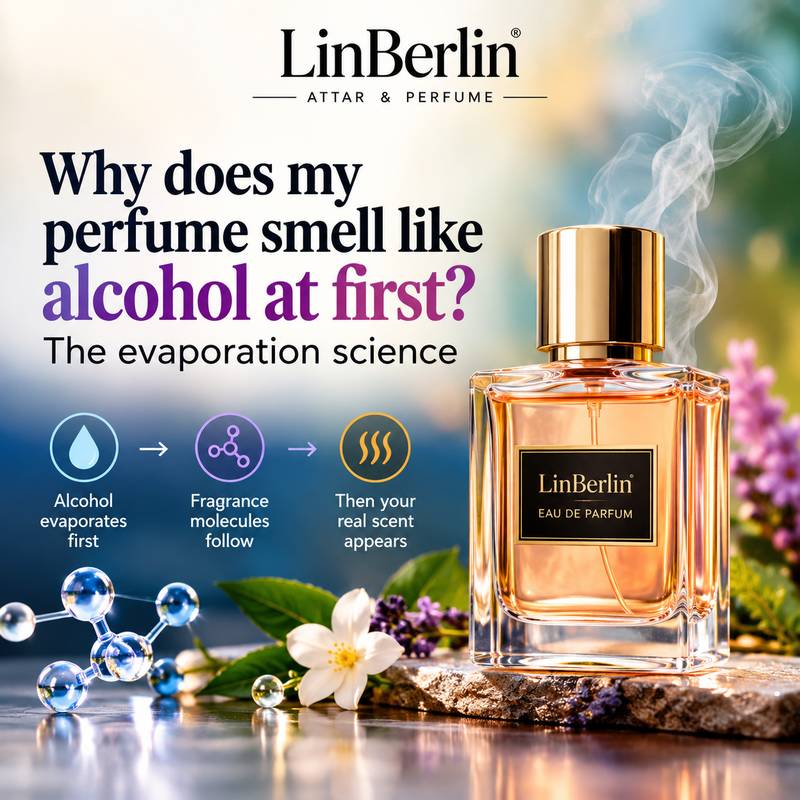
Nobody has ever complained that a bottle of perfume smells too much like the bottle. But press the nozzle once, hold your wrist to your nose, and for a few seconds you are not smelling flowers or woods at all. You are smelling a solvent doing what solvents do best: leaving.
What that sharp first hit actually is
Most spray perfumes are mostly ethanol. An eau de toilette can be well over 70 percent alcohol by volume, and even a richer eau de parfum usually carries more solvent than scent. The fragrance oils are dissolved in it so they can be sprayed as a fine mist, and that mist is the whole delivery system.
So the alcohol smell isn't a flaw, exactly. It's the carrier announcing itself before the passengers get off.
Ethanol is extremely volatile (it boils at about 78°C, far below water) and skin sits at roughly 32 to 34°C. That gap is plenty. The moment droplets land on you, the alcohol starts leaving as vapour, and vapour is what your nose reads. Your nose can't tell "perfume" from "solvent" until the solvent has thinned out, so for the first minute you get both at once.
The evaporation timeline, minute by minute
Think of it as a race with an unfair start. Ethanol leaves first because its molecules are small and light. The lightest fragrance molecules, the bright citrus peel, green leaf and airy aromatic ones, leave nearly as quickly, and they leave riding on the alcohol's cloud. That's why the opening of a fresh perfume can smell both boozy and sharply citrusy. It's — well, it's really two evaporations overlapping.
Within a minute or two, most of the free ethanol is gone. What remains on your skin is the oil fraction, and it behaves differently. Heavier molecules cling. They move into the air slowly, in the order of their weight and volatility, and that ordering is exactly what perfumers call the pyramid. If you want the full mechanics of how that unfolds over an hour, the guide on how top, heart and base notes work walks through it without jargon.
Here's a rough sense of what you're smelling and when:
- 0 to 30 seconds: mostly ethanol vapour, with the sharpest top notes hitching a ride.
- 30 seconds to about 5 minutes: the alcohol thins out and the opening notes become readable. This is the stage where people say "oh, now it smells nice."
- Later: the heart and base take over, and stay far longer than either of the above.
Why some bottles smell more like alcohol than others
But not every perfume shouts the same way. Concentration matters most: a light eau de cologne has a lot of solvent and very little oil, so the alcohol phase is proportionally big. A parfum has more oil and less solvent, so the transition is gentler.
Spray distance matters too. Up close, you're laying a wet patch of concentrated liquid on skin, and the evaporation is loud and cold on the skin. From 15 to 20 centimetres away the mist spreads into smaller droplets that dry faster and more evenly. And denatured alcohol, the kind used in commercial perfumery, sometimes carries trace bittering agents, so a cheaper formulation can smell harsher than a well-made one. I can't tell you which category your particular bottle falls into without smelling it, and honestly, sometimes the answer is just "the formula is a bit rough."
Realistically, a perfume that still smells like rubbing alcohol after several minutes is telling you something. Either it was made with a lot of low-grade solvent, or it's very young and hasn't had time to settle after blending.
What your skin has to do with it
Skin is not a neutral surface. It's warm, slightly acidic, and (this surprises people) it's constantly losing water. Dry skin absorbs alcohol and oils quickly and gives them back quickly, so the opening can feel harsh and the drydown thin. Oily skin holds fragrance longer, but it can also bend the scent in odd directions. Sensitive skin may simply sting.
That variation is why two people can spray the same bottle and describe completely different first impressions. If you're curious about the deeper chemistry behind that, there's a clear explanation of why the same perfume smells different on different people.
One thing worth doing is moisturising first. Lightly hydrated skin gives fragrance something to grip, which slows the runaway evaporation and softens the alcohol burst. There's a proper look at the science in this piece on why moisturised skin makes fragrance last longer. Use an unscented moisturiser, though, or the two smells will fight.
Practical ways to get past the alcohol phase
You don't have to just endure the first minute. A few habits help, and they're simple.
- Spray on pulse points from a hand's width or more away, not point blank.
- Let it dry on its own. Rubbing your wrists together is the most common thing people do, and honestly, the science on whether it "crushes" top notes is unsettled, but it does warm the skin and speed up the loss of the lightest ones, so waiting is the safer bet.
- Judge the scent after five minutes, not five seconds. A first sniff is a poor test of any perfume, alcohol-based or not.
- If you're buying, test on skin and go do something else for an hour. Blotter cards flatter everything.
And if you dislike the alcohol phase altogether, spray on clothing or hair ends instead. Fabric holds oils well and lets the ethanol leave quickly. Test on a hidden area first, since some perfumes can stain.
When to be careful
Alcohol-based perfume on compromised skin is a bad idea. Cracked skin, a fresh sunburn, eczema flare-ups, or skin recently treated with retinoids or exfoliating acids (AHAs, BHAs) can react to both the ethanol and to fragrance ingredients, and stinging or redness is your cue to stop. If you have known fragrance allergies, patch test on the inner forearm and wait a day before wearing anything new. If you are pregnant, or think you might be, ask your doctor which fragrance ingredients and essential oils they'd want you to skip, because the answer varies.
Dry skin, oily skin and reactive skin all have different limits, and there's no universal rule. The safest general approach is the simplest: less product, applied to healthy skin, tested first.
What changes when there's no alcohol at all
Traditional attar takes a different route. Instead of ethanol, the scent is captured in a base oil, often sandalwood, so there's no volatile solvent to leave first. A kewra attar, for instance, opens as itself: soft, green-floral, slowly radiating from warm skin. There's no boozy overture to sit through.
That doesn't make attar automatically better or gentler. Oils can still irritate, and some natural materials are strong allergens in their own right. What "natural" means on a label is a longer conversation, and the article on what natural perfume actually means is a good place to start if you want to look past the marketing. Attar also diffuses more quietly. You trade the initial burst for a closer, slower, warmer scent.
The short version
The alcohol smell is ethanol evaporating, plain and simple, and it's usually gone within a couple of minutes. Spray from a little distance, moisturise beforehand, and give it five minutes before you decide anything. If you've done all of that and it still smells like a first-aid kit, the problem is the bottle, not you.